
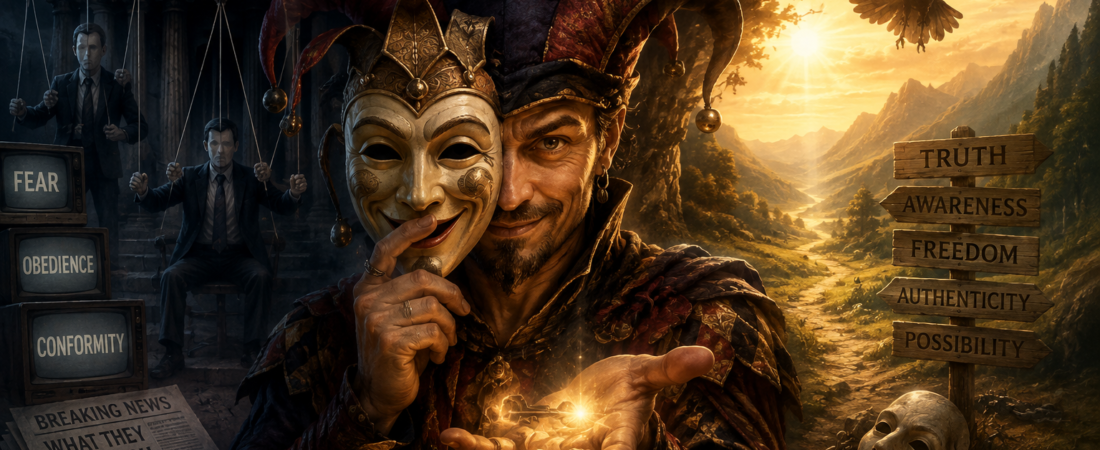
When you think of the Trickster archetype, it’s natural to relate this part of your personality with the part of the psyche that plays tricks on you. It’s often thought of as a disruptive force.
However, its chief purpose is not to simply create chaos, but to expose the false beliefs and deflate the ego. The function of the Trickster archetype is to shatter illusions and reveal the truth of reality.
Its actual motivation is to evolve your personality so that you continue to grow, succeed and thrive.
The Trickster gets a bad reputation because the way this archetype goes about bringing you to self-realisation can be disruptive, deceptive and chaotic.
Also known as the Joker, the Trickster teaches you a lesson by making a fool out of you.
The Function of the Trickster Archetype
The Trickster appears when you become too identified with one way of thinking, behaving or seeing yourself. This archetype challenges your assumptions, exposes self-deception and reveals distorted thinking, chiefly by making false assumptions, deceiving you and distorting your thinking.
When you repeatedly ignore parts of your personality that seek expression, you can become psychologically one-sided; unbalanced. The result may be frustration, stagnation, self-sabotage or neurosis.
Jung noted that the one-sided personality is a result of repression and can cause all manner of problems:
Thought-Provoking Quote
“The loss of a soul corresponds with the tearing loose of an essential part of one’s nature; it is the disappearance and emancipation of a complex [archetype] which therewith becomes a tyrannical user of consciousness, oppressing the whole man; it’s throws him out of his course and constrains him to actions whose blind one-sidedness has self-destruction as its inevitable issue.”
~ Carl Jung, CW6, Psychological Types, p.279 (1923)
When the personality is one-sided, “every impulse towards adaptation to the outer world tends to be repressed and to sink into the unconscious.” (Ibid, p.208) Jung believed that withdrawing from the world into the unconscious may not correct the imbalance. The Swiss believed the best way to resolve the complex is to find a way to adapt to the environment.
Understanding how the archetypes influence your behaviours can help you identify which parts of your personality are one-sided and neurotic and which need to be given expression.
The Trickster’s role is to disrupt one-sided patterns so that you can learn to adapt to your environment and cope with life better.
You will find that the Trickster may challenge an assumption you have taken for granted.
After years of being a people-pleaser, for example, you realise people are taking you for granted, and you feel like a fool. Then you realise the pattern has happened all your life because you wanted to be accepted.
Once you reach this moment of Truth, you change your attitude and start saying no to people. You set boundaries, you say how you feel, and you stand in your own power.
Whilst the Trickster’s intervention may initially feel like failure or “bad luck”, it shows you the path that leads to greater self-awareness.

How to Recognise a Developed Trickster
A developed Trickster combines intelligence, humour, creativity and psychological flexibility.
You may recognise this archetype in yourself when you:
- Question rules and assumptions that don’t make sense (the Trickster has a pronounced bullshit detector)
- Notice hypocrisy, manipulation or inconsistencies
- Find unconventional solutions to difficult problems
- Adapt quickly when circumstances change
- Use humour to defuse tension and reveal uncomfortable truths
- Laugh at yourself rather than taking your ego too seriously
- Enjoy entertaining others and bringing lightness into serious situations
- Know when a pattern needs to be disrupted and when it simply needs patience
- Turn mistakes and embarrassing experiences into insight
The developed Trickster is not rebellious for the sake of rebellion. It knows the difference between breaking a rule because the rule is limiting growth and breaking it simply because you dislike being told what to do.
Its humour connects rather than humiliates. Its intelligence reveals rather than manipulates. Its creativity opens possibilities rather than creating unnecessary complications.
The developed Trickster can see what others overlook and, importantly, can question its own perception as well.
How to Recognise the Undeveloped Trickster
When the Trickster is undeveloped or unconscious, its disruptive energy can become chaos, deception and self-sabotage.
You may recognise it when you:
- Create unnecessary drama to seek attention
- Use sarcasm or humour to avoid feeling vulnerable
- Make jokes at other people’s expense for “a bit of fun”
- Lie or distort the truth to protect your self-image
- Resist responsibility because it feels restrictive
- Avoid confronting uncomfortable truths
- Dream up grandiose fantasies
- Make promises or boasts you don’t live up to and become unreliable or unpredictable
- Escape into fantasy rather than dealing with reality
The undeveloped Trickster can become particularly destructive when you are cut off from your emotional life. Because you have desensitised, you don’t realise how poking fun at others can be hurtful.
This personality type is a prankster, class clown and joker. Everything becomes a joke because taking something seriously is too uncomfortable.
This version of the Trickster may also create an elaborate story about why things go wrong while refusing to examine its own contribution. Eventually, the very strategies used to avoid discomfort create the circumstances that force self-confrontation.

Developing the Trickster
Developing this archetype involves observing how your behaviours impact on other people. Start with radical honesty. Notice the stories you tell yourself, the jokes you make.
How do you think they impact your decision-making and the feelings of others?
Learn to question habitual behaviours and attitudes, especially when they are childish and irrational.
Are you using humour to create connection, or do you pick on people you see as inferior and weaker than you?
Want To Know More About The Trickster Archetype?
Libera Mente has developed an archetypes program that explains the functions, motivations and emotional wounds that influence your life.
You will learn how to recognise whether archetypes like the Trickster are developed or undeveloped, and how they shape your experiences in life.
If you want to overcome persistent conflicts, challenges and problems, sign up for our self-development program today and transform your life by moving Beyond The Comfort Zone.
Each month, you will work with a different archetype and discover whether that part of your personality is helping you to manage your life effectively, or whether it is too one-sided and unbalanced.
When an archetype is carrying an emotional wound, our archetype model explains what the wound is, how it was caused and how its maladaptive behaviours are creating problems in your life.
More importantly, our self-development program shows you how you can resolve undeveloped parts of the personality and integrate archetypal qualities you need to be more successful, peaceful and fulfilled.
