Integrating archetypes enables you to heal emotional wounds. By emotional wounds, I don’t necessarily mean emotional trauma such as abuse or a severe accident.
Emotional wounds are split-off parts of the personality that prompt you to feel a lack of self-worth, unlovable, or inadequate in some way. They are subconscious programs that prompt maladaptive behaviours.
When you identify maladaptive behaviours and the emotional wound that programmed them, you can move forward by integrating archetypes that are repressed.
Whilst integrating archetypes looks slightly different for everyone, the processes are more or less the same.
Integrating archetypes requires self-awareness and involves an understanding of which archetypal qualities you need to adopt. Archetypal qualities are ways of being.
For example, in the screenshot below, you can see the adapted qualities of the Everyman archetype is accommodating, adaptable, ambitious etc.
When the Everyman is undeveloped, you will notice patterns of behaviour that allow people to take advantage of you, avoidance and bitterness. An abandonment wound lies at the root of the Everyman’s emotional wound.
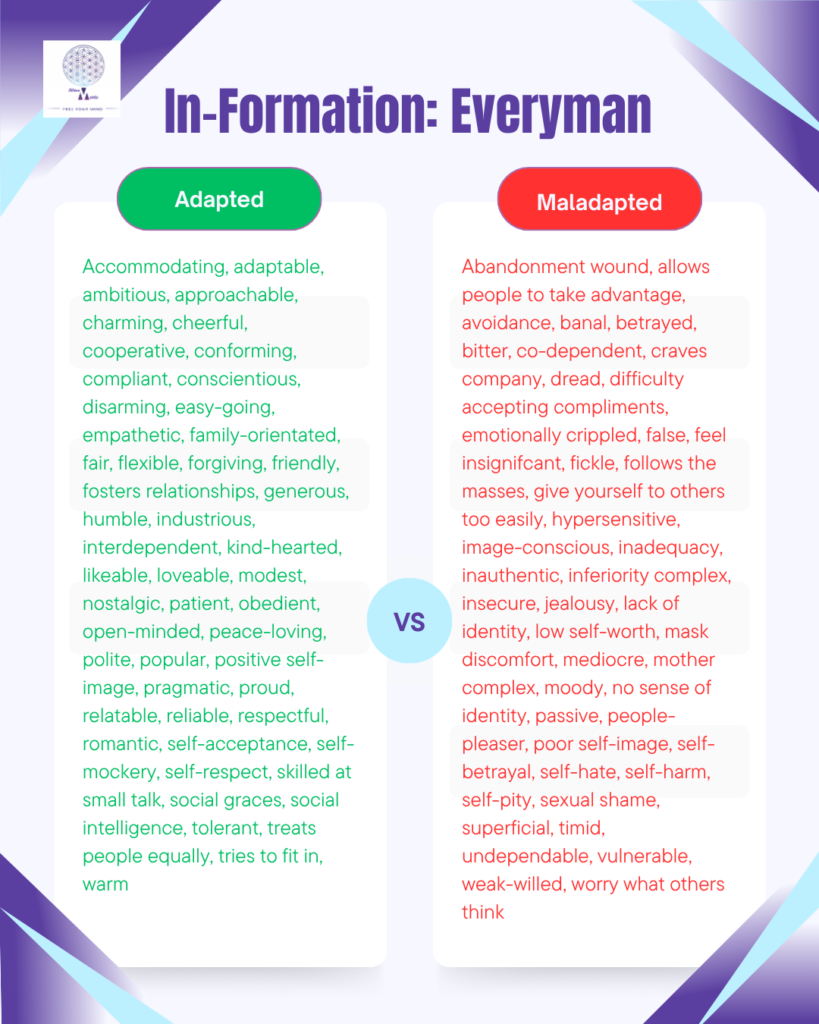
The abandonment wound is evident in the Everyman’s craving for company. You are fickle, inauthentic and image-conscious because you desperately want to fit in and have an unconscious fear that you will be rejected if you don’t agree with others, do as they say, or go where they go.
Because you feel unlovable, the Everyman comes online to make you lovable. The archetypal qualities the Everyman offers make you lovable. But when the Everyman is undeveloped, the behaviours you adopt to make you lovable eventually make you unlovable because you are emotionally crippled, filled with dread and superficial.
Integrating Archetypes Through Observation
The Libera Mente Self-Development Program is designed to help you identify which archetypal energies are influencing your life, both constructively and destructively. You can identify which archetypes create your best moments and your worst moments by observing patterns of behaviours, motivations and attitudes.
To integrate archetypes, observe your patterns of thoughts, emotions, behaviours; attitudes, moods, instincts, impulses, complexes and neuroses.
Regular patterns enable you to identify the archetype that is causing the problem. Sometimes, the same archetype will resolve the wound; other times, it will be blocking another archetype that, when integrated, can help you thrive.
It’s important to honour each of the archetypes and give them expression. When archetypes are repressed or suppressed, their maladaptive behaviours cause problems.
The problems, challenges and conflicts you encounter in life are an opportunity to integrate the archetypal qualities you need to overcome problems, challenges and conflicts. By doing so, you heal or partially heal the emotional wound at the root of the problem.
The solution will be different for everyone at any given moment, so I don’t give blanket advice.
However, the rule of thumb is to determine where you’re being too one-sided and where a maladaptive behaviour is compensating for an archetypal quality that has not been integrated into conscious awareness.
By observing behaviours that are unhelpful, negative and destructive, you can identify undeveloped archetypes that have not yet been integrated into the conscious mind and, therefore, are accessible by the Thinking Brain.
It should be understood that archetypes are energies, and that archetypal qualities is In-Formation stored in energy particles.
Carl Jung, the leading voice of depth psychology, noted:
Thought-Provoking Quote
“…there is no energy unless there is a tension of opposites; hence it is necessary to discover the opposite to the attitude of the conscious mind. It is interesting to see how this compensation by opposites also plays its part in the historical theories of neurosis:”
~ Carl Jung, CW7 Two Essays on Analytical Psychology, 2nd Ed, para 78, (1966)
Jung also noted that content in the conscious mind seldom agrees with In-Formation in the unconscious. Subsequently, the opposing forces become dysregulated.

Conscious and Unconscious Archetypes
The contents of the conscious mind have adapted to the environment and enable you to manage life stress-free or with a controlled stress response that helps you to stay alert and focused.
Content in the unconscious prompts responses that are maladaptive. Jung wrote that they are “not only all the forgotten material of the individual’s own past, but all the inherited behaviour traces constituting the structure of the mind.” (CW8, p.97, 1970)
Inherited behaviour traces are the archetypes and all the archetypal qualities they offer. It is the 12 archetypes that constitute the structure of the mind, and thus can be thought of as neural networks.
In the Libera Mente archetype model, we call the “forgotten material” that Jung mentions “undeveloped archetypes.” These archetypes may be split off and partially exist in an undeveloped state, or they may be totally repressed because they have never been given expression at all.
Either way, archetypes need developing by integrating archetypal qualities into the conscious mind, where they can be accessed by the Thinking Brain and the Emotional Brain as adaptive behaviours.
Thought-Provoking Quote
“…the shadow is an inferior component of the personality and is consequently repressed through intensive resistance. But the repressed content must be made conscious so as to produce a tension of opposites, without which no forward movement is possible…Life is born only of the spark of opposites.”
~ Carl Jung, CW7 Two Essays on Analytical Psychology, 2nd Ed (1966)
Jung called unconscious content the Shadow personality. Because the archetypal energies – In-Formation – that are present in the central nervous system, influence how you engage with life.
In neuroscientific terms, archetypal qualities are the pieces of information that are communicated between neurones in the brain. You are only capable of behaving in ways that your brain is able to communicate.
For example, if you need to have courage, but you have little or no positive experiences of courage, you are less likely to easily summon courage when you need it, because the Emotional Brain will take over and decide how you respond to the environment.
The Emotional Brain typically seeks comfort, safety or protection. If this one-sided attitude continues, the energy in the unconscious cannot be given expression and eventually becomes stagnant.
Jung classified undeveloped archetypes as complexes, neuroses and disease. Basically, they are cut-off parts of the personality that have not been integrated into conscious awareness. The longer these energies remain repressed or maladaptive, the more likely you are to develop a disease, and a debilitating disease.
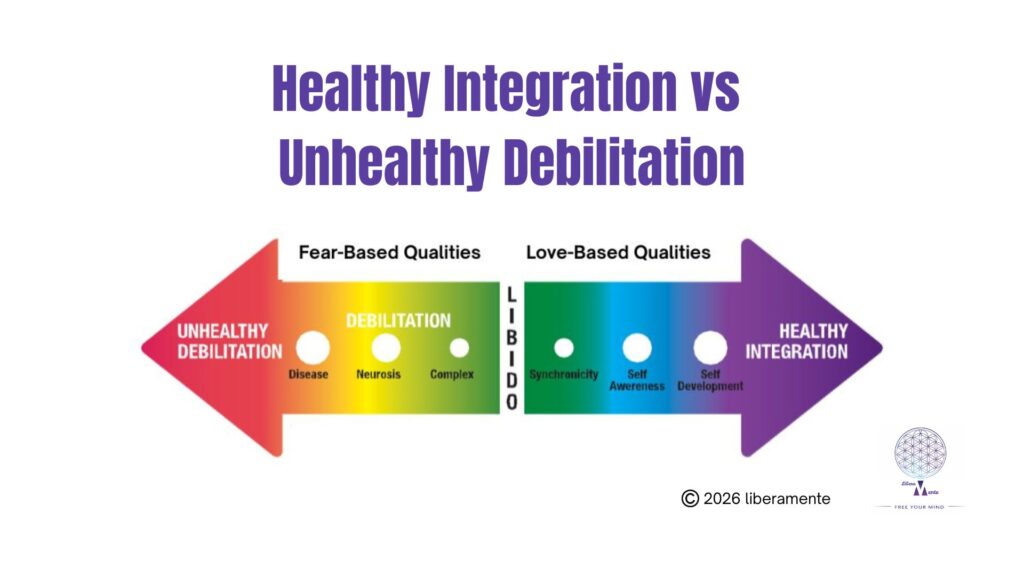
Complexes are autonomous and influence your behaviours. Jung noticed that complexes have a “peculiarity of appearing as a personality,” which can be identified in patterns of behaviour.
Think about it. If energy is In-Formation, then you will respond to the environment the same way every time because the information in your neural networks determines that you will act that way. The only way to change that is for the Thinking Brain to take control of the Emotional Brain.
Let’s take a look at how you can recognise unconscious maladaptive parts of the personality.
Jung noted that “the archetypes are continuously present and active.” (CW8, para 288, 1970) However, when the archetypes are split off and thus undeveloped, the conscious attitude becomes one-sided and ignores alternative ways of being.
Even if you are aware you need to behave in a different way at times, you find it difficult because the information stored in your central nervous system forces you to behave in the way you have become accustomed to, how you are programmed to behave.
In other words, the information processed by neural networks develops coping strategies and habitual behaviours you adopt as your own. You may be consciously aware of behaving in a certain way, and think you know why you are doing it, but the behaviour is actually maladaptive.
Unconscious energies become “personified.” But when unconscious energies that are maladaptive are running the show, they are often unhelpful, negative and destructive. Integrating archetypes helps you to become helpful, positive and constructive.
Thought-Provoking Quote
“Psychologically, personification always signifies a relative independence (autonomy) of the personified contents, i.e. a relative splitting off from the psychic hierarchy. The content of this kind is not obedient to voluntary reproduction, but either reproduces itself spontaneously or in some similar way becomes insulated from consciousness. For instance, when an incompatibility exist between the ego and a certain complex, such a cleavage is produced. As is well known, one frequently observes the dissociation between the ego and the sexual complex. But other complexes may also become split off, the power complex for instance corresponding with the sum of all those aspirations and ideas which came at the acquisition of personal power.”
~ Carl Jung, CW6, Psychological Types, p.254, (1923)
Split-off complexes serve as compensatory factors. The opposing energies, have a precise and exact opposite which forms a potential. Psychic processes, therefore, can balance unbalanced energies.
Archetypes are typical forms of behaviour and, when unconscious, disrupt the natural order of the psyche. “When they become conscious, naturally present themselves as ideas and images, like everything else that becomes the content of consciousness.” (CW8 para 294, p.294)
Undeveloped archetypes – complexes – show up as maladaptive behaviours.
Examples of Maladaptive Behaviour
- Perfectionism
You set excessively high, often unattainable standards, and experience intense anxiety or self-criticism when those standards aren’t met — sometimes to the point of procrastination or avoiding tasks altogether rather than risking an imperfect result.
The reason for procrastination is that mistakes feel unacceptable. They’re interpreted as evidence of personal inadequacy – that you are “not good enough”, or “good for nothing.” Control over outcomes becomes a way of controlling how you might be perceived and judged by yourself and others.
The compensatory factor is to condition a sense of self-worth — often rooted in childhood environments where love, approval, or safety felt tied to achievement or flawlessness. Being perfect is a substitute for simply doing your best, because your best is not good enough. And you have to be the best, not simply to be your best.
When I was 11, maybe 12, I accrued the second most amount of merit marks in a class of around 33 people. When I told my dad I came second, he said, why didn’t you come first.
Procrastination has been a problem for me. The underlying cause was a fear of not being good enough, because my neural networks are conditioned to be the best.

- Avoidance (of conflict, emotions, or difficult situations)
Avoiding uncomfortable conversations, sidestepping disagreements, suppressing thoughts and feelings to avoid conflict and withdrawing from social life are all examples of the avoidant personality.
Avoidance surfaces for various reasons as well. Because you want to be liked, you avoid telling people the truth about what you think and how you feel so that you fit in. You have social anxiety, so you stop socialising. You have a fear of intimacy so you avoid relationships.
The unconscious processing is meant to protect you from the underlying fear of rejection or abandonment. Avoidance offers short-term relief and a false sense of safety, but eventually causes loneliness, sadness and neuroses. If you start a relationship, the likelihood is that you will sabotage it at some point. To avoid being rejected, you become the rejector.
- People-pleasing
People-pleasing is defined as consistently prioritising the needs, opinions, and comfort of others over your own. You agree to go places you don’t really want to go, do things you don’t want to do or give generously so people don’t think you’re selfish.
There are many reasons for becoming a people-pleaser. The most prominent reasons are because you have a poor self-image, a lack of self-esteem and a fear of rejection. You may struggle to say no because you feel guilty about letting someone down, or because you don’t want people to think badly of you.
These unconscious drives make you believe that being agreeable, helpful and generous will make you likeable and lovable. You think it will make other people acknowledge you, respect you and revere you. What it actually does is burn you out, and may also make others think you’re weak, fickle and unreliable.
Integrating Archetypes with Libera Mente
Observing maladaptive behaviours enables you to identify which archetypes are undeveloped and why. You can also identify how undeveloped archetypes create challenges, conflicts and problems, and which archetypal qualities you need to adopt to overcome challenges, conflicts and problems.
You then need to determine how you will integrate the In-Formation. This is when it becomes different for everybody. Sometimes you will need to expose your ego to a particular situation and learn a behaviour or response from experience.
Other times, you need to have a word with yourself and decide to adopt a new attitude, choose to take an uncomfortable action, or initiate new lifestyle changes by planning what to do next.
The tools available to you in Beyond The Comfort Zone are designed to help you to develop archetypal qualities. The various exercises help to give more insight that brings you to self-awareness and helps you reach a decision.
When you get to know the archetypes, speak with them as though you’re helping a friend sort out a problem. Have a rational conversation with the undeveloped parts of your personality and ask them what they want and how you can help.
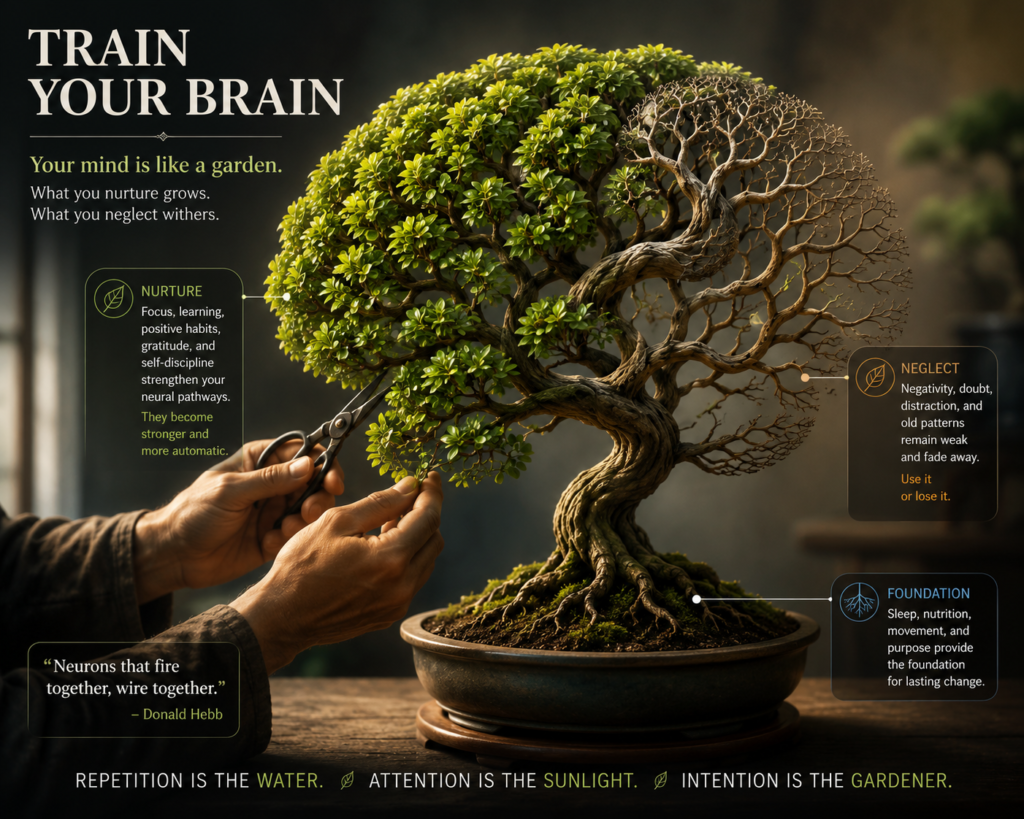
Essentially, you need to train your brain. Find out how in the Libera Mente Life Coaching program, Beyond The Comfort Zone and get to know your archetypes.