

How do you recognise self-loathing and challenge the thoughts that keep you trapped in cycles of frustration, anger and loneliness?
Do you ever have a persistent sense that something about you is fundamentally inadequate—that you’re not good enough, worthy enough, attractive enough, capable enough or deserving enough?
Maybe you get frustrated when things don’t go your way, or you react angrily to situations that make you feel disrespected, humiliated or betrayed.
Self-hate often exists alongside low self-esteem, shame and feelings of worthlessness. Over time, it can influence how you interpret almost everything. Even positive experiences can be dismissed as luck, politeness or an exception to the rule.
For example, you may focus on what went wrong while overlooking what went well.
A compliment becomes suspicious.
A mistake becomes proof of personal failure.
The problem is not simply that you have negative thoughts. It is that those thoughts begin to feel like facts.
Recognising the patterns of self-loathing is an important first step towards changing them.
How to Recognise Self-Loathing Patterns
1. All-or-nothing thinking
All-or-nothing thinking leaves little room for nuance. Something is either a complete success or an absolute failure. You’re either good at something or hopeless. Someone either likes you or cannot stand you.
This way of thinking turns ordinary setbacks into devastating verdicts. One mistake becomes, “I always get things wrong.” A difficult conversation becomes, “Nobody understands me.”
Life is rarely that simple. Most experiences exist somewhere between the extremes. Learning to recognise this can help you find an alternative perspective and respond in ways that are more constructive.

2. A persistent focus on the negative
Self-loathing often encourages you to search for evidence that confirms your negative view of yourself.
You may remember the one critical comment while forgetting ten positive ones. You may focus on an awkward moment rather than the rest of the conversation. When something goes well, you might dismiss it as luck or insist that it does not really count.
This reflects a tendency to give negative information more weight than positive information. The result is a distorted picture of your life—and of your own value within it.
3. Low self-esteem
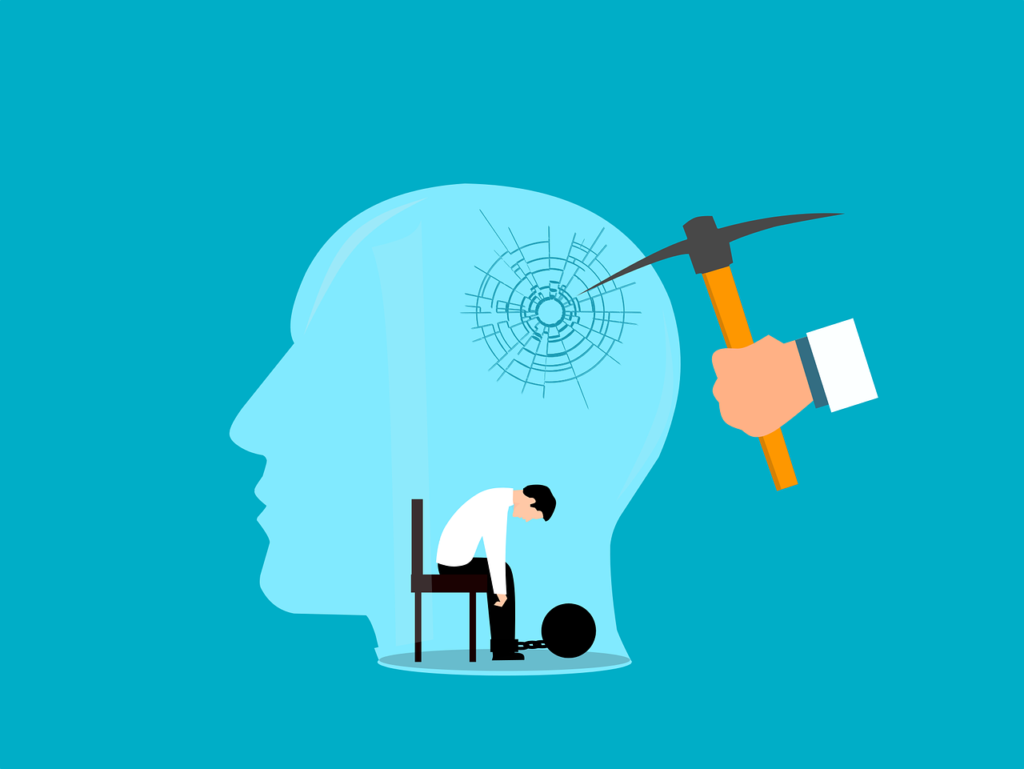
Self-esteem concerns the way you evaluate and value yourself. When self-esteem is low, you may struggle to recognise your strengths or believe that you deserve respect, kindness and consideration.
You might assume that other people are more capable, more attractive or more deserving than you. You may also feel uncomfortable taking credit for your achievements because doing so conflicts with the belief that you’re not good enough.
Low self-esteem does not mean you lack ability. It means your perception of your own worth may be persistently negative.
4. Difficulty accepting compliments
When someone offers a genuine compliment, how do you respond?
If you immediately dismiss it, make a joke, change the subject or assume the person is only being polite, self-loathing may be influencing the interaction.
A compliment challenges a negative self-image. Rather than allowing the positive information to be accepted, the mind may find a reason to reject it:
“They’re just being nice.”
“They don’t really mean it.”
“If they knew the real me, they wouldn’t say that.”
Accepting a compliment can feel uncomfortable when you have self-worth. You feel you are undeserving, or that accepting compliments are meant to stroke your ego.
The real reason is that your subconscious mind has a fragmented sense of who you are.
5. Attacking yourself for making mistakes
Everyone makes mistakes. The difference lies in how you respond to them.
A healthy response might be, “That didn’t go well. What can I learn from it?”
Self-loathing takes a different approach:
“I’m useless.”
“I always mess things up.”
“I’m a failure.”
This is the difference between criticising a behaviour and attacking your character. A mistake is something you have done. It’s not a complete description of who you are.
When self-criticism becomes harsh, repetitive and difficult to escape, it can reinforce the very feelings of inadequacy you are trying to overcome.

How to Stop Self-Loathing
Self-loathing does not evaporate by “thinking positively”.
If your negative self-image has developed over many years, it needs to be examined, challenged and gradually replaced with a more balanced relationship with yourself.
The following four strategies can help.
1. Use journaling to identify patterns of self-loathing
Self-loathing can operate automatically. You may experience an emotional reaction without fully understanding what triggered it or what story you are telling yourself.
Journaling gives those thoughts somewhere to go besides around and around inside your head.
At the end of the day, write about situations that affected you emotionally. Pay particular attention to moments when you felt ashamed, rejected, criticised, inadequate or angry with yourself.
Ask:
- What happened?
- What did I immediately think about myself?
- What emotion did I experience?
- What did I assume the situation meant?
- Have I felt this way before?
- Is this reaction connected to an older experience or belief?
The aim is not to produce pages of polished writing. It is to identify recurring patterns.
With consistency, you may begin to notice that certain situations repeatedly activate the same underlying belief—for example, “I am not good enough”, “I am unlovable” or “I must prove my worth”.
Research has found that expressive writing can help reduce psychological distress, although journaling should be viewed as a supportive practice rather than a substitute for professional treatment where that is needed (Marković, Bjekić, & Priebe, 2020).

2. Challenge your self-loathing inner critic
Your inner critic may sound convincing, but confidence is not the same as accuracy.
When a harsh thought appears, pause before accepting it as the truth. Ask yourself:
- Is this thought based on evidence?
- Am I exaggerating one mistake?
- Would I speak to someone else in this way?
- Am I confusing something I did with who I am?
- Is there another explanation for what happened?
It can help to imagine your inner critic as a hostile commentator who has become far too comfortable taking charge.
You do not have to silence the voice completely. Instead, learn to question it.
If the thought is, “I’m a complete failure,” you might respond:
“I made a mistake, but that does not make me a failure.”
If the thought is, “Nobody likes me,” you might respond:
“I feel rejected right now, but I do not have enough evidence to conclude that nobody values me.”
You can also ask what a trusted friend would say if they heard you speaking about yourself in this way. Sometimes we can offer others understanding that we would never extend to ourselves.
The objective is not to replace every negative thought with an unrealistically positive one. It is to develop a more accurate and proportionate response.
3. Practise self-compassion and self-acceptance
Self-compassion does not mean making excuses for harmful behaviour or refusing to take responsibility. It means responding to your own difficulties with the same fairness, patience and humanity you would offer someone else.
When you make a mistake, ask:
“What would help me learn from this?”
rather than:
“How can I punish myself for getting it wrong?”
Self-acceptance begins when you stop making your right to exist, belong or receive kindness dependent on constant achievement.
You can acknowledge your weaknesses without defining yourself by them. You can take responsibility without humiliating yourself. You can want to improve without treating your present self as unacceptable.
This is especially important because self-loathing often creates a destructive cycle:
- You make a mistake.
- You attack yourself.
- You feel ashamed and discouraged.
- Your confidence decreases.
- You become more fearful of trying again.
- Another setback appears to confirm your negative self-image.
Self-compassion helps interrupt that cycle. Research into compassion-focused therapies suggests that they can improve self-esteem and may be useful for people struggling with harsh self-criticism and shame (Thomason & Moghaddam, 2020).

4. Examine the relationships around you
The way other people treat you can influence the way you learn to treat yourself.
Consider the people you spend the most time with. Do they respect your boundaries? Can you be honest around them? Do they encourage your growth, or do they repeatedly belittle, manipulate or undermine you?
Not every difficult relationship can be ended immediately. Family responsibilities, work, finances and shared commitments can make distance complicated. However, you can still begin to establish boundaries and reduce the amount of influence unhealthy interactions have over your self-image.
It is also worth examining whether you are surrounded by people who reinforce your negative beliefs because their behaviour feels familiar.
Healthy relationships do not require you to earn your place through constant performance. They allow room for disagreement, mistakes, vulnerability and growth.
As you strengthen your relationship with yourself, look for connections in which you are treated with the same dignity you are learning to offer yourself.
Which archetype is related to self-hate?
Self-hate is predominantly a trait of the Hero, but can also surface in the Everyman, Creator and Lover. The Everyman and the Creator have body dismorphia, or a deformity they hate about themselves. In this situation, self-acceptance is the best way forward.
For the Hero, however, self-loathing is an emotional wound born from feelings of inadequacy. This is an archetype that often rushes into things without a strategy, makes a mistake and feels incompetent. A history of failure and rejection becomes rage directed inwards as self-loathing.
Self-hatred is then masked by the Hero’s. In the subterranean vault of the personal unconscious lingers a limiting belief that you’re not good enough. The Hero tends to project this personal disgust with yourself onto others.
Men might project self-loathing onto other men in the form of competition, dominance and violence. You need to feel better than the next man to feel better about yourself. One-upmanship is an obvious trait.
Women often project self-loathing onto male lovers whenever they feel let down. When their “knight in shining armour” doesn’t live up to expectations or meet your demands, you let them know about it with emotional outbursts — and possibly violence.
Feelings of inadequacy fuel aggression and make you defensive. Angry outbursts reveal your weaknesses. Aggression is a defence mechanism to protect you from the pain of feeling rejected and unloved.
To overcome the inferiority complex tied to self-loathing, invest in your emotional world. Listen to your feelings when you ask, how you really feel about yourself.
If you feel like a failure, a good-for-nothing, and often say, nothing ever goes right, the chances are the unconscious hatred you have towards yourself is creating situations that prompt you to plan before your act, to control your impulses before rushing into something. This will limit the number of mistakes you make.
But the Hero also has to recognise that mistakes are par for the course. By making mistakes, you learn to do things better until you finally succeed. Trial and error is an important part of self-development.
Life Coaching
Self-loathing is not simply a habit of being negative about yourself. It’s often a deeply rooted pattern in which mistakes, criticism and disappointment are interpreted as evidence that you are fundamentally unworthy.
Identifying these patterns and understanding them is the catalyst to healing self-hate. You can identify the patterns in the Libera Mente archetypes model.
Begin by identifying the thoughts behind self-loathing. Write them down. Question their accuracy.
Identify the archetype self-loathing thoughts relate to and you can identify the emotional wound; low self-worth, I am unlovable, I am good for nothing etc.
Once you know why and how you developed a pattern of self-loathing, you can work on developing the archetypes that are split off from conscious awareness.
Pay attention to the relationships that either reinforce or challenge your negative self-image. And recognise that you do not need to become perfect.
You just have to accept that this is the best you can be right now and take pride in who you are and what you have achieved.
The goal is not to convince yourself that you’re superior to anyone else. It is to stop organising your life around the belief that you’re inferior.
If you experience self-loathing and want to upgrade the subconscious programs, sign up for the Libera Mente life coaching program Beyond The Comfort Zone, or contact Rich on the contact form below to schedule a 1-2-1 session.

References
- Marković, M., Bjekić, J., & Priebe, S. (2020). Effectiveness of expressive writing in the reduction of psychological distress during the COVID-19 pandemic: A randomized controlled trial. Frontiers in Psychology, 11, 2936.
- Thomason, S., & Moghaddam, N. (2020). Compassion-focused therapies for self-esteem: A systematic review and meta-analysis. Psychology and Psychotherapy: Theory, Research and Practice.