

“The self, like the unconscious, is an a priori existent out of which the ego evolves. It is, so to speak, an unconscious prefiguration of the ego. It is not I who create myself, rather I happen to myself.” [1]
~ Carl Jung, CW 11, Psychology and Religion: West and East, (1969)
Do you know the saying “I’m caught in two minds”?
If you don’t know that saying, you will know the feeling. It is the conversation you have in your head which has opposing views or choices, and you don’t know which view or choice to go with.
And that means there are three voices in your head, all of which sound like you.
To explain, I’ll use the example we all know. Trying to give up a bad habit such as an addiction.
You know you need to stop [your addiction] but you feel an emotional pull to continue. The voice in your head says, “Go on, it’s alright, you need this. You can give up tomorrow.”
Do you recognise that voice?

That is the voice of the ego. The role of the ego is to protect your emotional wellbeing, keep you safe and soothe discomfort.
To do that, the ego pulls you towards sources of comfort, joy and pleasure, which helps to soothe your discomfort and protect your emotional wellbeing.
In short, the ego is the part of your brain that is focused on survival. Its focus is outward-facing and only knows what protects your emotional well-being from previous experience.
The second voice in your head says, “Don’t do this; you said you were going to quit. You know it’s good for you.”
This is the voice of the Self — and the voice you should be listening to.
And you know it’s the voice to be listening to, but because it doesn’t have an emotional weight attached to it, you ignore it.
You may listen to the Self for a little while, but the ego keeps chiming in with, “One more time won’t hurt. You need this to get you through the day.”
The third is You — caught in two minds. That voice says: “Oh, I don’t know what to do.”
For a while You might say, “No, no, I’m not doing it; I’m stopping. I promised myself (my Self) that I would stop today, and I’m stopping today.”
But the ego persists, and You eventually say, “Fuck it, I’ll stop tomorrow.”
What is the Self-ego Axis?
The Libera Mente life coaching program uses the concept of the Self-ego axis (or ego-Self axis), proposed by psychologist Erich Neumann, who was inspired by Carl Jung’s brilliant theory of the Self and the ego.
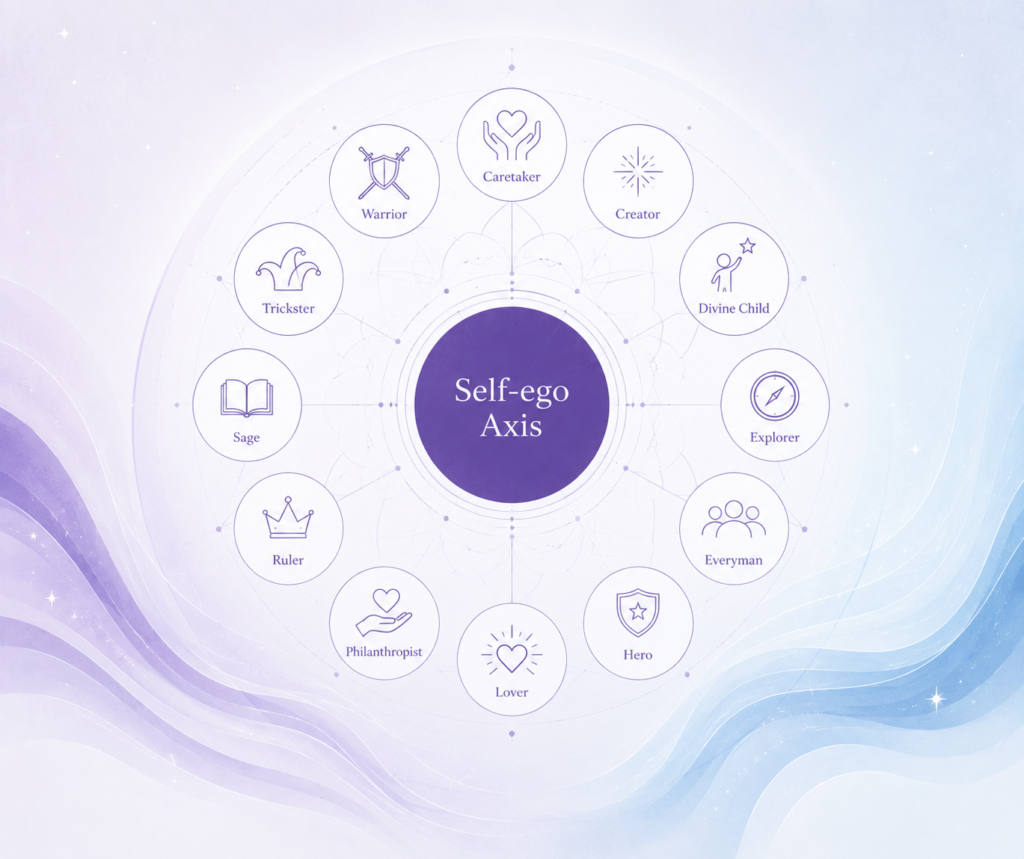
In Jungian theory, the ego-Self axis is the ‘seat of consciousness’. Jung said that when the connection between the two axis points is intact and functioning properly, your psychological health and overall well-being are at an optimum.
If the axis is damaged, however, You are disconnected from your Self, and more inclined to listen to the demands of the ego.
However, what the ego doesn’t realise is that You can’t develop psychological or emotional maturity without access to the Self.
“The ego-self axis represents the vital connection between ego and Self that must be relatively intact if the ego is to survive stress and grow. This axis is the gateway or path of communication between the conscious personality and the archetypal psyche. Damage to the ego-Self axis impairs or destroys the connection between conscious and unconscious, leading to alienation of the ego from its origin and foundation.” [2]
~ Edward Edinger, Ego and Archetype
The role of the Self is to evolve the personality. It ushers in the repressed parts of the personality — the archetypes that have not been given full expression.
For Jung, the integration and development of the archetypes are critical for maintaining sound physical and mental health. They give meaning to life and influence success and failure, happiness and sadness, love and fear.
Jung said the world of the archetypes belonged to the collective unconscious, and that the collective unconscious contained content relative to mankind.
Between them, 12 archetypes contain all the qualities, both good and evil, that mankind is capable of accessing; i.e courage or cowardice, compassion or indifference, trust or distrust.
“I have employed the concept of the collective unconscious to embrace all these archetypes. They are psychic forms which, like the instincts, are common to all mankind, and their presence can be proved wherever the relevant literary records have been preserved. As factors influencing human behaviour, archetypes play no small role. The total personality can be affected by them through a process of identification. This effect is best explained by the fact that archetypes probably represent typical situations in life. Abundant proof of identification with archetypes can be found in the psychological and psychopathological case material….The difference between archetypes and the dissociated products of schizophrenia is that the former are entities endowed with personality and charged with meaning, whereas the latter are only fragments with vestiges of meaning—in reality, they are products of disintegration.” [2]
~ Carl Jung, Structure & Dynamics of the Psyche
Dissociation was a theory initially proposed by Pierre Janet. The pioneering French psychologist said that when instinctual drives are denied by external experiences, information cannot be integrated and organised by the central nervous system.
In simple terms, rather than becoming part of a coherent memory and sense of Self, aspects of the experience can become split off.
The parts that are split off include behavioural tendencies, ideas and emotions.
Behaviours, ideas and emotions belong to the archetypes. They are archetypal qualities, or as we explain in the Libera Mente self-development programs: In-Formation.
Archetypes are energies. And all energy carries information. This information, or In-Formation, is communicated between neural networks in the brain.
In-Formation, essentially makes You who you are. In-Formation determines how you behave, what you think and how you feel.
“My notion of personality is pretty simple: it’s that your “self,” the essence of who you are, reflects patterns of interconnectivity between neurons in your brain. Connections between neurons, known as synapses, are the main channels of information flow and storage in the brain. Most of what the brain does is accomplished by synaptic transmission between neurons, and by calling upon the information encoded by past transmission across synapses.” [3]
~ Joseph LeDoux, Synaptic Self, p.2 (2002)
What happens when the Self-ego axis is damaged?
When the Self-ego axis is damaged, you don’t have access to the In-Formation you need to manage your life to the best of your ability.
You are cut off from certain archetypal qualities that would otherwise enable you to manage situations easily or easier.
When archetypes are split off, they appear as complexes and neuroses. Jung noted that neurosis is self-division. [4] The more divided you are, the more one-sided you become and the more complexes and neuroses you develop.
The more one-sided you are, the more aggressive, hostile, and incompatible to others you become. Jung wrote: “There are people who suppress their good qualities and consciously give free rein to their infantile desires. (CW7, para 236, 1966) [5]
To heal the Self-ego axis, the polar energies of the archetypes need to be reconciled and brought into harmony.
To become whole, the repressed parts of the personality, need to be brought forward. Once archetypal qualities that are unconscious are in conscious awareness, you are in a stronger position to learn new behaviours and attitudes that improve your life.
That’s why it’s important to recognise the three voices in your head and learn which voice to listen to.
When the archetypes are available in their fullness, you experience peace, love and wisdom.

How does the Self-ego axis function?
The role of the Ego
The “ego” is responsible for managing your physical and emotional survival. Its first thought is to stay safe and keep comfortable.
However, it only knows to do what you have done in the past. In other words, the ego responds to subconscious programs; memories of the past stored in the central nervous system and communicated via neural networks.
So you could say that the ego is who you think you are.
But you are You — what Hindu philosophy calls the “Witness” or the “Observer.” The observer is an aspect of consciousness which becomes aware of how you — the ego — is creating your experience of reality.
The Witness observes your thoughts, actions and emotions which the ego performs.
Subsequently, the ego is responsible for making decisions that prompt actions. This includes how you respond to people, react to demands and relate to objects.
The ego can only make decisions in accordance with In-Formation stored in your subconscious — memories.
“While it is sometimes assumed in depth psychology that the Ego is secondary in importance to the unconscious, the Ego is in fact vital to our survival. It is only when it is possessed by, identified with, and inflated by another energy form — an archetype or complex (an archetypal fragment like the Tyrant) — that it malfunctions. Its proper role is to stand back and observe, to scan the horizon, to monitor the data coming in from both the outside and the inside and then, out of its wisdom — its knowledge of power, within and without, and its technical skill in channeling — make the necessary life decisions.” [6]
~ Robert Moore, Douglas Gillette, King, Warrior, Magician, Lover
Jung noted the ego becomes inflated when decision-making is one-sided. In other words, you are run by subconscious programs and ignore the archetypes of the collective unconscious.
Consequently, most of the decisions are made by the central nervous system. Not by You, but by the ego.
If your subconscious programming — or personal unconscious — as Jung calls it, is influenced by a fragmented archetype, a complex, there is a tendency to be unhelpful, negative and destructive. [7]
“Such a content is an autonomous complex divorced from consciousness, leading a life of its own in the psychic non-ego and instantly projecting itself whenever it is constellated in any way — that is, whenever attracted by something analogous to it in the outside world.” [8]
~ Carl Jung, CW12, Psychology and Alchemy
If your subconscious programs are undeveloped, they are rooted in fear. They feel unsafe, discomfort, dis-ease.
The more you seek safety and comfort, the more likely you are to engage in self-destructive behaviours, self-sabotage, addictions. You are more likely to act with aggression, greed or avoidance.
When the ego is too one-sided, and thus in a state of imbalance, unconscious archetypes rear up and take possession of the ego.
For example, when you don’t get what you want, you get angry. If you feel you are accused or criticised, you become defensive. When you find a situation too uncomfortable, you run away.
“Whenever a stimulus word touches something connected with the hidden complex, the reaction of the ego consciousness will be disturbed, or even replaced, by an answer coming from the complex. It is just as if the complex were an autonomous being capable of interfering with the intentions of the ego. Complexes indeed behave like secondary or partial personalities in possession of a mental life of their own” [9]
~ Carl Jung, CW11 Psychology and Religion
Whenever you have an emotional outburst that is disproportionate to the event, or behave in a maladaptive way, it is an archetype guiding you to self-awareness.
You — (You) — just have to observe why you reacted a certain way, then ask your Self what You need to do.
The Role of the Self
Whereas the role of the ego is to survive, the role of the Self is to thrive.
This is the part of the Self-ego axis that encourages you to engage with life so that you grow.
Communication with the Self requires introspection. It will inform you which archetypal qualities you need to adopt to overcome the challenge, conflict or problem the ego is not programmed to deal with.
“The Self is the ordering and unifying center of the total psyche (conscious and unconscious) just as the ego is the center of the seat of subjective identity whilst the Self is the seat of objective identity. The Self is thus the supreme psychic authority and subordinates the ego to it.” [10]
~ Edward Edinger, Ego and Archetype
The Self, therefore, is a central figure in self-development.
Whereas the Self is born, the ego has to be developed. The ego learns specific behaviours in relation to past experiences.
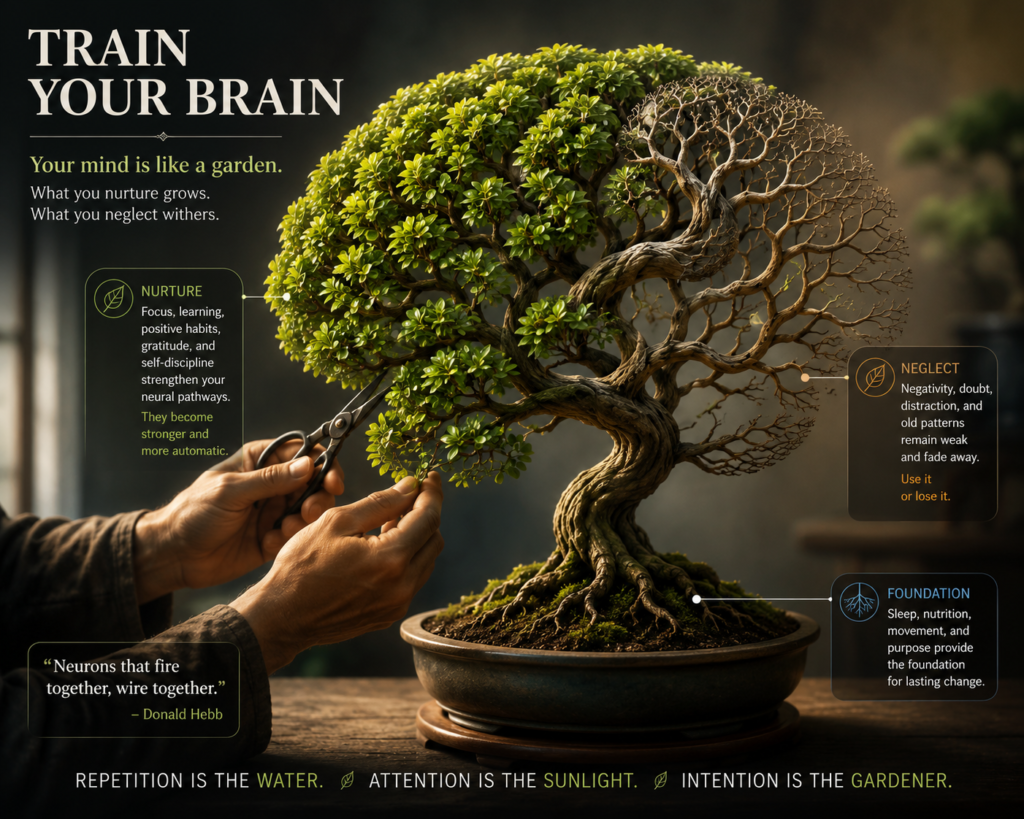
Essentially, You have to train the brain to do everything you need to do in your life. And that requires integrating the In-Formation given to you by the archetypes.
Because the Self has access to the collective unconscious, it provides access to the whole personality.
As, Edward Edinger points out, the ego should be a subordinate of the Self.
You should listen to the voice of the Self, and not the ego. At least not until the ego has been trained with all the archetypal qualities you need to manage your life to the best of your ability.
Instincts and Archetypes
Archetypes are always active in some capacity and influence your life. Either the ego has adopted an archetypal quality it associates with, or the archetype takes possession of the whole man when the ego represses that part of your personality.
In the latter case, you say things like, “I don’t know what came over me,” or “It was so unlike me.” They are the moments of madness when you have no control over your thoughts, emotions or actions.
The ego dissociates from the parts of your personality that ‘civilised’ society deems unacceptable. Instincts become repressed, which can cause the ego to become one-sided.
When the ego is overinflated, it becomes separated from the Self and the Self-ego axis is severed. This means You lose contact with the archetypes, which in their fullness constitute the whole personality.
“Instincts are not vague and indefinite by nature, but are specifically formed motive forces which, long before there is any consciousness, and in spite of any degree of consciousness later on, pursue their inherent goals. Consequently, they form very close analogies to the archetypes, so close, in fact, that there is good reason for supposing that the archetypes are the unconscious images of the instincts themselves, in other words, that they are patterns of instinctual behaviour.” [11]
~ Carl Jung: CW9 Part 1, The Archetypes and the Collective Unconscious
Civilisation creates a paradox. On the one hand, we learn to control animal instincts, but on the other hand, we become disconnected from the whole personality and unable to cope with the pressures of the external world.
To reconnect, You have to speak with your Self.
“Like the voice of the intellect (which is part of it), it [the Self] speaks softly but it will be heard, even if in a distorted form. That is, it has a dynamic force of its own, pressing always for open, uninhibited expression. Efforts must be used in its suppression or repression from which fatigue can result. This force is one main aspect of the “will to health,” the urge to grow, the pressure to self-actualisation, the quest for one’s identity. It is this that makes psychotherapy, education and self-improvement possible in principle.” [12]
~ Abraham Maslow: Toward A Psychology Of Being (1962)
To become whole — to heal — there has to be a reconciliation between the Self and ego. The Self-ego axis needs repairing so the lines of communication are open.
Unconscious content has to be brought into conscious awareness and integrated into the conscious personality — the ego. Train the brain.
Although this makes the Self sound “evil” as religions position it, the Self represents our instinctive nature, which is intrinsically good.
The Self is love.
And as you’ve probably heard, Love Conquers All.
Amor vincit omnia.
The Love-Centred Self
In his book, Freedom: The End of the Human Condition, the Australian biologist Jeremy Griffith demonstrates that humans are “cooperative and loving, not competitive and aggressive” [14] by nature.
The Self is your True Nature.
Living from a place of love rather than from fear is a life of peace, happiness and harmony.
In short, you need to be SELF-directed and not egocentric. When you are ego-centred, your views and desires are primarily invested in your own needs.
You are “cooperative and loving, not competitive and aggressive”, selfless and not selfish.
When you are disconnected from the Self, you are directed by the ego.
Jung noted that archetypal energies show up in the personal unconscious as “habitual attitudes, in which the one mechanism permanently dominates.” [15]
When the conscious attitude is one-sided, instincts attempting to respond to the outer world sink into the unconscious [16] and cause emotional dysregulation.
Emotional dysregulation can lead to difficulties in managing feelings and behaviours, resulting in heightened stress, anxiety, and conflicts in relationships.
It may also contribute to mental health issues such as depression and anxiety disorders.
Energy that is re-pressed becomes de-pressed. which causes emotional pain to languish.
“Repeated experiences of alienation continue progressively right into adult life. This is how the ego grows and separates from its unconscious identity with the Self…we must have recurring reunion between ego and Self in order to maintain the integrity of the total personality, otherwise there is a very real danger that as ego is separated from Self the vital connecting link between them will be damaged. If this happens to a serious extent we are alienated from the depths of ourselves and the ground is prepared for psychological illness”. [17]
~ Edward Edinger, Ego and Archetype
For individuals to become integrated and healthy, there has to be a harmonious reconciliation between the ego and the Self. But for that to happen, you need to know how they became separated in the first place.
Repairing the Self-Ego Axis
The goal of self-development is to bring the Self-ego axis into harmony. And that involves recognising the difference between the voice of the Self and the voice of the ego.
In the first instance, You need to identify subconscious programs that are unhelpful, negative and destructive.

For example, the “I am not good enough” program causes you to procrastinate, argue with others or avoid situations altogether.
In this circumstance, the ego is inflated and attempts to protect your emotional structure by being defensive.
You then have to determine why you don’t feel good enough in relation to what was said — the trigger. What happened in your past to create feelings of inadequacy?
Once you know that and identify the part of your personality that is repressed, you can start looking at ways of integrating archetypal qualities that develop knowledge, skills and beliefs that serve you.
Edward Edinger describes other states of ego-inflation as:
“Spells of anger are examples of inflated states. The attempt to force and coerce one’s environment is the predominant motivation in anger…Power motivation of all kinds is symptomatic of inflation…Lust and alI operations of the pure pleasure principle are likewise inflation. Any desire that considers its own fulfillment the central value transcends the reality limits of the ego and hence is assuming attributes of the transpersonal powers…In fact taking on oneself too much of anything is indicative of inflation because it transcends proper human limits. Too much humility as well as too much arrogance, too much love and altruism as well as too much power striving and selfishness, are all symptoms of inflation.” [18]
~ Edward Edinger, Ego and Archetype (1992)
There are many ways for the archetypes to become split off and for the ego to become inflated.
The Libera Mente archetypes model is designed to help you to identify which archetypes are fragmented and why. More importantly, our self-development program helps you to identify solutions that work for you.
Only You can choose to integrate the repressed parts of your personality. Start by listening to the Self and repairing the Self-ego axis.
Learn how to listen to the Self with the archetypes model in Beyond The Comfort Zone.

References
[1] Carl Jung, CW 11, Psychology and Religion: West and East, para 391 (1969)
[2] Edward Edinger, Ego and Archetype, p.7 (1992)
[3] Carl Jung, Structure & Dynamics of the Psyche, 2nd Ed, para 254 (1970)
[4] Joseph LeDoux, Synaptic Self, p.2 (2002)
[5] Carl Jung, CW7 Two Essays on Analytical Psychology, 2nd Ed, para 18 (1966)
[6] Carl Jung, CW7 Two Essays on Analytical Psychology, 2nd Ed, p.236 (1966)
[7] Robert Moore, Douglas Gillette, King, Warrior, Magician, Lover, p.106 Kindle Loc 1600, (1990)
[8] Carl Jung: Vol.9 Part 1, The Archetypes and the Collective Unconscious, 2nd ed, transl. R. F. C. Hull, para 88 (1968)
[9] Carl Jung, CW12, Psychology and Alchemy, 2nd ed, para 410 (1968)
[10] Carl Jung, CW11 Psychology and Religion, trans. R.F.C. Hull, p.14, (1958)
[11] Edward Edinger, Ego and Archetype, p.3 (1992)
[12] Carl Jung: CW9 Part 1, The Archetypes and the Collective Unconscious, 2nd ed, transl. R. F. C. Hull, para 91, (1968)
[13] Abraham Maslow: Toward A Psychology Of Being, p.160, Kindle Loc 3165, (1962)
[14] Carl Jung, CW6, Psychological Types, p.425 (1923)
[15] Jeremy Griffith, Freedom: The End of the Human Condition, p.95, par 153, Kindle Loc 2872 (2015)
[16] Carl Jung, Psychological Types, p.13, (1923)
[17] Carl Jung, CW6, Psychological Types, p.208 (1923)
[18] Edward Edinger, Ego and Archetype, p.42 (1992)
[19] Edward Edinger, Ego and Archetype, p.14 (1992)