Identifying the archetypes that cause your problems and the archetypes that resolve conflicts can help you to unlock the repressed parts of your personality.
Let me ask you a question.
Have you ever wondered why you behave how you behave and why you feel how you feel?
When was the last time you did something and later regretted it?
Or maybe you just feel lost, restless and frustrated.
All these thoughts, feelings and behaviours belong to the archetypes. Every trait, attitude and emotion known to man can be attributed to an archetype.
What are Archetypes?
Archetypes are parts of the personality that perform a specific function. When the function is fulfilled, you feel happy, energised and at peace with yourself.
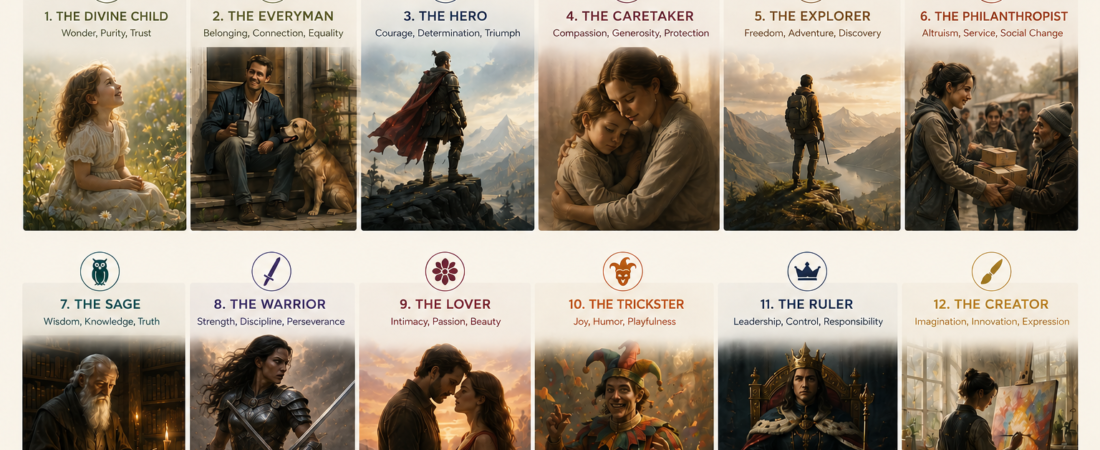
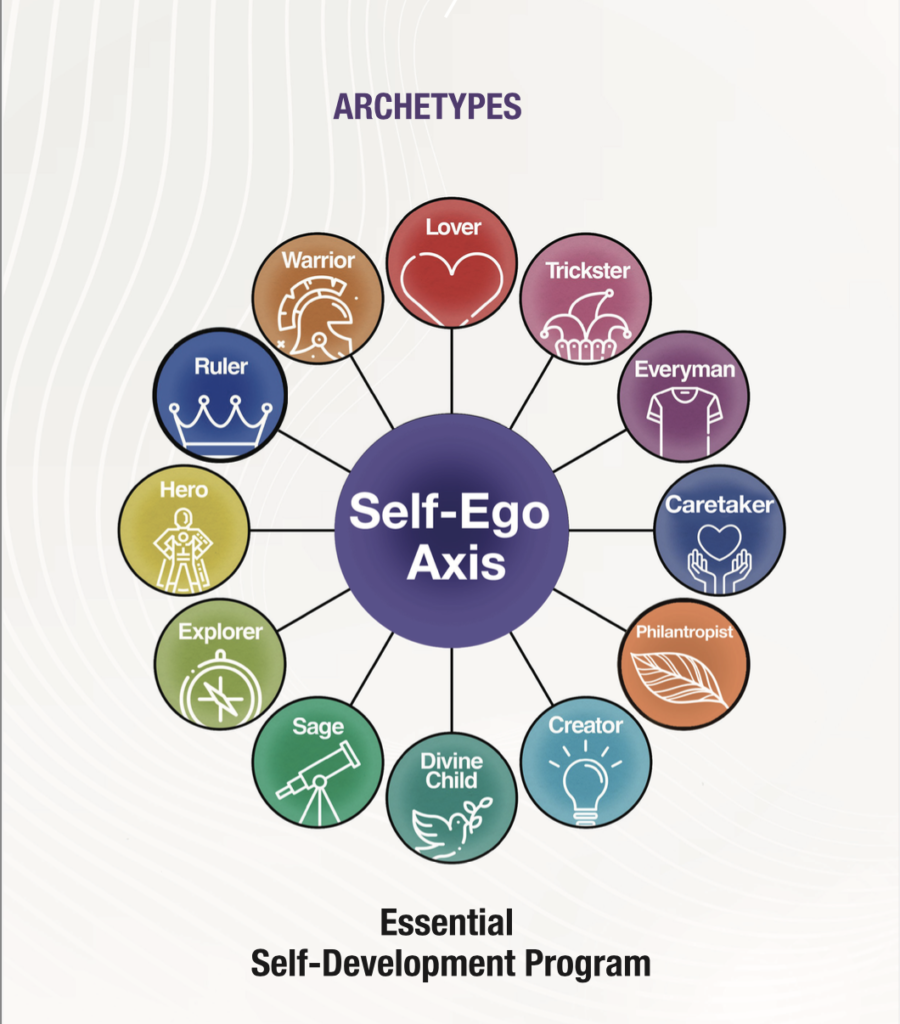
Each part of your personality can be broken down into 12 personality types, or archetypes. Each archetype serves a function, has its own set of motivations and can be identified by a set of “qualities” – behaviours, attitudes and emotional responses.
Archetypes, therefore, can be defined as personality traits that emerge as specific patterns of thoughts, behaviours, emotions, attitudes, desires and motivations.
They are subtle energies stored as memory, learned behaviours, and instincts.
As developing humans, we must learn to integrate the qualities of the archetypes into our central nervous system. Into our store of memory. Archetypes in their fullness enable you to cope with everything life throws at you. The more archetypal qualities you develop (learn), the more healthy, wise and peaceful you become.
The qualities each archetype provides are both masculine and feminine, positive and negative, helpful and unhelpful.
Whilst you are developing, the archetypes are fragmented, or “dismembered”. We, therefore, have to re-member the ignored and unexpressed parts of ourselves.
We do this by adopting the archetypal qualities that are missing from our neural networks. We must learn how to become the person we need to be to fulfil the function we want or need to achieve.
In other words, the fragments of your personality that have not yet been fully developed need to be made whole.
Did you know the word, whole has the same root as the word, healthy.
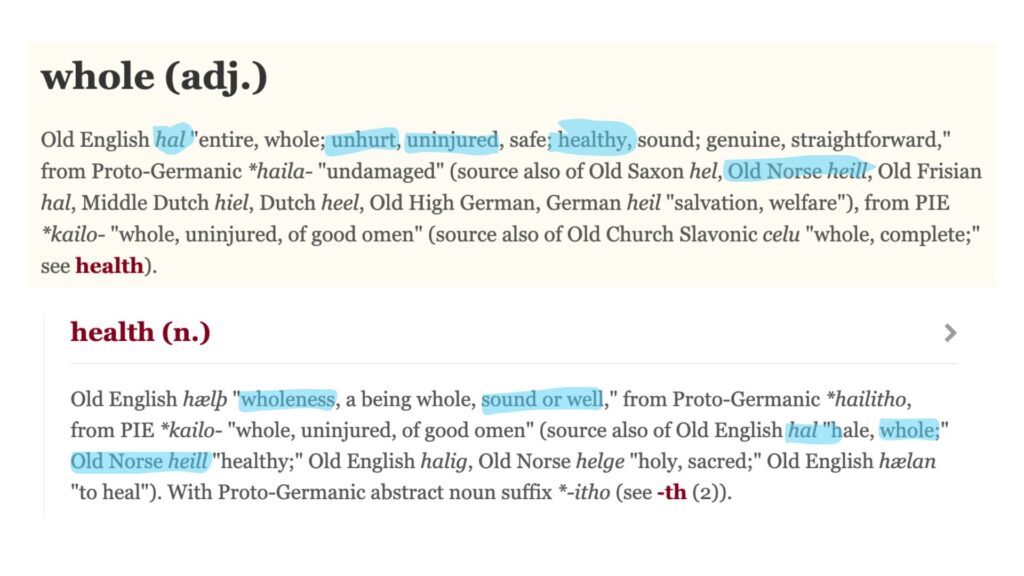
To be whole is to be healthy.
That means that developing the repressed parts of your personality is preventative medicine.
Archetypal qualities are energies. All energy has a vibration and a frequency. The more energy you have, you operate at a higher frequency.
Is it a coincidence that the ancient art of sound healing is proving to be beneficial in bioengineering?
Not only that, but archetypes play a significant role in how you experience life.
You create your experience of reality by how you respond to the environment; thoughts, feelings and actions are often automatic responses. They are automatic because your central nervous system is programmed to respond a certain way in relation to the information stored as memory.
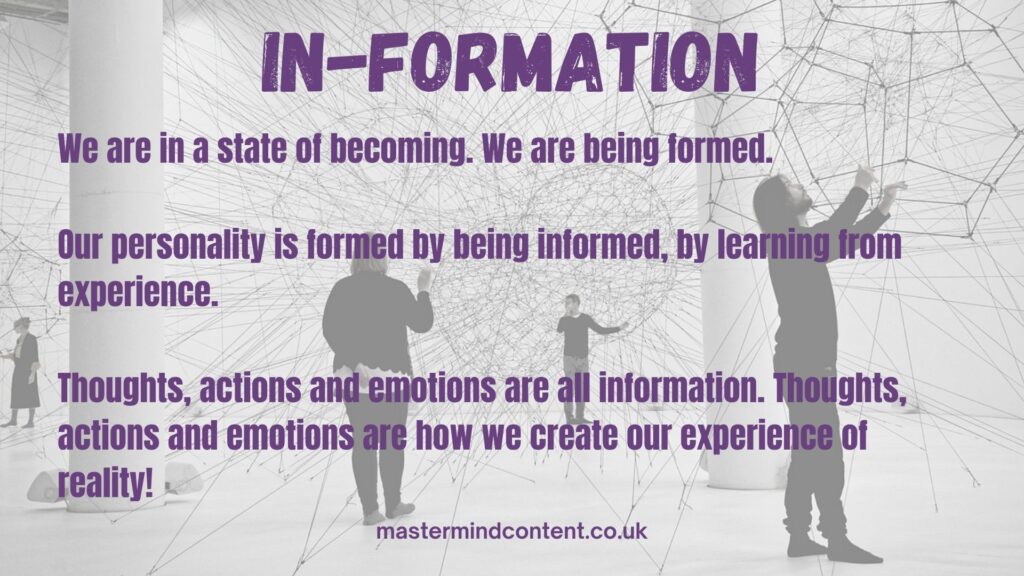
All energy carries information.
We are information.
Look at the word. In-Formation.
The fragmented archetypes that are not integrated into the conscious personality are known as complexes. Carl Jung, the great Swiss psychoanalyst who coined the phrase, noted that complexes cause the chaos that comes with stress, emotional disturbances and childish behaviours.
Jung described archetypes as autonomous personalities or complexes that behave “like secondary or partial personalities in possession of a mental life”. [Carl Jung, CW11 Psychology and Religion, p.14 (1958)]
“Every archetype, at its first appearance and so long as it remains unconscious, takes possession of the whole man and impels him to play a corresponding role.”
~ Carl Jung, Psychology and Alchemy
Observing childish and irrational behaviours, motivations, emotions and attitudes, give you an insight into understanding the contents of your central nervous system.
The archetypes show you how and why you are experiencing problems, conflicts and challenges.
The archetypes model we have developed at Libera Mente also shows you how to overcome problems, conflicts and challenges by helping you see where you are going wrong and how to put it right.
We help you to become whole: healthy, happy and wise.
Working With The 12 Major Archetypes
In the Libera Mente Archetypes Tool, archetypes are depicted as subtle energies we call “qualities.”Qualities are bits of information that are decoded, processed and stored as memory.
Each archetype is illustrated as “developed” or “undeveloped.
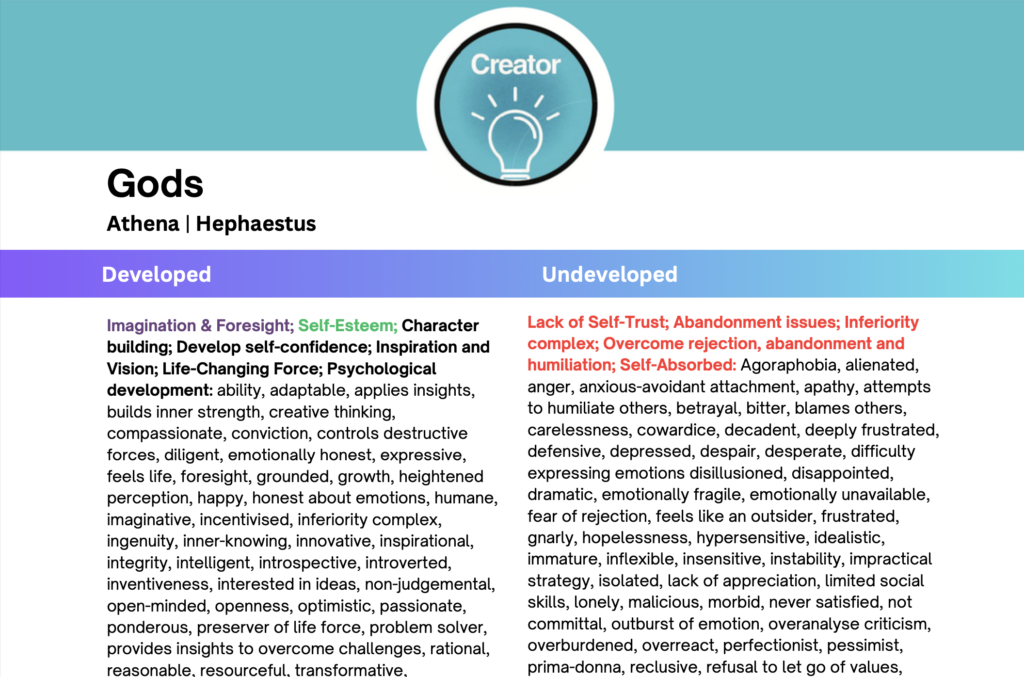
If you display more of the qualities in the developed column, the archetype is integrated into the conscious personality and doesn’t pose too many problems.
If you display most of the qualities in the undeveloped column, the archetype is repressed. Unexpressed.
When parts of your personality are not given expression, they remain in a childish state of maturity.
To evolve into the best version our ourselves, we must develop the archetypes from a childish state into maturity and eventually into wisdom.
This is what is meant by the maiden, mother, crone, and prince, king, wise old man triads of ancient mythology.
It’s also important to note that you are NOT one archetype.
You are all 12!
That’s not to say you don’t have dominant archetypes. You do. But it is often dominant archetypes that have the most influence over your life and repress others, which might serve you better at specific times.
“When, therefore, the individual stands consistently upon one side, the unconscious ranges itself squarely upon the other, and rebels.”
~ Carl Jung, Psychological Types
Identifying The 12 Major Archetypes
The Ruler Archetype
Also known as King, Sovereign, Tyrant, Bully, Father
The Ruler is characterised as power-driven, the part of your personality that expresses your will. It is the chief decision-maker and, when developed and healthy delivers satisfactory rewards and success.

When undeveloped, the decisions you make are often influenced by other archetypes and lean towards habitual behaviours that provide comfort, joy and pleasure; behaviours that help to regulate your nervous system or defend yourself when you feel attacked.
Whereas some people need power over others to make themselves feel powerful and in control, a well-developed Ruler puts trust in others and relinquishes power by delegating decisions.
Essentially, the Ruler is your autonomous behaviours and gives you the capacity to initiate change. It is the neo-cortex, and in well-developed individuals works in harmony with the heart.
When this part of your personality is developed, it gives you the capacity to control your thoughts and emotions and adopt the most appropriate response to any given situation.
The respected psychoanalyst John W. Perry described the Ruler as the “central archetype” around which the rest of the psyche is organised.
Thus the Ruler draws on the energies of other archetypes and relies on their integrated qualities to function at its best.
The neocortex, or Thinking Brain, functions effectively when you have information.
If the information communicated via neural networks are influenced by emotions and desires, you may not always make the best choices.
If the Ruler archetype is developed, your behaviours are aligned with your intention.
You are disciplined, act with conviction, and strive for wholeness. You thrive.
In their book, King, Warrior, Magician, Lover, Jungian analysts Robert Moore and Douglas Gillette point out, the energy of the ‘King’ (Ruler archetype) means you are calm, centred and life-giving.
The Ruler’s superpower is to be self-directed. You are autonomous, in control of your actions and emotions, and act with conviction.
“..the Self, the imaginary center of wholeness, directs not only the species-specific but also the individual development of the human being…That is to say, in the human individual the Self exerts its effects as the tendency not only to play the typical role in one’s adaptation to life but also to discover one’s own authentic beingness and to achieve Self-realization through life and the collective; i.e., to actualize one-Self in one’s own unique suchness. But for Self-realization all the phases of transformation are necessary.”
~ Erich Neumann, Essays, Fear of the Feminine
When developed, the Ruler archetype is a good leader. You carry an air of authority, people respect your opinions and take your instructions on board.
You exude confidence and authority. When making decisions, you have the mental capacity to use logic and reasoning rather than knee-jerk reactions prompted by emotional impulses.
Depending on whether the information you store as memory is benevolent or tyrannical, you will either persuade and inspire others to willingly support your vision or subdue them through manipulation and force.

The undeveloped Ruler places unreasonable demands on others. It is manipulative, conceited and deceitful. People who only care for themselves and ignore everybody demonstrate the patterns of an undeveloped Ruler.
Because the tyrannical Ruler wants complete control, people who are possessed by this archetype find it difficult to hand over the reins to others or admit when they are wrong.
In such cases, the shadow energies will appear in the form of arrogance, entitlement, elitism, exploitation, inflexible, narrow-mindedness and using intimidating tactics to get their own way.
When the Ruler archetype is underdeveloped, people will not admit they cannot do something because they feel it undermines their authority.
The underlying cause of the repressed Ruler is a feeling of inadequacy, often due to a strict, authoritarian upbringing where their behaviours and ideas were often frowned upon.
The Caretaker
Also known as The Caregiver, Mother, Queen, Maiden, Samaritan, Idealist, Healer
Together with the Ruler, the Caretaker is one of the most important archetypes to develop because of its prominence in everyday life.
Just as you make decision everyday, you also have to perform mundane tasks and routine obligations — and this is the function of the Caretaker.
The Caretaker takes care of everything, including themselves and others.

Mainstream psychology calls this archetype the Caregiver. I feel the Caretaker is a more suitable description. This is evident by analysing the definitions of the two words.
The Oxford English Dictionary describes a caretaker as “one who takes care of a thing, place, or person; one put in charge of anything.”
The caregiver is described as “a person who takes care of a sick or old person at home.”
This latter definition indicates a caregiver takes care of other people. And this archetypes is an habitual people-pleaser. A caregiver does not take care of the themselves. They give all their energy, time and resources to others.
The definition of the Caretaker implies that you also take care of yourself as well as others, and everything in your life. You fulfil your duties, including the duty to yourself.
When you come to this realisation, and develop this part of your nature, you release the grip of the people-pleaser in you.
As an interesting side note, the word “caregiver” is a relatively modern term that replaced the word “caretaker”.
Just saying.
Other attributes associated with the Caretaker are generosity, commitment, and patient. This archetype gives you a nurturing quality, whereby you prioritise responsibilities and have the self-control to fulfil your obligations even when you don’t feel motivated to do so.
The Caretaker is a positive and nourishing mother figure. You’re not afraid of upsetting your child by saying “No,” because you know what is best for their development.
The same is true of the Caretaker archetype because you know what best for your life now, and in the future.
You see this archetype developed in parents who have the flexibility and presence of mind to understand the personal freedom of their children. But also have control over them so they are not unruly and wild.
Whenever you can, the Caretaker allows children to explore the world and nurture their development through supervision, support and tuition.
When the Caretaker is repressed, you consider yourself a victim and subconsciously become a “martyr” or “slave”.
By giving yourself to others, you lose your sense of Self and find it difficult to set boundaries.
You feel guilty saying no.
You lack faith in yourself and the universe.
You have low self-worth.
The motivation of this archetype is to appear kind, generous and helpful. All your subconscious programs are, therefore, designed to make you appear kind, generous and helpful, even if they are maladapted.

Being a victim, however, eventually makes you feel bitter, and resentful. There is a tendency to ruminate that you do everything for everyone else and nobody does anything for you.
Guilt-tripping becomes part of your emotional armour because you project your repressed feelings of guilt onto others.
Ultimately, you’re seeking validation for your good deeds. Compliments and recognition boost your self-worth.
Shadow energies of the Caretaker surface as feelings of incompetence, and the need to prove to others that you are capable and useful.
Feelings of guilt and shame ultimately impact your ability to relax and enjoy life. Trapped in your hips, these blocked energies prevent the loving and creative aspect of the feminine principle from flowing through you.
The Creator
Also known as Artist, Architect, Innovator, Inventor, Visionary, Hermit
When used in the right way, the Creator is a transformative energy.
Using your imagination and foresight — the superpowers of the Creator — you’re able to envision the future.
This capacity gives you the scope to prepare yourself mentally, emotionally and physically for real-life situations.
In short, the function of the Creator helps you to create the outcomes you desire in life.

The qualities of the Creator make you adept at problem-solving; forward-thinking vision, creative thinking and inspiration.
There is a willingness to constantly develop new skills, attitudes and behaviour to enrich your life. That comes with the emotional intelligence a developed aspect of this archetype gives you.
Eager to improve, you can adapt to new circumstances without feeling flustered.
The most notable traits when the Creator is undeveloped appear as perfectionist tendencies, a fear of being humiliated and alienation.
Socially awkward, the Creator has a lack of self-worth and needs to develop the qualities of the Everyman to feel a sense of belonging.
Successful individuals dominated by the Creator tend to develop a superiority complex, which masks the inferiority complex.
The inferiority complex is born from a subconscious program that you are not worthy of attention because nobody understands you, or nobody listens. You feel ignored, dismissed and excluded.
Subsequently, this part of your personality can cause you to lose sight of what you have achieved. Low self-esteem and low self-worth are common features.
If you have ever been told, “an artist’s work is never finished”, the message was calling to your Creator archetype to let go of perfectionism. It is the ability to be content with what you have done.
Moreover, you become dissatisfied with everything else in your life. Unless something is perfect, you cannot be happy.
As a consequence, this archetype tends to sabotage relationships.
Self-sabotage also comes by way of withdrawal and exclusion.
The Divine Child
Also known as The Child, Innocent, Shaman, Healer, Idealist
The Divine Child is your essence, the Instinctive brain that serves as a guide to life. If you choose to listen.
This is the part of your personality that knows what you need, but can often be drowned out by the ego, which, informed by subconscious programs formed by the fragments of other archetypes, tends to do what you want.
There is a key difference between what you need and what you want.

We are born as the Divine Child, whole, connected, and at peace.
When we are born, our awareness is solely in the unconscious.
Around the age of two, we develop an ego and become more aware of the external world than the inner world. If the ego loses sight of your inner world of emotions and thoughts, the Divine Child is cast off — separated.
Consequently, you experience the biblical Fall and become absorbed in the materialism of the world in search of comfort, joy and pleasure.
Disconnected from the Divine Child, you lose touch with your inner guide. You become lost, misguided and irresponsible.
“By the end of the first year of life, if not before, the egogerm of the child begins to prepare for its subsequent autonomy. Initially this development, too, is sheltered by the mother, who supports and furthers the child’s growing independence just as she does its learning to walk and to talk. While the first postnatal, embryonic year still stands under the sign of the unconscious unity of mother and child in the primal relationship in which the mother is simultaneously world and Self, the “migration” (as we have called it elsewhere) of the Self from mother to child gradually begins. With this second birth at the end of the first year of life and “postnatal embryonic period,” the ego-development and increasing independence of the child’s personality become evident.”
~ Erich Neumann, Fear And The Development of Personality
As an archetype, the Divine Child is the most unique.
It exists in a state of potential and relies on the qualities of the other archetypes to be realised as the Ruler. Whilst in a state of potential, it is unrealised.
Unexpressed.
Repressed.
Depressed.
The goal of self-development is for the Instinctive brain of the Divine Child to be accessible by the Thinking Brain of the Ruler — symbolised by the mystic’s idea of “Alpha to the Omega”.

In some respects, this primordial energy contains pure consciousness. At the same time, it contains the innocence and naivety of a child. It is the aspect of your nature that is easily pleased because you don’t know any better.
The ability to connect with your inner Self can instil a sense of trust and stir utopia within you.
From a negative aspect, the undeveloped Divine Child makes you gullible, easily led, and passive. Without the knowledge of lived experience, you are blind to reality and lack initiative.
People who turn a blind eye to corruption are possessed by this archetype. So too the boys and girls that never grow up.
The undeveloped Divine Child is evident in people who are prone to mood swings, pessimism, reluctance and disappointment. They project blame onto others, shy away from challenges and are hesitant to try anything new.
People living a sheltered life are strongly influenced by the Divine Child. They have subsequently grown into adult children and harbour childish personality traits.
They can also be precocious and difficult to reason with. Moreover, they ignore anything that disturbs their emotional well-being. In doing so, they invite more problems into their lives.
They have yet to realise that every problem or situation they encounter in life is an opportunity to learn something about themselves and find the happiness they crave.
The Everyman
AKA: Member, Orphan, Persona, Realist, Victim
The motivation of the Everyman archetype is to fit in. This part of your personality needs to feel accepted, find a sense of belonging and enjoy life.
Its function, therefore, is to connect with others, make friends and get along with everyone. This is the archetype that enables you to integrate with society.
The Everyman wants everyone to like them.

Common traits you find in this archetype that serve you well are adaptability, agreeableness and co-operation. This archetype is amiable, compassionate and cheerful.
When developed you are loveable, grounded and interdependent. However, when its strengths are maladaptive, you hide behind a mask and become the person others expect you to be.
The undeveloped Everyman can prevent you from developing individual preferences, so you do what everyone else does and likes what everyone else likes — just to fit in.
Jung called this aspect of human nature, the Persona, and warned that if your ego associates with your persona, you lose any sense of identity.
“It is only because the persona represents a more or less arbitrary and fortuitous segment of the collective psyche that we can make the mistake of regarding it in total as something individual. It is, as its name implies, only a mask of the collective psyche, a mask that feigns individuality, making others and oneself believe that one is individual, whereas one is simply acting a role through which the collective psyche speaks.”
~ Carl Jung, CW7 Two Essays on Analytical Psychology (1928)
Subsequently, the undeveloped Everyman is inauthentic.
False. Plastic. Superficial.
Develop the Everyman and you work well in teams and perform well in groups without losing a sense of identity. You play your role, but recognise you are part of a cog in the clockwork.
Although you are conscientious and work hard, you are content with a simple lifestyle. Family is more important than work because being around the people you love is more fulfilling than pursuing career goals.
When maladapted, however, the Everyman yearns for personal safety by spending time with other people. This is how it gets its name of the Orphan archetype.
This maladaptation develops when the connection between you and your parents, or other family members, is broken.
The wound becomes even deeper when you struggle to fit in at school and feel betrayed, rejected and ostracised by your peers.

The gravest fear in the Everyman archetype is being left out. The feeling of loneliness is devastating because it comes from a subconscious program that informs you: I am not lovable.
When this archetype is dominant, you’re emotionally sensitive. You get upset easily when you feel rejected, humiliated and abandoned. If you feel betrayed, you may seek retribution.
You can detect this archetype if you are dependent on other people to make you feel fulfilled. If you are not content spending time alone, it’s because you have not accepted yourself.
You have rejected yourself.
This can give you a character weakness that exudes a feeling of helplessness and a codependency on others.
An underdeveloped Everyman prompts you to conform to societal norms and the demands of others.
You, therefore, become a people-pleaser by doing things others want you to do, going to places others want you to going into a career others say are good for you.
Everything you do is not of your choosing, but the choice of others.
The people-pleasing tendencies of the Everyman are distinguishable from the Caretaker in that you do what other people suggest to be liked, rather than taking on the responsibilities of others to feel helpful and useful.
Adolescents can often fall into this trap when they are dared by their peers. To fit in, the Everyman will do whatever it takes to feel part of the group.
At some point, you realise the people you hang out with ridicule you, disrespect you and take advantage of you.
They are not your friends.
You don’t fit in.
Eventually, you feel lonely even when you’re in their company.
The subtle energies of the Shadow Everyman manifest as social anxiety.
Denying yourself the things you want to do in life takes away the things you need to grow emotionally and spiritually. As you get older, this will manifest as restlessness and an overwhelming desire to differentiate yourself from your friends.
Explorer
Also known as The Seeker, Revolutionary, Rebel, Outlaw, Hunter, Archer, Sleuth, Detective
The archetype of the Explorer is your desire to research, discover and learn. When this aspect of your consciousness is awakened, you will be prompted to go on a voyage of self-discovery.
The Explorer sits in the second tier of character development because it generally comes online early on life. When a child is curious enough to explore the world around them, the Explorer personality is awakened.
Later in life, the teenager breaks away from the will of their parents.

The function of this archetype, therefore, is to find independence so that you assist the Everyman in building an identity you accept as your Truth.
It is the Explorer that exposes you to worldly experiences so you are able to determine what you like and what you don’t like.
Although the Explorer comes online early in childhood development, it is often one of the earliest to be quelled. Parents who constantly teach, “don’t do this, don’t do that,” and “that’s not a good idea,” dampen the Explorer’s inclination to discover.
If you ever felt like the black sheep of the family, or weird because you didn’t like the same things as your friends, you probably have a dominant Explorer that is refusing to be pushed into the unconscious.
The battle with the Everyman to fit in begins. The outcome may depend on how disconnected you are from the Divine Child because the Explorer can only develop if you are prepared to step beyond your comfort zone.
When the Explorer is repressed, this energy surfaces as angst, doubt and confusion. You are impatient, bore easily, and feel restricted.
Pop music and mediocre TV shows that are the “popular” appear superficial and stupid. You need entertainment that has depth and moves you.
You are not always prepared to settle for what is handed to you on a plate because you recognise you enjoy a richer quality of life by looking beyond the veil of illusion.

The shadow Explorer surfaces as an urge to do something dangerous. You need an adrenaline rush, an exciting change, something fulfilling.
This energy can also give you an irrational FOMO — fear of missing out.
It manifests as agitation, restlessness and the desire to do something different.
There is a tendency to flit from one thing to the next and never actually finish what you started. The underlying anxiety causes you to shy away from challenges as soon as you feel uncomfortable.
When this archetype is repressed, you feel stuck in a rut, unfulfilled and indecisive. You don’t know what to do with yourself.
That feeling of not knowing what to do with yourself is the Explorer urging you to try something new, to break away from habitual patterns that keep you trapped on the hamster wheel.
If you sigh regularly and find yourself saying: ”There must be more to life than this!” your Explorer is urging you to find more to life than what you have got.
However, if this energy is undeveloped but becomes a dominant force in your psyche, you resist settling down and starting a family.
Finding stability becomes a struggle because restlessness prompts you to change your location or environment.
You eventually learn that a change is not as good as a rest. You have to battle through the tough times before you can emerge on the other side, victorious
The Explorer’s prevalence for running away has to be tempered by the Hero, which gives you the courage and the willingness to fight discomfort.
Individuals who have not developed a Hero archetype by middle age will typically undergo a midlife crisis in search of an identity.
This can occur in a variety of ways but typically involves acting out unfulfilled fantasies.
The problem many people encounter during a midlife crisis is they hold on to their youth.
But the function of the Explorer is to help you evolve by discovering what’s best for you at every stage of life rather than hanging onto what you know from your youth.
Hero
AKA: Rescuer, Athlete, Survivor, Scout
The Hero is characterised by its superpower, courage. This energy gives you the motivation, the impetus, and the willingness to take action.
On the flip side, the Hero can prompt you to rush into something without proper planning. Therefore, the action you take may not always be the right thing to do.
Individuals with a developed Hero are not afraid to make mistakes.
Individuals with an undeveloped Hero avoid taking action in case they do make a mistake.

The archetypal qualities the Hero gives you help move the needle towards self-actualisation: confidence, a willingness to overcome challenges and a commitment to achievement.
Without evoking the powers of this archetype, you are riddled with self-doubt, apprehension and insecurity. Failure breeds self-hate.
But so too does not trying. And the undeveloped Hero does not possess the courage or the motivation to even try.
Without the Hero, life is unfulfilling because you never get to where you want to be. Your needs go unfulfilled.
Thus, the Hero archetype is the catalyst for engaging with life with the view of developing new ways of being.
The Hero is known as a fighter — but when undeveloped, it fights the good fight for the wrong reasons. You become defensive, argumentative and quarrelsome whenever you feel you need to be right.
The underlying cause for the Hero is a fear of failure, of wrongdoing or being accused of being wrong.
The shadow side to the Hero personality is often found in individuals who have repeatedly experienced failure in their early life, or perceived their parents and teachers were never satisfied with their output.

This subconscious program gives you the drive and the impetus to prove people wrong — or that other people are wrong and you are right.
You can become so blinded to the Truth that you don’t accept any wrongdoing, and, therefore, neglect to change your attitude or behaviours.
Consequently, you remain stuck in a situation you don’t want to be in or continue experiencing “bad luck” because you fail to learn life lessons that enable you to evolve.
For instance, it might be difficult for you to end a relationship because your Hero governs you with lust.
Lust can appear in many forms but is a failing to manifest what you need, so you go after what satisfies the ego — the things you want.
“There is a lust for revenge, which is called rage; a lust for having money, which is called avarice; a lust for victory at all costs, which is called stubbornness; a lust for self-glorification, which is called boastfulness. There are many and varied kinds of lust, some of which are specifically named, others not. For who could easily give a name to the lust for domination, which, as we know from the civil wars, is nevertheless very powerful in the minds of tyrants?”
~ St. Augustine
The Hero is among the immature archetypes, characterised by failing to control one’s desires through reason and rational thinking.
There may be times when you feel vulnerable or dependent on others to make your decisions for you.
Co-dependency originates from a lack of trust in others that surfaces in the Divine Child and spreads into a lack of trust in yourself in the Hero — primarily due to repeated failures as a child because you acted on instinct without thinking things through.
Stupid becomes an internal nickname for yourself.
The drive to prove yourself can prompt you to make reckless decisions as an adult. Here, the Hero is trying to break into conscious awareness but is inflated by the Trickster, which gives you ideas above what you are capable of.
In this scenario, the Self overrides the part of your ego that serves to protect your survival instincts, but to do so, the Neo-cortex must be given the self-belief and courage to take action.
This is how the mind can play tricks on you.
Unconscious drives, when suppressed, eventually turn against you.
“The unconscious is not a demoniacal monster, but a natural entity which, as far as moral sense, aesthetic taste, and intellectual judgement go, is completely neutral. It only becomes dangerous when our conscious attitude to it is hopelessly wrong. To the degree that we repress it, its danger increases. But the moment the patient begins to assimilate contents that were previously unconscious, the danger diminishes. The dissociation of personality, the anxious division of the day-time and the night-time sides of the psyche, cease with progressive assimilation.”
~ Carl Jung, The Essential Jung: Selected Writing
The Hero can help you achieve your goals, but unless the positive aspects of this energy are developed, it can become destructive and harmful.
Individuals with a competitive and combative nature project the angst and self-criticism they feel towards themselves onto others. Punch-ups, spiteful insults and ill-treatment of others are not unusual for individuals possessed by this archetype.
Philanthropist
Also known as Father, Destroyer, Entrepreneur
The Philanthropist is one of the three ruling archetypes alongside the Warrior and the Ruler.
The distinction is that the Ruler is the neocortex and makes decisions using logic, reasoning and discernment. The Warrior makes decisions based on strategy or intuition. The Philanthropist is an emotional decision-maker.
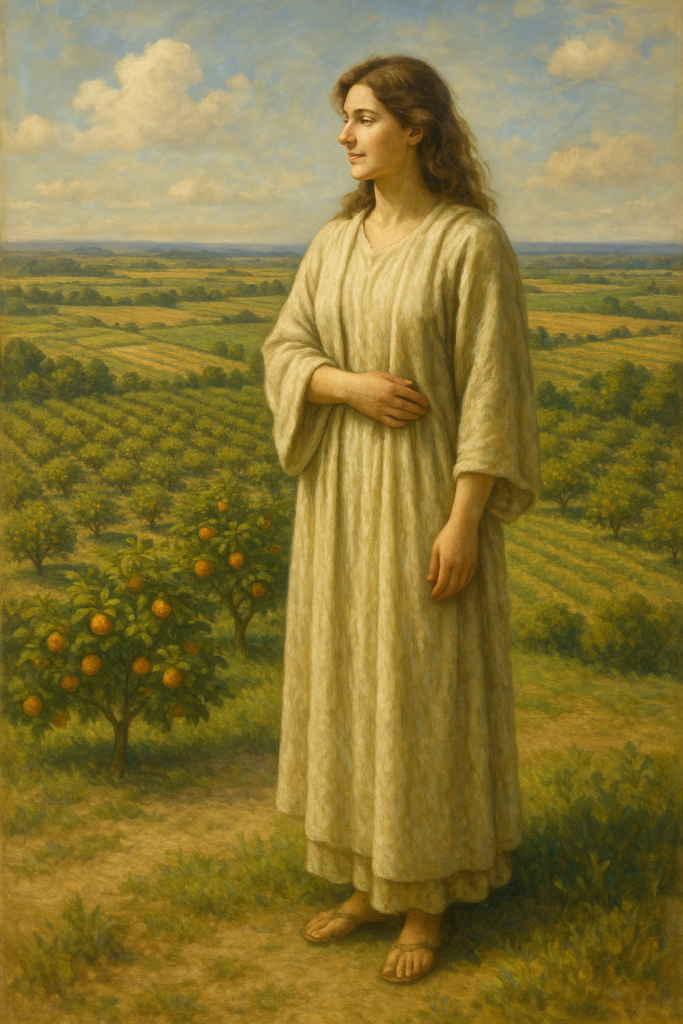
This archetype absorbs the energies of the other personable archetypes, namely the Caretaker, Everyman and Lover.
When developed, the Philanthropist has control over their feelings, expresses unconditional love and is prepared to make sacrifices for the greater good — but without making themselves a martyr like the people-pleasing Caretaker.
This archetype is clear about your intentions. You have the drive to bring ideas and opportunities into the world but without feeling the need to be recognised for your endeavours.
When developed, you have a willingness to do things for other people without wanting thanks. A philanthropist who gives to charities anonymously for example, is a developed human being.
On the flip side, philanthropists who name foundations after themselves or make it known they are donating huge sums of money to charity are not evolved human beings but nursing an insecurity so deep they need to be seen as king, generous and supportive.
Yet the undeveloped Philanthropist is rarely in a giving mood without wanting something in return. They are selfish, driven by misguided passion and bloated with false pride.
When you see an antagonistic narcissist, you are in the presence of an undeveloped Philanthropist. Beware, they may pretend to care about you, but the only person they care about is themselves.
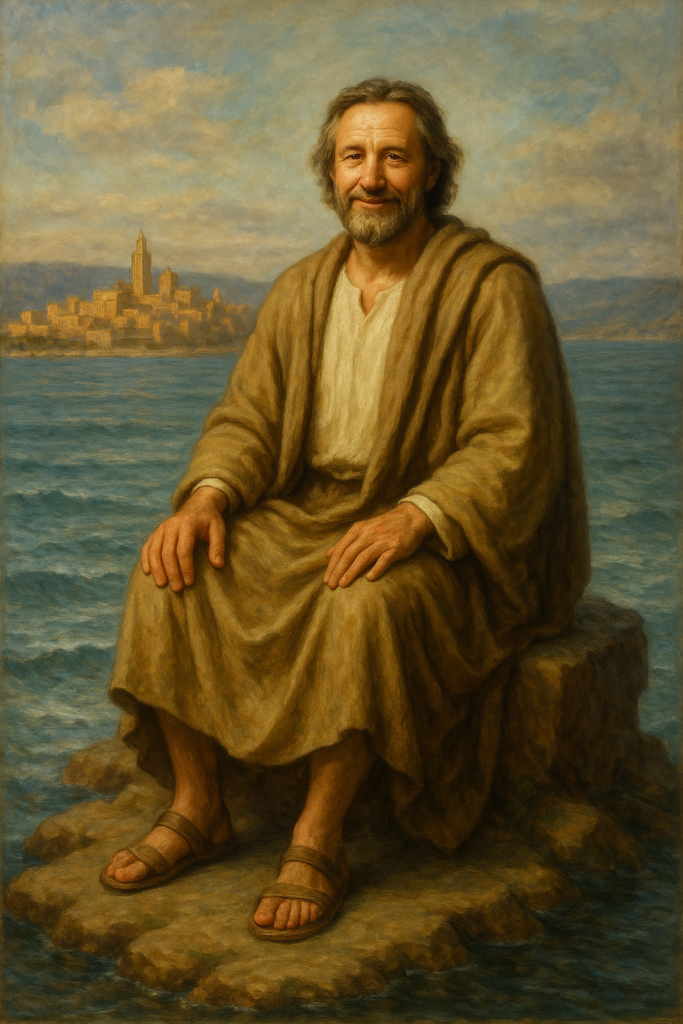
A developed Philanthropist cares about the well-being of others. They genuinely want to make the world a better place and are often found to be protesting in opposition to the rights of others.
They are the people who take to the streets to defend human rights, to stop immoral wars and expose corrupt corporations for irresponsible practices that cause damage to health and the environment.
A true Philanthropist archetype has the sense to let go of destructive behaviours, habitual routines that no longer serve you and attachments do not align with your life goals.
You can make bold decisions if you believe it is the best thing to do for yourself and others. This inner strength enables you to develop as a person, evolve spiritually, improve your career and build loving and meaningful relationships.
When the Philanthropist is wounded, this energy shows up as agitation, impatience, arrogance, and a low frustration tolerance. A craving for power and recognition can make you dictatorial, irrational and selfish.
This energy typically emerges as an ideal and can lead you down the path to fanaticism. Irrational behaviour creeps in, and you find yourself becoming more ill-tempered, overstretched and impractical.
The underlying motivation for the undeveloped Philanthropist is a single-minded attitude that you must be successful to be admired.
To successfully integrate the Philanthropist archetype, you must be prepared to make changes for the benefit of others and go with the flow when adapting to new ways of being.
The Sage
Also known as Wizard, Sorcerer, Wise Judge (wise old man), Oracle, Muse, Pope, Magician
The Sage archetype serves as the bridge between the Emotional Brain and the Thinking Brain. When you draw on its superpower to reason, you are best placed to make decisions that enrich life.
You might think of the Sage as the wise counsellor to the Ruler. This energy emerges as self-awareness and an inner knowing that gives you the confidence to make the right decisions.
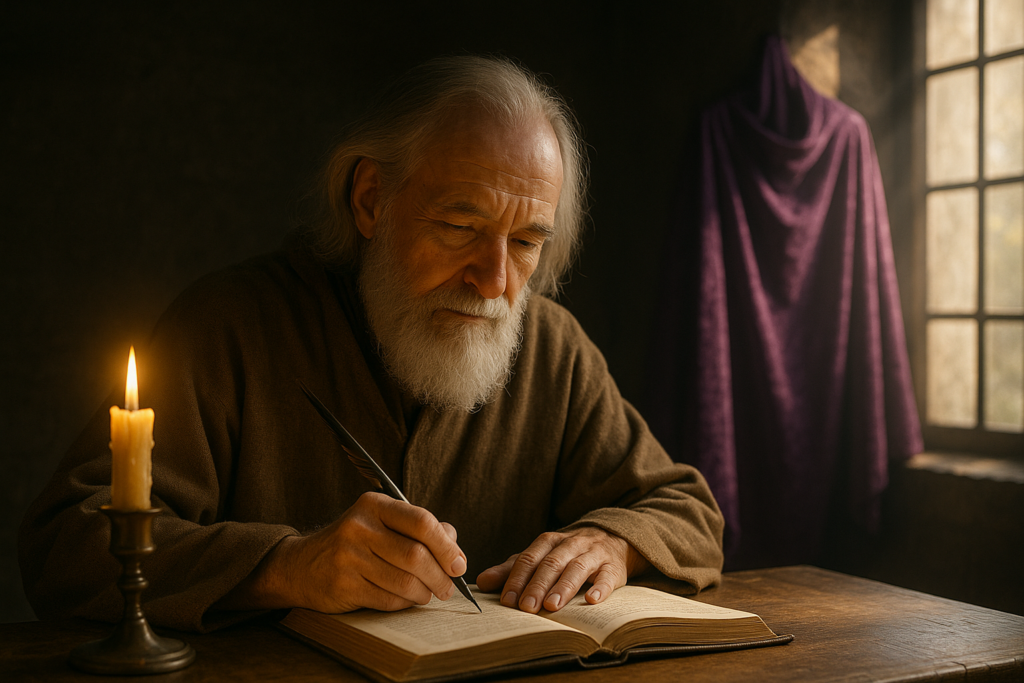
Whereas intuition surfaces in the Divine Child and Explorer archetypes as a feeling you are uncertain about, in the Sage, you sense what your intuition is telling you.
This is your inner wisdom.
To fully develop the Sage, you must learn to trust this inner wisdom as “The Truth, the whole truth and nothing but the truth.”
Individuals who have a dominant Sage in their personality tend to be intellectual, knowledgeable and wise. This is the archetype that sums up the expression, ‘Knowledge is Power’.
The inner Sage in you understands how to focus your energies, work with the forces of nature and use whatever resources you have to hand.
By tapping into the infinite resource of the Supreme Intelligence (consciousness), the wisdom of the Sage appears.
It is wisdom that enables you to detach from the world, to step back and observe how you are creating problems, conflicts and challenges. The intuitive insights you receive from the Sage gives the Ruler a different perspective.
People with a well-defined Sage are often introverted. Although they are considered quiet, silent types, they have an inner strength and a rich inner world that enables them to detach from the trivialities of ordinary life.
However, this detachment can make the Sage personality appear cold and unfriendly. People who do not understand this aspect of human nature do not trust you and will keep their distance.
It’s not uncommon for this personality type to be considered a loner or a weirdo.
Detachment has both positive and negative consequences.

On the one hand, you are not bound by material possessions. On the other hand, you deny yourself the simple pleasures in life because it’s beneath you — unless you have developed the Lover.
Moreover, you have little time for small talk and have a low tolerance for people who do not meet your intellectual standards.
The shadow nature of the Sage gives you a holier-than-thou attitude. You adopt the belief that your way is the right way, and for some people, the only way.
When the Sage energy is dominant, you may also have a tendency to analyse your emotions intellectually rather than associating with a feeling.
Because the Sage personality lives in their head, they are cut off from the emotional life which takes place in the body.
The Lover
Also known as Maiden, Addict, Hedonist, Damsel, Prostitute, Courtesan
The Lover archetype encourages you to form healthy attachments with yourself, with others and the world around you.
This is a binding energy which provides you with passion for the things you care about. The things that make you feel good and regulate the central nervous system.

However, the CNS does not know what is good for you and what is not good for you.
The attachments you bond with are sometimes unhealthy habits, turbulent relationships and dangerous past times.
When this archetype is developed, you feel comfortable in your skin. You feel life — unlike the Sage who lives life in their head.
The Everyman shares qualities with the Lover. But whereas the wounded Everyman finds it difficult to be open, the Lover understands that honesty is the root of commitment and affection.
This energy enables you to find happiness in the small things in life because you are endowed with a deep sense of love, gratitude and appreciation.
Being part of somebody else’s life whilst maintaining your personal identity and autonomy comes naturally to you without feeling the people-pleasing tendencies of the Everyman.
The Lover, therefore, is the balancing energy that heals the wounded Everyman.
Contrary to popular belief, the interests of the Lover archetype do not revolve solely around relationships and sex. The function and motivation of this archetype is to develop meaningful relationships.
Being this connected to your feelings helps you to understand what life is all about. By understanding the nature of others, you recognise what brings happiness, fulfilment and abundance.
When you’re in control of your “libido” — the vital creative energies that influence your behaviours — you become a magnet for attracting the things you deserve.
Men who are encouraged to “suck it up” and repress their feelings typically neglect to develop the Lover archetype.
The Lover is also repressed in children who are brought up in an environment that sets narrow boundaries. Devout religions and rigid views of how to present yourself in public ultimately destroy the Lovers’ charm, passion and sexuality.
Locking up the Lover ultimately hinders your ability to love yourself or form healthy attachments with the external world.
A lack of self-love can erupt in destructive behaviours. On the one hand, a repressed Lover might become promiscuous in search for love, or turn to class A drugs to feel alive.
Alcoholism, sugar cravings, gambling, shopping, social media and gaming addictions are also signals that your Lover archetype is being ignored and is asking you to take notice.

This archetype also shows up in destructive ways through obsessions. Loving someone too much, for example, can lead to infatuation and suffocate your partner.
When they start to ask for more space in your relationship, the fear of rejection makes you paranoid and breeds rabid jealousy, possessiveness and petty arguments.
Here we see the hapless romantic who is always searching for the right person and is desperate to feel loved. The shadow Lover is needy, hedonistic and depressed.
A common complaint of people living with the shadow Lover is a false belief that you cannot be loved. And that makes it difficult for you to love.
Infatuation and the excitement of a new relationship serve as a substitute for love. The neurosis stems from a lack of love when experienced as a child, and like the Everyman, they feel unlovable or unworthy of love.
The key difference is that the Everyman becomes a people pleaser, whereas the Lover becomes a narcissist. You see this in chauvinists, drama queens and exhibitionists
An undeveloped Lover surfaces as boastfulness, exaggerating your successes and overindulgence.
Trickster
Other Trickster Archetypes: Joker, Fool, Joker, Entertainer, Magician
The Trickster is the fun-loving side of your character that seeks to bring joy and laughter through humour. This side of your personality is put to best use at home and social engagements, where you can express your sense of humour and create a jovial atmosphere.

When this part of the personality is well-developed, you are genuinely funny, equipped with a sharp wit and understand how to use humour wisely.
When the Trickster is undeveloped, jokes become pranks. There is a tendency to call attention to yourself because you need to be seen.
From a positive perspective, the Trickster teaches you not to take life too seriously. Working in tandem with the King, the Jester helps to create a work-life balance.
In medieval Royal Courts, it was the role of the Jester to distract the King from his world responsibilities and concerns and to keep his feet on the ground to prevent him from becoming egotistical.
“When the trickster is evident in the psyche, there is a “personification of traits of character which are sometimes worse and sometimes better than those the ego-personality possesses…the trickster motif does not crop up only in its mythical form but appears just as naively and authentically in the unsuspecting modern man — whenever, in fact, he feels himself at the mercy of annoying “accidents” which thwart his will and his actions with apparently malicious intent. He then speaks of “hoodoos” and “jinxes” or of the “mischievousness of the object”…on a civilised level, it is regarded as a personal “gaffe”, “slip” “faux pas” etc, which are then chalked up as defects of the conscious personality.” The “main part of him [the trickster] gets personalised and is made an object of personal responsibility.”
~ Carl Jung, The Archetypes and the Collective Unconscious
Because the Trickster places pleasure and happiness above all else, it helps you to dissolve the stress associated with modern life.
Jung classified the Trickster as a rudimentary stage of psychological development — the “psyche that has hardly left the animal level.” It shows up as “instinctual, uninhibited, and often childish.”
It is the prankster in the classroom, the joker in the group, the inhibited leader of the pack, and the fool who acts without any thought of the consequences.
But whilst the Trickster archetype is capable of buffoonery and crude behaviour, he can also fuel the creative function to bring forth innovative ideas.
For example, this archetype provokes the personal consciousness to acknowledge your character flaws. The Trickster will make you believe anything is possible, even when it isn’t. Success and failure both lead to transformation.
Although Jung classified the Trickster as “a summation of all the inferior traits of character in individuals” [CW9i], it is the aspect of consciousness that attempts to instil a belief that your goals are possible.
Individuals with a dominant Trickster archetype are free-spirited innovators who can think outside the box. They can “transform the meaningless into the meaningful.”

However, because the Trickster in your psyche has a habit of filling your mind with false perceptions, it cannot always be trusted. You, therefore, have to call on the Sage and apply logic and reason. When you hold some of the Tricksters ideas up to reality, the illusion will fall apart.
When the playful side of your nature that seeks enjoyment is repressed, the shadow strikes a compromise — usually in self-destructive behaviours.
But if you observe what happens and how you feel when the shadow Trickster is at play, this archetype becomes a guiding light to releasing trapped emotions buried in your subconscious.
A person with a dominant Trickster will often have mental flights of fancy that have no grounding in reality. They also make jokes at inappropriate moments and sometimes try to be funny by pulling your leg, but rather than being playful, they can hurt somebody’s feelings.
These are symptoms of an immature personality that has not outgrown childish behaviours. When permitted to project too often, the Trickster can become annoying.
Whilst a creative imagination can produce positive results, the Trickster can invent fantasies which can only exist in the imagination, but make you believe they are possible. Ideas influenced by films, TV, comics and celebrity media, for example, fall into this category.
But regardless of whether the Trickster appears as the inspirational creative force or the self-sabotaging destructive force, this archetype is a catalyst to establish order out of chaos.
Warrior
Other Warrior Archetypes: Destroyer, Dragon-slayer, Knight, Soldier, Outlaw
The Warrior archetype has a positive mental attitude that imbues you with self-confidence, composure and courage.
When this archetype is matured, you know what you want and you know how to get it. Warriors do not hold back when faced with challenges. Nor do they simply charge in without a plan.
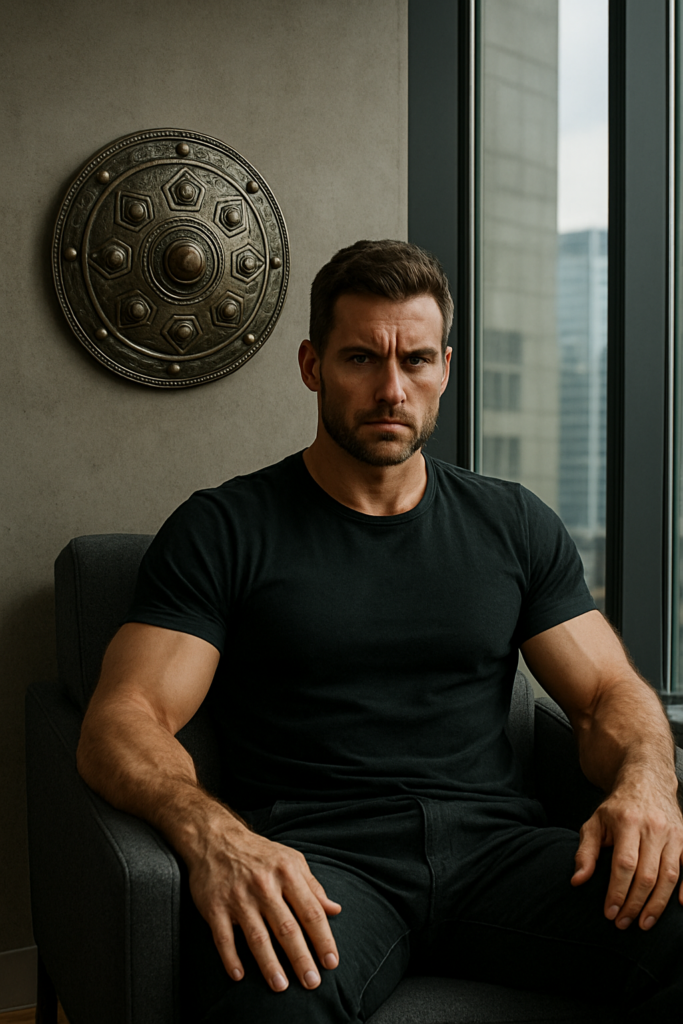
When the Warrior is in its fullness, you are self-assured and have an inner calm that enables you to control your emotions. You’re not afraid to make mistakes, and when you do, you recover from setbacks quickly.
The defining characteristics of the Warrior archetype are personal integrity, practical logic and the determination to succeed.
The drive of the undeveloped Warrior, however, is fuelled by greed, arrogance or misdirected pride. Sometimes, they are more intent on proving a point than accepting they were wrong.
And this archetype hates being wrong or looking inferior in any way, shape or form. If their insecurity complex is prodded, the wounded Warrior goes from being defensive to aggressive to violent.
As a ruling archetype, the Warrior is a part of the psyche which makes decisions for you. The Warrior has one foot in the Instinctive Brain and one foot in the Thinking Brain.
When the Instinctive Brain has more power than the Thinking Brain, impulses do your bidding for you. Such decisions are determined by how well-developed the practical archetypes; the Hero, Creator and Sage.
The key differences are that the developed Warrior knows your limitations and has a strategy in place before taking action. You’re also more open to take advice from others and you physically confront the challenge you previously imagined.

The repressed Warrior is not in control of your emotions. For example, even though your intention is to be calm when you are being assertive, you appear aggressive to others.
Aggressive energy can also surface in a myriad of ugly ways: violence, anger, frustration, abusiveness, jealousy, revenge, impatience, recklessness and irrational behaviour.
A lack of emotional security can also lead to indiscretions that involve some form of risk-taking; i.e. cheating on your spouse, extreme sports, or gambling higher bets than you can afford.
To develop the Warrior in you, it’s important to avoid unnecessary conflicts and arguments. Because the Warrior’s insecurity surfaces as a dislike of being told what to do, you tend to be defensive.
This is due to an underlying fear that you will have to relinquish control, which means losing your personal power.
Subconsciously, you feel inferior and don’t trust yourself to do the right thing in some areas of your life. This complex is projected onto other people you want to have power over.
This subconscious attitude can cause you to lose sight of personal growth. Competitiveness, manipulation and selfishness creep in to make sure you get what you want.
In this frame of mind, you risk developing a “Me versus the World” attitude. Everything becomes a duality for the wounded Warrior; winning and losing, profit and loss, all or nothing.
And the undeveloped Warrior does not like to lose. You have to walk away with all or nothing. Subsequently, you are always fighting, always struggling and always keeping up your guard.
Discover The 12 Major Archetypes
In my opinion, understanding the nature of each of the 12 major archetypes and recognising them in your own life is arguably the most powerful self-development tool available.
When you recognise how you are creating challenges, conflicts and self-sabotage, you can also see how to avoid creating the same experiences.
The archetypes model at Libera Mente is designed to help you identify complexes and neurotic behaviours and determine the root cause underlying these repressed parts of your personality.
With this level of awareness, you can move forward and integrate the qualities you need to face challenges and live life with fewer conflicts and less emotional stress.
To make it even easier to learn and re-member all the archetypal qualities you need to function at your best, each of the archetypes has been assigned a male and female god from the Greek pantheon.
Stories and images are shown to increase memory recall from around 10-20% to 74%. Greek myths can also help you to identify which archetype is influencing your life faster than any other archetypal model.
Are you ready to transform the areas of your life that are stressful?
Contact Rich at Libera Mente today by completing the contact form below. We can then schedule a free 30-minute discovery and take it from there.