

Dissociation is a mental process in which a person becomes disconnected from their thoughts, feelings, sense of identity, memories, or surroundings.
In broad terms, dissociation means the brain cannot adapt to an experience which is too overwhelming, threatening, or difficult to process. It’s the mind’s way of creating psychological distance from a stressful situation.
You could compare it to a computer crashing when it is overloaded with data.
But dissociation exists on a spectrum — from the mild, everyday kind almost everyone experiences occasionally to more intense forms that you physically notice. You may lose focus whilst you’re driving, or you may experience a total disconnect in neural activity. The latter can significantly disrupt daily life.
What is actually happening?
Psychologists describe dissociation as a disruption to consciousness, memory, identity, or perception. Normally, your experience is integrated. Your thoughts, emotions, bodily sensations, memories, perceptions and sense of identity all belong to one coherent experience of “me, here, now.”
Your sense of self, your awareness of the present moment, and your memories all work together as a coherent whole.
Dissociation interrupts that integration.
Pieces of the experience become “split off” and you feel detached from yourself.
Do you know that experience? The feeling of being detached from your surroundings?
That was your central nervous system dissociating from the experience because the amygdala sounded a code red.
In code red, you go emotionally numb, and you’re unable to access certain memories because, at some time or other, that memory caused pain and suffering.
An emotional wound you body wants to hide from the brain.
At its most extreme, you may feel as though you’re observing yourself from a distance.

But don’t panic. General dissociation is not necessarily a sign of pathology. Mild dissociation is a normal part of being human. It simply means that a neurone in your brain is refusing to talk to a neurone in another part of the brain.
More persistent or intense dissociation, however, can be linked to trauma-related conditions and, in the most extreme of cases, lead to dissociative disorders.
What does dissociation feel like?
People describe dissociation in strikingly similar ways, even though the experience can vary.
For most people, most of the time, dissociation is mild. It serves as a temporary escape from reality and is generally not harmful.
It’s not dramatic or even obvious unless you know the signs.
The mildest and most common experiences look like zoning out when you lose connection with your environment, going quiet, or being a little “checked out” while functioning normally on the surface.
In other words, you’re not present in the moment.
In general, mild dissociation is nothing to concern yourself about, perhaps unless you have them so frequently, they become disruptive to everyday life.
I often dissociate when I am performing mundane tasks or speaking to someone who bores me shitless.
My mind is programmed to escape into my imagination for stimulation.
There is an emotional wound that needs healing there, but, as yet, thinking about stuff whilst people are rambling on about crap is not a threat to my physical, emotional or mental health.
- A sense of unreality or detachment from one’s surroundings, often described as feeling like you’re behind glass, underwater, or watching the world through a screen. This is sometimes called derealization.
- A sense of detachment from oneself — feeling like an observer of your own life, or like your thoughts, body, or actions don’t quite belong to you. This is often called depersonalization.
- Gaps in memory — losing track of time, forgetting how you got somewhere, or being unable to recall parts of a conversation or event.
- Emotional numbness — a flattened, muted quality to feelings that would normally be intense, as though something is being experienced from a distance.
- A foggy or “spaced out” quality to thinking, sometimes mistaken for poor concentration or daydreaming.
Why does the mind dissociate?
Dissociation is fundamentally a protective mechanism. When a situation is emotionally overwhelming — too intense, too frightening, or too painful to process fully in the moment — the mind can create distance as a way of managing what would otherwise be unbearable.
Dissociation is closely associated with past trauma.
Imagine a child who is frightened, humiliated or overwhelmed by something happening at home. They cannot leave. They cannot confront the adult. They may not even have the psychological development necessary to understand what is happening.
The nervous system has limited options.
The child might fight.
They might run away.
They might freeze.
Or they may psychologically distance themselves from the experience.
That distancing can reduce the immediate intensity of what they are experiencing in the moment.
This is why describing dissociation simply as a malfunction is misleading. In the situation in which it develops, it can be an adaptive response.
The problem is that a protective response from the past, can become a maladaptive response in the present.
What’s more, the maladaptive response can be automatic, even in situations that are not physically dangerous, but that do prod the emotional wound that opened when the original dissociation took place.
Trauma researchers have proposed that dissociation can become conditioned to reminders of the original experience.
When you feel dissociation taking place, it is the central nervous system disrupting the fear, humiliation or pain of the original experience because some aspects of the current experience are present.
If you observe what is present and causing dissociation, you can identify the emotional wound.
Once you identify the emotional wound, you can work on healing the wound.
The deeper psychological issue
From a Jungian perspective, dissociation is known as the splitting off or dismemberment of the personality.
The key idea isn’t that you literally lose a piece of yourself. You lose the connectivity of synapses that transfer information between neurones.
Something belonging to the personality, an archetypal quality, can become excluded from ordinary conscious participation. When you can’t fully adapt to life circumstances, you adopt maladaptive responses to those same situations.
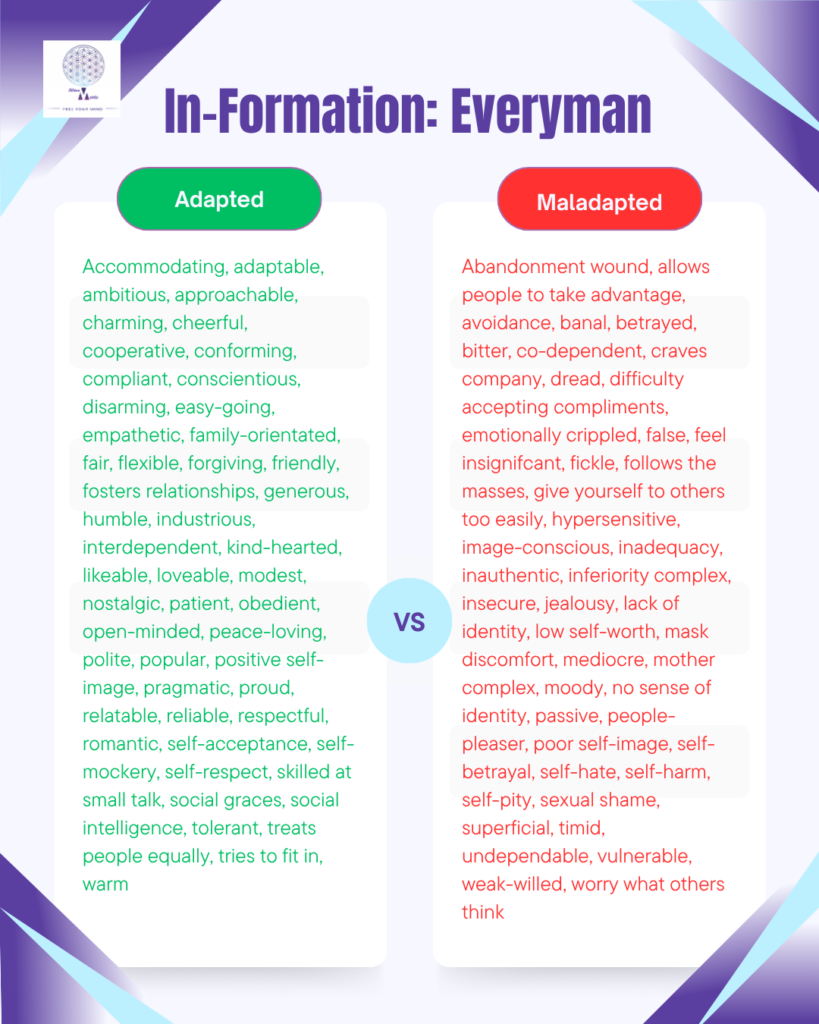
For example, a child may learn:
“Being angry makes you look bad.”
“Being assertive makes people reject me.”
“Crying is weak.”
“Wanting things for myself is selfish.”
The natural impulse doesn’t necessarily disappear. Instead, the person may learn to suppress awareness or expression of it.
Over time, the excluded quality may become associated with particular emotions, behaviours, memories or situations.
In Jungian terminology, material that has been separated from consciousness can become associated with a complex and exert an influence outside the ego’s conscious intentions. These influences can be identified with archetypes that are not fully developed.
Life Coaching Archetypes Model
The next time you experience dissociation at a higher grade than zoning out, such as feeling separated from your body or being in a glass chamber, ask yourself, why did that happen.
What was the trigger that prompted your brain to protect you from fear, pain or humiliation?
If you don’t find an answer, contact Rich on the contact form below to schedule an appointment. Alternatively, sign up for our Self-Development Program: Beyond The Comfort Zone.
This life coaching program is an introduction to the archetypes, where you will learn how to identify which archetypes are blocking you from moving forward and which archetypal qualities will transform your life.
If you feel it’s time to stop ignoring the parts of your personality that can help you get from where you are to where you want to be, get in touch by using the contact form below.
