

Carl Jung’s model of the mind offers one of the most fascinating ways of understanding why we think, feel and behave as we do.
The great Swiss psychoanalyst proposed the idea that the human psyche stores various energies, consists of multiple parts and has a dynamic structure which contains conscious and unconscious content.
You may think you make your own decisions, but when you examine your choices you may question whether you actually made that choice or whether some invisible force prompted you.
You may think you’re driving the car, but you’re actually being directed by whoever is reading the map.
Jung’s model of the mind illustrates how he believed the complex dynamics of the human psyche work. Most of the time, you identify with the thoughts and feelings that pop in and out of your head, and you may think you’re consciously aware that you want to do something.
You may think you are choosing what to eat, how to spend your time or how to behave.
Yet, you’re not always consciously aware of why you do something.
You suddenly get cravings for comfort food, have the urge to gamble, or check your social media account. You know you’re doing this, but you don’t fully understand why. What is the motivation?
One of the central discoveries in Jung’s model of the mind is that unconscious contents become autonomous. They have a life of their own and influence how you think, feel and behave; what you eat, what you do and how you react.
Most of the time, the subconscious is running the show.
You. Not You!
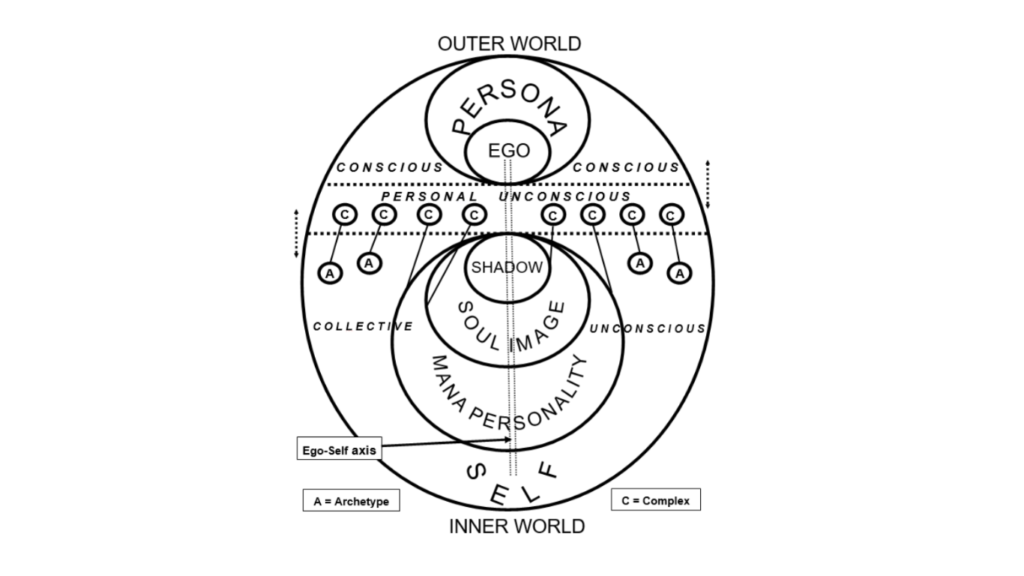
Jung’s model of the mind shows there are three layers of consciousness: The conscious mind, personal unconscious and the collective unconscious.
We’ll dive into each layer more deeply in a little while.
For now, keep in mind that the personal unconscious is a trouble-causer. This part of your personality is responsible for your childish and irrational behaviours. It’s also the driver behind addictions such as gambling, overeating and doomscrolling.
Jung called these psychologically organised patterns complexes. Get to know your complexes and why they exist, and you can take your first steps on the road to recovery.
“I wanted to express the fact that one or other basic instinct, or complex of ideas, will invariably concentrate upon itself the greatest sum of psychic energy and thus force the ego into its service. As a rule the ego is drawn into this focus of energy so powerfully that it identifies with it and thinks it desires and needs nothing further. In this way a craze develops, a monomania or possession, an acute one-sidedness which most seriously imperils the psychic equilibrium…. A man thinks that he wills and chooses, and does not notice that he is already possessed, that his interest has become the master, arrogating all power to itself.”
~ Carl Jung, CW7, Two Essays on Analytical Psychology
Does this description resonate with your experience of life?
Modern neuroscience shows that these ideas, desires and motivations are actually memories; information that is communicated between neurones in the central nervous system. The brain then makes a decision about how to think, feel and act based on the information that carries the most weight.
Let’s use addiction as an example.
You know you should not do something.
You tell yourself you’re not going to do it.
Then you do it anyway.
Did you know there are three voices in your head? If not, I recommend checking out the article on the Self-ego axis. This concept is useful for self-observation and self-knowledge.
Jung’s model of the mind also recognises that the unconscious contains universal patterns of human experience. He called this layer the collective unconscious and proposed it was “made up essentially of archetypes.” CW9 par 88 (1968)
Archetypes are essential to life. They play a central role in who you are.
It is, therefore, of the utmost importance that you understand how your archetypes influence your life. When they are split off and dismembered, they become autonomous complexes and cause trouble.
When they are developed, the archetypes provide you with the qualities you need to manage your life to the best of your ability.
Essentially, Jung’s model of the mind helps to explain why you sometimes feel a particular way for no particular reason that you’re aware of, why you sometimes act against your better judgment, and why you experience repetitive cycles and say “I can’t believe this has happened again!”
What is Jung’s Model of the Mind?
Jung divided the psyche into several interacting components. The most important for understanding his model are:
- The conscious mind
- The personal unconscious
- The collective unconscious
- The ego
- The Self
- The persona
- Complexes
- Archetypes
Understanding the differences is important because Jung’s psychology is often simplified into a collection of mysterious phrases about the unconscious. A casual reading of Jung can easily become confusing and misleading.
When you study Jung’s model of the mind and break down the most important components, you discover a deeper understanding of how your mind works.
In my opinion, Jung was way ahead of his time.
Let’s begin with the part of the psyche we know best.
Or think we know best.
What is the Ego in Jung’s Model of the Mind?
For Jung, the ego is the centre of consciousness and gives you a sense of personal identity — the feeling of being I.
The ego is the outward-looking part of the psyche. It associates with what you consciously know about yourself and the world around you. Your ego learns through experience; it develops knowledge and skills, forms opinions and responds to the environment in accordance with information stored in the central nervous system.
In essence, Jung’s description of the ego echoes what today’s neuroscientists say about memory.
“Learning, and its synaptic result, memory, play major roles in gluing a coherent personality together as one goes through life. Without learning and memory processes, personality would be merely an empty, impoverished expression of our genetic constitution. Learning allows us to transcend our genes..Salman Rushdie said, “Life teaches us who we are.” Our genes may bias the way we act, but the systems responsible for much of what we do and how we do it are shaped by learning.”
Joseph LeDoux, Synaptic Self, p.9 (2002)
However, the ego has limitations. It only knows what it has experienced in the past and thus navigates the world in relation to past experiences.
And as you know from your own experiences, how you navigate has mixed results. There are good time and bad times, joy and regret, pride and humiliation.
Yeeaaaah, we’ve all been there.
What is most interesting about Jung’s model of the mind is that the Swiss believed the ego is a relatively small part of the total personality. Much of what influences your experience of life exists outside the field of conscious awareness.
Essentially, we’re run on subconscious programs — the information that is communicated between neural networks in the brain.
Gerald Edelman, a Nobel Prize-winning biologist, proposed that external influences, like environmental stresses, play a crucial role in activating synapses by selecting groups of neurons, which strengthens their connections and corresponds to useful memories.
In other words, memory, a record of past events, determines how you react in the present. The patterns of neural activity are reminiscent of archetypes, another of Jung’s concepts that are hotly debated.
Archetypes are neural networks and can help you to understand why you behave in a particular way and still be completely wrong.

The ego is not deliberately letting you down. It simply doesn’t have access to all the archetypal qualities you need to be the best version of yourself.
Everything the ego does is a learned behaviour, a coping strategy to adapt to challenges you encounter in life. To respond to life effectively, the ego has to be trained.
And that can be difficult, because the ego does not like change.
Ever tried to change a habit or quit an addiction?
It’s fucking hard!
The One-Sided Ego
Jung identified the ego with a conscious attitude that has become one-sided.
You may know this expression by its modern term: habitual behaviour or habit.
The ego tends to identify with particular attitudes, beliefs and ways of behaving. Over time, these behaviours become familiar. They have predictable outcomes, which make you feel comfortable. So you do them more often.
But there are also situations which have predictable outcomes your ego is concerned about and would rather avoid. The avoidant ego uses strategies such as running away, becoming defensive or deflecting blame.
You have a negative experience or a conflict with someone and begin to think: This is just who I am.
But Jung’s model of the mind prompts a different question:
Is it really who you are — or is it simply the part of yourself you have developed most strongly?
For example, someone may identify as:
- The strong silent type
- A people-pleaser
- Wise beyond your years
- The class clown
- A drama queen
- A gossip
But similarly, you can be strict or soft, easy-going or stubborn, aggressive or assertive.
When the ego becomes too strongly identified with one particular attitude or behaviour, it excludes other aspects of the personality.
The strong silent type may be refusing to acknowledge that they are bored or feel vulnerable.
People-pleasers often don’t realise they are neglecting their emotional needs.
The class clown is seeking attention because he feels unseen and unheard.
When consciousness becomes too one-sided, Jung found that “over-emphasis upon the one function is synonymous with repression of the other.” CW6 pp.80-81, (1923)
Repressed parts of the personality are what cause all the problems in your life.

What is the Persona in Jung’s Model of the Mind
Jung used the term persona to describe the social face we present to the world. Each persona makes you act differently depending on where you are and who you are with.
You behave differently in a job interview than you do with your closest friends. The hard man in the street is soft and gentle in the home. The respected politician looking dapper in his clean suit is corrupt and dirty behind the scenes.
Jung described the persona as part of the personality that helps you to adapt to social expectations in different environments.
“Fundamentally, the persona is nothing real: it is a compromise between the individual and society as to what a man should appear to be. He takes a name, earns a title, exercises a function, he is this or that. In a certain sense, all this is real, yet in relation to the essential individuality of the person concerned it is only a secondary reality, a compromise formation, in making which others often have a greater share than he. The persona is a semblance, a two-dimensional reality.”
Carl Jung, CW7 Two Essays on Analytical Psychology, par 246 (1966)
The persona is how you want to appear, and not who you are or how you should be.
When the ego becomes completely identified with the persona, you live according to expectations rather than developing your own ideas, opinions or tastes. You neglect to develop any sense of individuality because you are afraid of being rejected.
Jung warned that identifying too strongly with the persona invites the archetypal qualities that have been repressed to surge up and create havoc. Jung wrote:
“The forces that burst out of the collective psyche have a confusing and blinding effect. One result of the dissolution of the persona is a release of involuntary fantasy, which is apparently nothing else than the specific activity of the collective psyche. This activity throws up contents whose existence one had never suspected before. But as the influence of the collective unconscious increases, so the conscious mind loses its power of leadership. Imperceptibly it becomes the led, while an unconscious and impersonal process gradually takes control. Thus, without noticing it, the conscious personality is pushed about like a figure on a chess-board by an invisible player. It is this player who decides the game of fate, not the conscious mind and its plans.”
~ Carl Jung, CW7 Two Essays on Analytical Psychology, par 251 (1966)
The persona may help you to adapt to society, but beyond that serves no useful purpose. It makes you superficial, inauthentic and submissive.
Psychological development requires you to discover and express the parts of your personality that fulfil the function you need to perform, not that you have been trained to perform like some circus monkey.
The Personal Unconscious
Beneath the conscious mind lies what Jung called the personal unconscious. This contains psychological material that belongs to the individual.
In Jung’s model of the mind, it is important to make the distinction between the personal unconscious and the collective unconscious. The personal unconscious organised by lived experience and is a collection of:
- Forgotten memories
- Repressed experiences
- Subliminal perceptions
- Painful ideas
- Emotional experiences
- Psychological contents that have not yet become conscious
“We have to distinguish between a personal unconscious and an impersonal or transpersonal unconscious… The personal unconscious contains lost memories, painful ideas that are repressed… subliminal perceptions… and finally, contents that are not yet ripe for consciousness.”
~ Carl Jung, CW7, Two Essays on Analytical Psychology
The personal unconscious is therefore not simply a storage cupboard containing embarrassing memories from secondary school. It’s a psychologically active collection of experiences which continue to influence your life even when you are not consciously thinking about them.
For example, you may be consciously blind to why you became anxious in a particular situation, yet still experience the anxiety whenever something similar occurs at a later date.
You have developed a habitual response without understanding the experience that originally contributed to it.
Habitual responses are records of your life, organised into neural networks and communicated between neurones.
This is one reason why changing habits can be so difficult.
Complexes: The Untrained Ego
Psychology today recognises over 30 complexes, a term originally coined by Jung. His most important observation was that complexes emerge as irrational and childish behaviours. These are the parts of your personality that are undeveloped and, consequently, have not adapted to your environment.
A complex is an indication that the ego is not fully developed with the archetypal qualities you need to cope with certain situations you encounter in your life.
“Whatever we persistently exclude from conscious training and adaptation necessarily remains in an untrained, undeveloped, infantile, or archaic condition, ranging from partial to complete unconsciousness. Hence, besides the motives of consciousness and reason, unconscious influences of a primitive character are always normally present in ample measure and disturb the intentions of consciousness. For it is by no means to be assumed that all those forms of activity latent in the psyche, which are suppressed or neglected by the individual, are thereby robbed of their specific energy.”
Carl Jung, Structure & Dynamics of the Psyche, p.170 (1970)
According to Jung’s model of the mind, a complex is an organised pattern of behaviour that associates with a common theme.
To paraphrase Calvin S. Hall and Vernon J. Nordby, Jung reasoned that associated groups of feelings, thoughts, and memories (complexes) are like separate little personalities within the total personality. They are autonomous, possess their own drive, and control thoughts and behaviour. [Calvin S. Hall and Vernon J. Nordby: A Primer of Jungian Psychology, p.36 (1973)]
Jung noticed that a complex has a particular emotional charge, which when activated, influences how you perceive and respond to the present using memories from the past.
This is why people sometimes react to situations in ways that appear disproportionate to the actual event. The present situation may only be the trigger, but the response is a reaction that has been programmed.
Moreover, complexes process perceptions and experiences outside of the ego’s conscious awareness. “Their ability to assimilate new associations gives them a strength and diversity that competes with the ego. They behave much as if they were personalities.” [Van Eenwyk, Archetypes & Strange Attractors: The Chaotic World of Symbols, pp.31-32 (1997)]
Jung described unconscious contents as autonomous energies that can take possession of the ego:
“Such content is an autonomous complex divorced from consciousness, leading a life of its own in the psychic non-ego and instantly projecting itself whenever it is constellated in any way — that is, whenever attracted by something analogous to it in the outside world.”
~ Carl Jung, CW12, Psychology and Alchemy
Complexes are particularly important to observe because they reveal which parts of the personality have not been given full expression and remain in an infantile state of psychological development.
You can also look at complexes as fragmented archetypes. In the Libera Mente archetypes model, we show how undeveloped archetypes surface as unhelpful, negative and destructive patterns of behaviours, attitudes and motivations.
Complexes and One-Sided Behaviour
Jung believed that when the conscious attitude is one-sided, the psyche develops a compensatory factor to self-regulate and restore balance. [Carl Jung, Man and His Symbols, p.79 (1964)]
Compensation can be crucial to personal growth. The archetypal shadow alternately destabilises and balances the Self-ego axis to facilitate psychological growth. Without tensions of opposites, growth is not possible. [Van Eenwyk, p.98 (1997)
Without introspection, a function of the Self, there is a danger of becoming stuck on a hamster wheel, chasing your tail.
John R. Van Eenwyk explains it like this:
“Since psychological growth is a function of the polarity of the psyche, conflict is inevitable. Archetypes, as Jung said, are bipolar. Before we can gain access to higher functioning, consciousness must open itself to the unconscious, which often feels chaotic and threatening. Resisting the chaos of the unconscious, however, effectively increases its influence. There is nothing worse than refusing to consider the possibility that something we find disturbing in the environment may actually be a projection of something in ourselves. When the unconscious cannot get our attention by speaking quietly, it shouts. We have nightmares, our children become unmanageable, our spouse unreasonable, our job boring. Then we feel even more threatened.”
~ John R. Van Eenwyk, Archetypes & Strange Attractors: The Chaotic World of Symbols, p.100 (1997)
Whilst complexes and neuroses, or “poor mental health” may appear to be obstacles preventing you from living the life you desire, they are actually indicators that can reveal how to live the life you deserve.
They contain information — In-Formation — about something the ego is missing from conscious awareness, a behaviour, attitude or motivation the ego has yet to learn.
For example, the people-pleaser who constantly takes care of everyone else may develop exhaustion, emotional distress and burnout.
Psychologically, the pattern reveals a one-sided attitude organised around the unconscious need to be useful, acknowledged and wanted. In seeking constant validation, you take care of others and neglect to take care of yourself.
Your sense of Self-worth is skewed because you feel like a nobody and need to prove your value.
This does not mean that every unhelpful or destructive behaviour is a secret message wrapped in a bow. Sometimes, you need to be angry, stand your ground or help others.
The patterns which reveal an imbalance are maladaptive, disproportionate reactions to the event.
The question to answer is: What is this complex trying to show me about the way I am living?

Jung’s Model of the Mind: Ego-Possession?
Jung sometimes used the term possession to describe how a complex gains excessive influence over the ego.
Before you start looking for holy water, Jung was not necessarily talking about literal demonic possession, although Satan is used as a symbolic personification of a habitual pattern that leads you into temptation.
Sound familiar.
The concept describes psychological possession in which the ego becomes so strongly identified with a particular complex, attitude or psychological pattern that they lose the capacity to reflect on it objectively.
Jung wrote:
“One of the most important changes of internal structure is the phenomenon of possession: some content, an idea or a part of the personality, obtains mastery of the individual for one reason or another… Possession can be formulated as the identity of the ego-personality with a complex.”
~ Carl Jung, CW9, The Archetypes and the Collective Unconscious
This is what happens when a coping strategy becomes a way of being, and you think it is perfectly normal and reasonable to be like that.
People-pleasing is a prime example.
You don’t simply help someone because you want to help; you do it because you feel guilty if you don’t.
Feeling-toned complexes determine how you interpret the world, how you respond to others and how you want to be perceived.
Complexes can help explain why intelligent people repeatedly make stupid decisions they later regret.

The Collective Unconscious
Jung’s most controversial concept was the collective unconscious.
Unlike the personal unconscious, the collective unconscious does not consist of material acquired through personal experience.
This deeper layer, Jung proposed, exists outside of your personal experiences, but provides you with archetypal qualities that are available to the whole of humanity.
“This deeper layer I call the collective unconscious. I have chosen the term ‘collective’ because this part of the unconscious is not individual but universal; in contrast to the personal psyche, it has contents and modes of behaviour that are more or less the same everywhere and in all individuals.”
~ Carl Jung, CW9, The Archetypes and the Collective Unconscious
The collective unconscious is the source of the archetypes, which Jung likened to instincts.
Sometimes you act on instinct and surprise yourself. In these moments, you have access to archetypal qualities because the central nervous system did not prevent In-Formation from accessing the decision-making faculties of the brain.
When these qualities are not directly accessible to consciousness, they have to be consciously integrated. Firstly, you need to identify the complex and the corresponding archetype. You can then work on developing the fragmented archetype by exposing yourself to relevant circumstances that enable you to learn behaviours, attitudes and motivations that the ego has not yet learned.
“The more experiences we have, the greater are the chances that the latent images will become manifested. That is why a rich environment and opportunities for education and learning are necessary for individuating (making conscious) all aspects of the collective unconscious.”
~ Calvin S. Hall and Vernon J. Nordby: A Primer of Jungian Psychology, p.41, (1973)
When you get to know your archetypal patterns that cause problems in your life, or make you feel unhappy, frustrated, and angry, you can identify ways to express the unrepressed parts of your personality.
What Are Archetypes?
Archetypes are identifiable patterns of thoughts, actions, and emotions which influence how you experience life. Each archetype serves a particular function and has its own set of attitudes and behaviours.
Each archetype, therefore, has specific qualities that are either helpful or unhelpful, positive or negative, constructive or destructive, depending on whether they are developed or undeveloped.
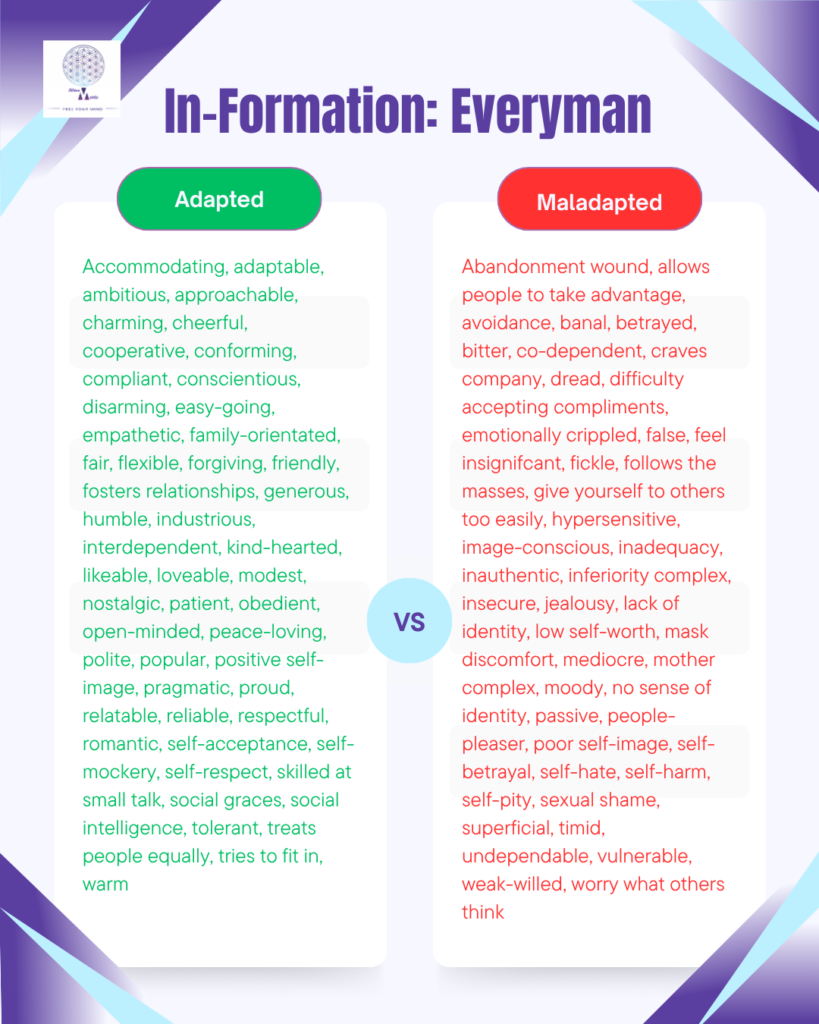
Archetypal qualities are cognitive functions, feelings, attitudes, motivations and behaviours, i.e; discernment, joy, love, criticism, frustration, manipulation etc.
James Hillman captured the importance of archetypes when he wrote: “These are the archetypes, the persons to whom we ultimately owe our personality.” [Hillman, Re-Visioning Psychology (1975)]
When the archetype is split off and repressed, the complex contains and archetypal dimension that is maladaptive.
For example, someone may have a complex organised around rejection and abandonment. The abandonment wounds belong to the individuals personal experience,’ and a coping strategy has been organised as a subconscious program.
Subconscious programs prompt you to perform specific actions to avoid the pain and suffering that rejection and abandonment cause you.
You have a problem because something happened to you in the past which needs to be resolved in the present otherwise the problem will continue to get worse.
A complex becomes a neurosis, a neurosis becomes a disease. A disease becomes a debilitating disease.
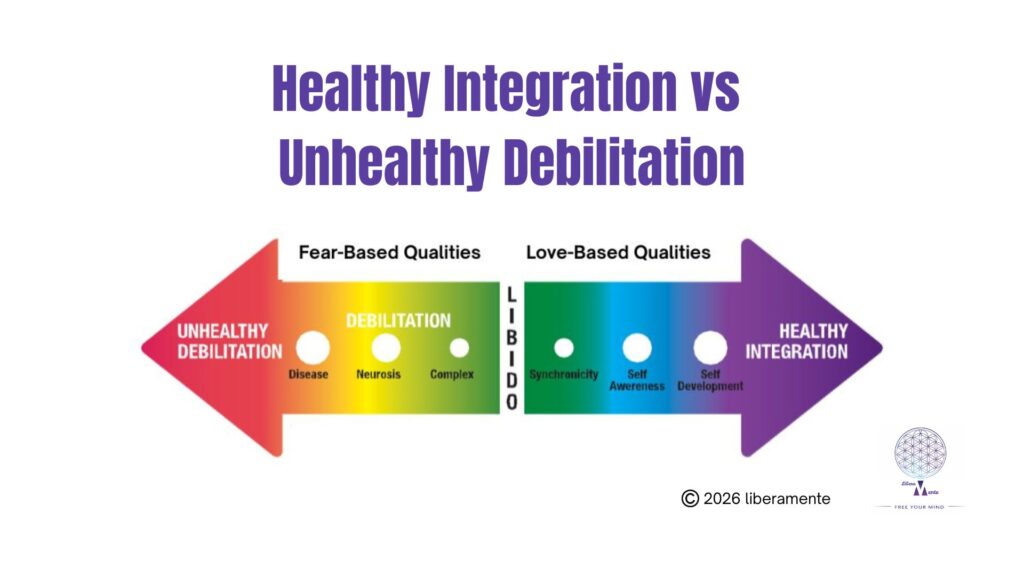
If you examine the chart above, you can see that if you identify a complex, you can move towards healthy integration by becoming aware of the complex.
Jung used the term libido to describe psychic energy; energy that is stored, processed and expressed by your central nervous system.
Consciously directing libido into the world enables you to develop fragmented archetypes in their fullness.
“The way to look at the difference between the active and passive poles in bipolar shadow system of the archetypes is to assess the Ego’s identification with or disidentification from the archetype in its fullness….In the case of identification, the result is Ego inflation, accompanied by fixation at infantile levels of development. In the case of extreme disidentification, the Ego experiences itself as deprived of access to the archetype.”
Robert Moore, Douglas Gillette, King, Warrior, Magician, Lover (1990)
Jung said the path to healing was to make unconscious content known to the conscious mind and to reconcile the tension of opposites. The individuation process, as Jung called it, involves integrating archetypal qualities the ego has not yet learned.
To help you with that, it helps to understand the relationship between the ego and the Self.
The Self: The Link To Wholeness
Jung’s concept of the Self represents the totality of the psyche. You might call it your Higher Self or the whole personality. If you take a look at Jung’s model of the mind, you can see that the Self belongs to the collective unconscious.
The collective unconscious, remember, is the world of the archetypes.
If the Self is the total psyche, the collective unconscious is all the archetypes in their fullness brought together into a unified whole. The goal of self-development is to integrate all the archetypal qualities you need to live a happy and fulfilling liing life into conscious awareness.
To train the ego.
It is the role of the Self to communicate with the ego and encourage it to learn new behaviours that are buried and forgotten.
To develop, the ego needs to be connected to the Self, and YOU need to listen to what the Self is telling the ego to do.
The American psychologist, Edward Edinger said the ego must be made subordinate to the Self:
“The Self is the ordering and unifying center of the total psyche (conscious and unconscious) just as the ego is the center of the seat of subjective identity whilst the Self is the seat of objective identity. The Self is thus the supreme psychic authority and subordinates the ego to it.”
~ Edward Edinger, Ego and Archetype
In Jung’s model of the mind, the letter A you see circled in the above diagram stands for archetypes. When they are split off, they become a complex identified by the letter C.
So, as mentioned above, a complex is a fragmented archetype that exists in an undeveloped state of maturity. When you integrate the repressed parts of the archetype, it matures into fullness and imbues you with peace, love and wisdom.
An archetype in its fullness enables you to navigate life more easily and with more joy in your heart.

Individuation: Becoming Whole
The central process in Jungian psychology is individuation, the process of becoming psychologically, emotionally and spiritually whole.
It involves becoming conscious of the parts of your personality that at some point were rejected, disowned and forgotten. You become whole by exposing the ego to new experiences and encountering challenges that enable you to adapt to life by learning how to overcome fear of the circumstances.
“We must restore the wholeness of the personality that was lost in the cultural ideals, or we will live in a state of dividedness that grows more and more painful throughout our evolution.”
Robert Johnson, Owning Your Own Shadow, p.9 (1991)
Ego development has four steps:
- Recognition of the complex in which you experience discomfort, chaos or destruction
- Understanding the nature of the complex and attaining self-awareness
- Adopting new ways of being where one discovers your passion, purpose and meaning to life
- Appreciation, gratitude and being presence in the moment
An underdeveloped ego lacks the psychological resources required to manage life effectively. Instead, the “shadow Self” becomes overly dependent on familiar coping mechanisms and attachments such as food, alcohol, drugs etc. Anything that provides stimulation, a source of comfort, relief, protection, or escapism.
Unless you learn the life skills your ego needs to manage life effectively, the ego remains in a weak state of conscious development. James Hillman described the weak ego as a neurotic ego. [Hillman, Re-Visioning Psychology (1975)
A weak ego is controlled by complexes and neuroses that lurk in the shadows of the unconscious. These types of behaviours cause challenges and conflicts in your life. Then comes disease.
“A man who is possessed by his shadow is always standing in his own light and falling into his own traps… In the long run luck is always against him, because he is living below his own level and at best only attains what does not suit him.”
~ Carl Jung, CW9, The Archetypes and the Collective Unconscious
So, What Does Jung’s Model of the Mind Tell Us?
Jung’s model of the psyche offers an insightful tool that can help you to understand yourself.
Observing complexes enables you to identify which archetypes are undeveloped and why. You can also identify how undeveloped archetypes create challenges, conflicts and problems, and which archetypal qualities you need to adopt to overcome challenges, conflicts and problems.
You can then determine how you will integrate archetypal qualities which enable you to grow.
The tools we provide in our life-coaching program Beyond The Comfort Zone, are designed to help you to develop archetypal qualities. The various exercises help guide you to self-awareness and make decisions with confidence.
When you get to know the archetypes, speak with them and ask them what they want and how you can help, you access the path to healing, personal growth and fulfilment.
Essentially, you need to train your brain. Find out how by getting to know your archetypes and identifying complexes in the Libera Mente Life Coaching program, Beyond The Comfort Zone.
