
Have you ever noticed the number three crops up a lot?
Three is said to be the magic number and appears in countless mythologies. You also find three built into religious and civic buildings, often a door and two windows or three doors.
Once you see that, you can’t unsee it.
You’ll find threes everywhere.
Three also has an association with the Law of Thermodynamics: the transformation of energy within a system; existing state, transmutation and reordering. In myth, the transformation of energy is symbolised by death and rebirth.
Given you’re entire constitution is energy, the laws of thermodynamics and the magic three also apply to you. Whenever you expand conscious awareness or de-evolve by repressing part of your personality, you’re affected by the laws of thermodynamics.
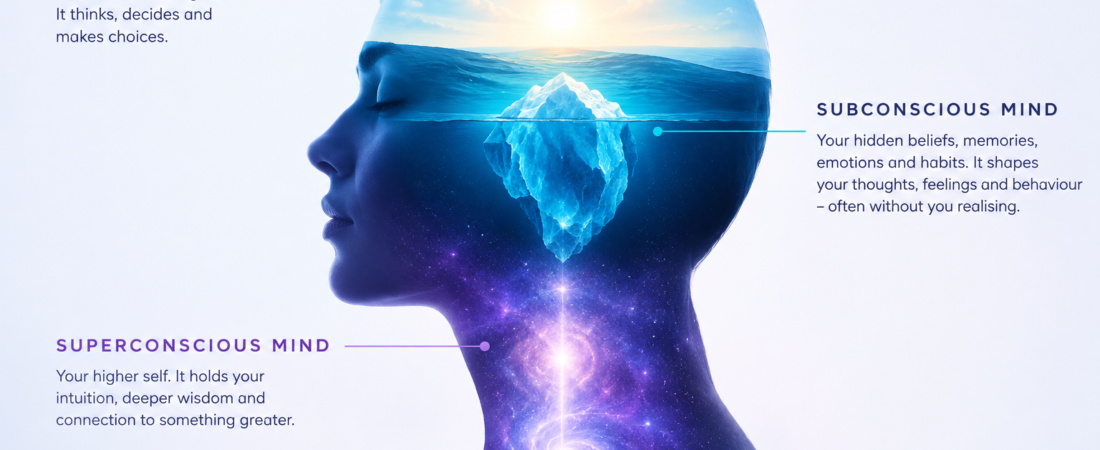
But the most important thing you need to know about the magic of the three is the interplay between the conscious mind, the subconscious mind and the Superconscious. The three minds have a direct relationship with energy flow and changes within a system.
All energy carries information, and information — In-Formation — influences your life.

Conscious Mind
The three minds are conscious awareness, the subconscious and the superconscious.
Knowing the difference between the three minds will help you to expand conscious awareness and not de-evolve by repressing parts of your personality that need to be given expression.
The conscious mind processes thoughts, actions and emotions that you are aware of in any given moment.
It decides what you do and when you do it.
However, the conscious mind can be possessed by maladaptive subconscious programs that the ego associates with. In this scenario, you may think you are consciously aware of what you’re doing, but you’re not aware of the motivation driving your behaviours.
In this scenario, the conscious mind has been possessed by an unconscious drive that is nothing more than a coping strategy.
Coping strategies tend to be maladaptive behaviours and attitudes because the conscious mind has not yet learned how to adapt to life. The central nervous system created a program that, at least for a while, enabled you to cope.
The conscious mind can also be hijacked by repressed archetypes in moments of madness when you say, “I don’t know what came over me, it’s so unlike me.”
What came over you was an archetype projecting onto the conscious mind to override the ego and make itself known. This is the Higher Self attempting to grab the attention of You — the observing I.
The conscious mind is also the seat of working memory, analytical thinking, decision-making, problem-solving, planning, and organising. But it is also the home of rumination, negative self-talk, judgment, criticism, and self-protective distortions such as avoidance, pre-meditated boastfulness or exaggeration.
Understanding the contents of the conscious mind involves becoming familiar with the three distinct voices in your head — the Self, the ego and You, the observing I, or Third I.
The three voices are all aspects of your personal consciousness, but they are running on different programs — different In-Formation. The ego is your actual self, the Self is your ideal self, and the Third I is your authentic self.
You become the whole “I am I” by integrating the repressed parts of your personality and integrating the archetypal qualities you need to adapt to life in ways that enable you to express your authentic self.
When you develop an archetype in its fullness, the Self and the ego live side by side in the conscious mind. The heart and the head are in balance and harmony.
Subconscious Mind: Complexes | Neuroses | Disease
Beneath the conscious mind lies the subconscious. This is where the majority of your actual psychological life takes place, whether you’re aware of it or not.
The subconscious mind is the vast storehouse of your past — every experience you’ve ever had: every lesson learned, every belief formed, every wound received.
This In-Formation is organised into patterns of thought, feeling, and behaviour that operate automatically below the threshold of conscious awareness. It shapes your responses to the world in either an adapted response or a maladapted reaction.
Ultimately, the subconscious mind develops habitual patterns which enable you to navigate familiar situations stress-free. Some habits are helpful, positive and constructive. Some habits are unhelpful, negative and destructive.
Subconscious programs that fall into the latter categories are driven by a complex, a pattern of traits centred around a specific theme; i.e disrespect, unworthiness, inadequacy. When the issue arises, your response will be determined by In-Formation that informs your brain how to respond to corresponding triggers.
For example, if you have an inferiority complex, the wounded part of your personality is programmed to believe “I am not good enough.” If someone criticises you, the response will be to protect your personal integrity with a coping strategy that is designed to protect your personal integrity for that particular situation; i.e anger, avoidance, violence.
How you respond is determined by the In-Formation that is communicated between neural networks, or in other words, which archetype has taken on the responsibility to protect your personal integrity in any given scenario.
For some people, the protective response will be to retaliate with a verbal or physical attack. Someone else will flee the scene and criticise themselves for being useless. Another program may prompt you to eat a full tub of ice cream as a means of self-soothing.
Subconscious reactions are not chosen consciously. They are biological responses created by neural networks. You simply find yourself thinking, feeling, or behaving in negative ways and wonder why you keep encountering the same problems. “I can’t believe this has happened again. It’s just my luck!”
To overcome subconscious programs, identify the ego. This voice tells you to do what you’ve always done. It is the voice that says “you need this,” “I’m not ready to quit,” and “I can’t do it.”
Yeah, that voice.

Superconscious: The World of Archetypes
The Superconscious is another layer of unconscious content which lies beneath the stratum of the subconscious. This layer corresponds to Carl Jung’s collective unconscious and gives you access to all the archetypal qualities available to mankind.
It is the superconscious mind that scientific and psychological institutions ignore, despite groundbreaking discoveries in quantum physics and epigenetics that explain how your personality is impacted by outside influences you have no direct experience of.
Archetypal qualities that belong to you, which exist in the Superconscious, are the parts of your personality that have been repressed; cut off, disowned, forgotten, dismembered.
When you encounter a challenge in the external world, it’s because the archetypal qualities you need to overcome the challenge are still in the Superconscious. They have not yet been expressed or integrated into the conscious mind.
In neurobiological terms, the qualities available to you have been rejected by the CNS.
Ordinarily, the Self ushers in the messages from the archetypes. The Self is the second voice you hear that says, “I know I need to change and this is what I need to do.” However, it doesn’t have an emotional charge like the program the ego feeds you.
Consequently, the Self is typically ignored in favour of the ego. This is where You — the third I — needs to mediate between the two voices and make a decision that restores balance and harmony.
Sometimes, you will receive a download from the Superconscious and reach a moment of self-realisation — an “aha” moment. This is the beginning of the path towards self-awareness. Self-awareness is the catalyst for healing once You give your Self the permission to express itself.
Other times, you will receive a data dump from the Superconscious. These downloads have too much information for the conscious mind to process in the moment. The information fades and takes your understanding with it.
To recapture the In-Formation downloaded in a data dump of “Divine Inspiration”, you need to start from the beginning and ask, “Then what?” to get to the next step. You will eventually become consciously aware of the In-Formation that flashed in your head and, after some consideration, you will be able to understand it.

The Superconscious also communicates through dreams, synchronicity, and peculiar experiences that move you unexpectedly. In these situations, you sense there is something you need to know, or you feel an inner-knowing that you are in the process of a transformation because you feel an energy shift in your body.
In-formation coming to you from the Superconscious is asking to be ex–pressed rather than being re-pressed. It is the source of your highest qualities that enable you to show up as the best version of yourself and lower stress levels.
Want to Know How To Tap Into Your Superconscious
The Superconscious is the world of the archetypes, patterns of your personality that enable you to adapt to life rather than merely coping with situations. You can learn more about the functions and behaviour patterns of the 12 archetypes in this article, but in short, the archetypes are your personality traits.
When the archetypes are developed, you adapt to life. When they are undeveloped or completely repressed, your behaviours are maladaptive. You may cope, but you struggle. Life gets harder the more you ignore undeveloped personalities.
Libera Mente has designed a life coaching program that explains what archetypes are, how they function, and how to recognise them when they are developed and when they are undeveloped.
Beyond The Comfort Zone not only helps you to understand why you do what you do, but also feel how you feel. There are powerful tools that enable you to transform energy and expand conscious awareness. You will learn how to tap into the Superconscious and integrate repressed parts of the personality. You will grow and thrive.
Transform your life today by signing up for the Libera Mente life coaching program and join a community of supportive and knowledgeable people who will help you to make decisions with confidence and improve your life.
