

Humans have needs; physical, psychological and emotional.
This is hardly a revelatory insight, but ask yourself this question and think about it for a moment: Do you know what your needs are?
Here’s the revelation: Most people don’t know what they need.
You might know what you want. But I’m prepared to wager that you don’t know what you need.
If you’re ready to take on that challenge, read on to learn about Maslow’s Hierarchy of Human Needs and discover what some of your needs might actually be.
Maslow’s Hierarchy of Human Needs
In 1943, the American psychologist Abraham Maslow promulgated the idea that there is a hierarchy of human needs. And those needs do not operate randomly — they follow a specific order of priority, each level providing the foundation for the next.
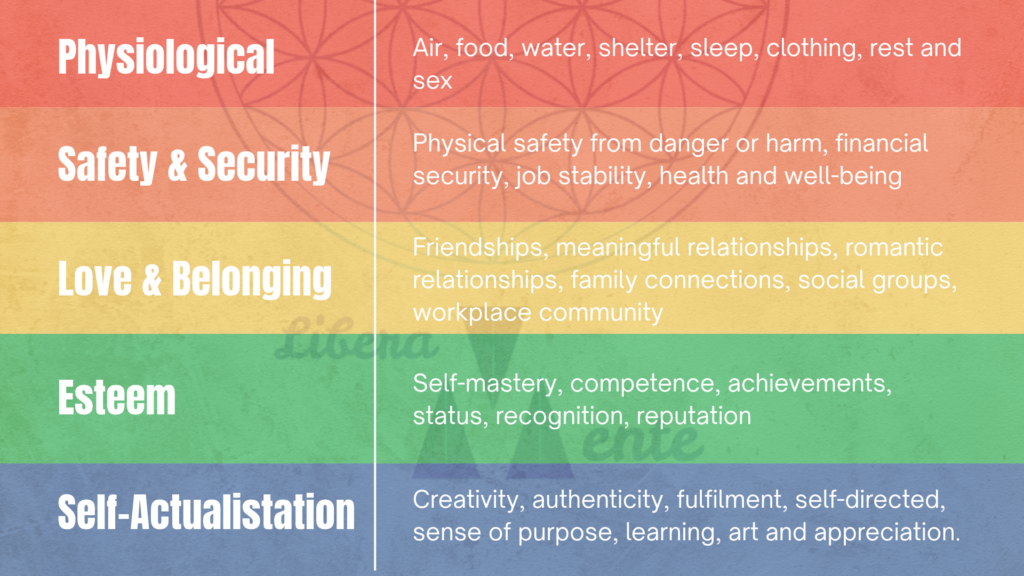
Maslow’s hierarchy of human needs is organised in a logical order ranging from the most fundamental biological requirements to the most elevated expressions of human potential. Human needs start with physiological needs, move into emotional needs, and then on to psychological needs.
Maslow’s logic is straightforward: you cannot meaningfully pursue your purpose in life if you don’t have access to food, water and safety because your focus is survival. You cannot build genuine self-esteem and meaningful relationships when emotional wounds make you feel vulnerable and unsafe around others.
Every level matters. This content explains what each one actually means — and what happens when it goes wrong.
“Since this inner nature is good or neutral rather than bad, it is best to bring it out and to encourage it rather than to suppress it. If it is permitted to guide our life, we grow healthy, fruitful, and happy.”
~ Abraham Maslow, Toward A Psychology Of Being
Level 1 — Physiological Needs: The Non-Negotiables
Before anything else — ambition, relationships, and personal growth — the body needs to function. Maslow placed physiological needs as the most basic human need because they are the most urgent and non-negotiable. When they are not met, nothing else matters. Without them, you die.
Physiological needs include: air, food, water, shelter, clothing, sleep, rest, and sex.
What happens when physiological needs go unmet in Maslow’s Hierarchy of Human Needs?
Think of the last time you tried to have a productive, emotionally intelligent conversation when you were exhausted or you hadn’t eaten.
The prefrontal cortex — responsible for rational thought, emotional regulation, and sound decision-making — is one of the first casualties of sleep deprivation and poor nutrition. You become irritable, reactive, and cognitively compromised in ways you frequently do not recognise until after the damage is done.
The person who snapped at their colleague at 3 pm on a Tuesday may not have been having a bad day. They might have been having a bad physiological baseline.
When physiological needs are met, the body is nourished, rested, and physically functional. The nervous system is not in crisis. You have the basic biological platform from which everything else becomes genuinely possible.
How to satisfy physiological needs:
- Eat nourishing, regular meals
- Create a living space that is clean, safe, and restorative
- Prioritise consistent sleep — the single most impactful thing you can do for cognitive and emotional function
- Move your body regularly, exercise at least 3 times a week
- Address medical concerns promptly
- Reduce chronic burden
Archetypes That Satisfy Physiological Needs
Archetypes play an influential role in our lives. Each archetype has specific functions and motivations. The archetypes responsible for satisfying physiological needs are the Caretaker, who takes care of your health and wellbeing, and the Hero whose primary motivation is to move.
Level 2 — Safety and Security Needs: The Foundation of Calm
Once the body is functioning, the nervous system turns its attention to safety. The human brain is extraordinarily sensitive to threats — whether real or perceived. The more emotional wounds you leave unchecked, the less safe you feel and the less equipped you are to manage life effectively.
The Swiss psychologist Carl Jung noted that when parts of your personality remain repressed, you are more likely to develop neurosis. Emotional wounds can prevent you from developing parts of your personality fostering the personal growth Maslow’s hierarchy of human needs illustrates is essential for enjoying a fulfilling life.
Thought-Provoking Quote
“There are vast masses of the population who, despite their notorious unconsciousness, never get anywhere near a neurosis. The few who are smitten by such a fate are really persons of the “higher” type who, for one reason or another, have remained too long on a primitive level.”
~ Carl Jung, CW7 Two Essays on Analytical Psychology, 2nd Ed, para 291 (1966)
In the absence of a sufficient sense of safety and security, the nervous system remains in a state of low-grade alert that makes everything seem worse. Life is harder in this state.
Safety and security needs include: physical safety, financial security, job stability, health and wellbeing, legal protection, emotional safety, and the sense of order and predictability that allows the mind to relax.
What happens when safety needs go unmet?
Consider the person carrying significant financial debt without a clear plan for addressing it. Every unexpected expense — a car repair, a medical bill, a broken appliance — activates the same threat response as a physical danger. The stress is chronic.
Cortisol levels are elevated.
The capacity for clear thinking, genuine connection, and creative problem-solving is systematically eroded by a nervous system that cannot distinguish between a sabre-toothed tiger and an overdue credit card bill. Both feel like survival.
Or consider the person in a relationship — professional or personal — where emotional safety is absent. Where criticism is unpredictable, conflict is unresolved, and the environment is fundamentally volatile.

No amount of personal development work done in that environment will fully take root — because the nervous system is spending most of its available resources on threat monitoring rather than genuine growth.
In this state of mind, the Emotional Brain hijacks the Thinking Brain and you’re unable to focus on achieving the higher goals in Maslow’s hierarchy of human needs.
When safety needs are met, you feel settled. This lays the foundation for genuine thinking, genuine connection, and genuine ambition. The absence of chronic threat is not a luxury. It is a prerequisite for everything above it on the hierarchy.
How to satisfy safety and security needs:
- Create a budget that gives you genuine visibility and control over your financial situation
- Address emotional wounds that make you feel isolated and alienated
- Establish routines that provide structure and predictability in daily life
- Establish clear, consistent boundaries in relationships — and maintain them
- Remove yourself from chronically toxic environments wherever possible
Archetypes That Satisfy Safety & Security Needs
Two archetypes that can satisfy safety and security needs are the Explorer and the Warrior. The motivation of the Explorer is to find your place in the world and to discover what you like and dislike. The Warrior is responsible for protecting and developing your personal integrity and standing up for your rights.

Level 3 — Love and Belonging Needs: The Ones We Pretend We Do Not Have
Most adults reach level 3 in Maslow’s hierarchy of human needs — and many of us pretend our needs are satisfied. In reality, adults who may appear functional are quietly struggling.
Humans are not designed for isolation. We evolved within social groups, shaped by millions of years of survival that depended on belonging to a tribe. Rejection, exclusion, and the absence of genuine connection are experienced neurologically as threats and activate the same neural pathways as pain.
Love hurts.
Love and belonging needs include: meaningful friendships, genuine romantic connection, family bonds, a sense of belonging to a group or community, and the experience of being genuinely accepted and respected in professional and social contexts.
What happens when love and belonging needs go unmet?
The person who tells themselves they do not need love, friendship or intimacy pretends they are demonstrating independence. Or that you’re an introvert and feel drained around people.
Whilst there is a grain of truth in the excuses we make, it is often the case that withdrawal from others is a strategy to protect a fragile emotional structure. Your safety and security needs are not being met, and consequently, your need for genuine connection is absent as well.
When you are unavailable or unprepared to risk feeling vulnerable, your inner voice defends your choices with a convincing narrative.
However, the consequences are significant and well-documented.
Chronic loneliness has been shown to increase health risks and lower lifespans. It elevates cortisol, suppresses immune function, disrupts sleep, and progressively erodes the neurological capacity for the very connection it’s depriving.
The longer the isolation, the more threatening genuine connection begins to feel. This maladaptive behaviour is triggered by an unresolved abandonment wound and becomes a self-defeating defence mechanism.
On the flip side, scientists at Harvard University have discovered that building meaningful relationships is the key to living a happy and fulfilling life.

What happens when Belonging needs go unmet
Belonging is felt when you’re seen, heard and valued. There is no potential threat to your emotional wellbeing or personal integrity so the parasympathetic nervous system is activated, and you can relax. The quality of emotional security that love and belonging provide is one of its primary structural components.
How to satisfy love and belonging needs:
- Invest in existing relationships with genuine presence rather than divided attention
- Join communities built around shared interests — not networking, but genuine interest
- Practice vulnerability by sharing something real about how you feel
- Repair conflicts rather than allowing them to fester or fall into estrangement
- Be authentic rather than seek approval from your friends — people-pleasing does not foster a sense of belonging
- Study human nature — understanding emotional needs improves your capacity to meet them in both directions
Archetypes That Satisfy Love & Belonging Needs
The Everyman and the Lover are the parts of your personality that specialise in relationships. The motivation of the Everyman is to connect with others and find a settled sense of belonging, whilst the Lover is responsible for developing meaningful relationships.
Level 4 — Esteem Needs: Feeling Genuinely Good About Yourself
Esteem is frequently misunderstood as the desire for admiration, status, and the approval of others. Maslow’s hierarchy of human needs is more precise than that.
It identifies two distinct dimensions of esteem: the intrinsic — a genuine sense of competence, capability, and self-respect that comes from taking personal pride in doing things well — and extrinsic value — the recognition, acknowledgement, and respect of others.
Both matter. But they are not equal. External esteem without internal esteem is a house built on unstable foundations. When you depend on external validation from others, your own perception of yourself is low. A poor self-image makes you perpetually vulnerable in social situations, and you may decide to choose withdrawal instead.
The latter option means your belonging needs cannot be fulfilled and thus your self-esteem needs have no chance of development either.
Maslow also identified cognitive and aesthetic dimensions of esteem: intellectual curiosity, creative pursuits, and appreciation of beauty that constitute some of the most genuine and most durable sources of genuine self-worth available.
Esteem needs include: genuine competence and mastery, meaningful achievement, recognition of genuine contribution, a reputation built on genuine character, and the intellectual and creative engagement that makes life feel genuinely worth living.
What happens when Esteem needs go unmet?
The person whose esteem is built primarily on external validation — status symbols, titles, the opinions of people they barely know — requires constant maintenance. Remove the external validation and the internal structure collapses because it was never genuinely there.
Consider the person who has achieved impressive things but whose inner critic refuses to register it as evidence of genuine competence. It’s not uncommon for qualified professionals to enter a workplace or job description and feel like an imposter.
The imposter complex is a signal that your esteem needs are not being met internally.
When esteem needs are met, you develop a grounded, non-defensive sense of self-worth. A quiet confidence that knows what you are capable of, takes pride in what you have contributed, and does not need constant acknowledgement or to boast about your achievements to remind everybody of your greatness.
How to satisfy esteem needs:
- Set and pursue genuinely challenging goals — not for the achievement alone, but for what the pursuit builds
- Develop new skills and areas of competence — mastery is one of the most reliable generators of genuine self-esteem
- Celebrate genuine progress rather than waiting for perfect outcomes
- Stop measuring yourself against others — comparison is esteem’s most reliable destroyer
- Practice genuine self-compassion alongside genuine self-challenge — both are necessary
- Seek feedback and own your development process rather than waiting for others to direct it
- Cultivate genuine independence — relying on your own judgment builds the self-trust that genuine esteem requires
Archetypes That Satisfy Esteem Needs
The Creator and the Sage are both fundamental to improving self-esteem. As the name suggests, the Creator is your capacity for creativity and is adept at learning new skills and solving problems. This archetype is also responsible for providing emotional body armour by preparing you for situations you can envisage.
The Sage is your inner wisdom and the capacity to reason and rationalise, which can help to nurture self-esteem. Critical thinking enables you to challenge negative beliefs about yourself. You can then replace unconscious perceptions with conscious, evidence-based recognition of maladaptive coping strategies that erode your sense of self-worth.

Level 5 — Self-Actualisation: Becoming What You Are Capable of Becoming
The pinnacle of Maslow’s hierarchy of human needs is Self-actualisation, his most famous concept.
Self-actualisation is not about becoming extraordinary in the conventional, headline-generating sense. You don’t have to achieve an exceptional feat or elevated levels of success to become self-actualised.
Maslow described it as becoming the most genuine version of yourself — living in authentic alignment with your values, recognising your limitations, and the capacity to enjoy each moment with very little effort.
Maslow described it simply: “To become everything one is capable of becoming.”
Self-actualisation needs include: mastery, creative excellence, authenticity, genuine fulfilment, a sense of purpose and meaning, and the aesthetic appreciation of beauty, art, and the richness of genuine human experience.
What happens when Self-actualisation needs go unmet?
The person who is living someone else’s definition of a successful life — the career chosen for status rather than a genuine fit, the relationship maintained for appearance rather than genuine connection, the daily existence shaped by obligation and convention rather than authentic value and genuine meaning — will eventually encounter the particular, unmistakable quality of existential dissatisfaction that no external achievement can resolve.
This is not depression in the clinical sense, though it can develop into it. It is the entirely predictable consequence of a genuinely capable human being living at significantly less than their genuine capacity — the Jonah Complex in its most quietly devastating everyday expression.
When self-actualisation needs are met, life has a quality of coherence.
You have a strong sense of who you are, what you do, and why you do it. Your job feels meaningful because it’s enjoyable and fulfilling.
Your relationships provide emotional nourishment because they are meaningful, even in difficult moments.
Daily existence has a quality. You feel alive, engaged, connected. You can be authentic without having to put on a performance, walk on eggshells or be careful what you say.
How to satisfy self-actualisation needs:
- Be genuinely curious about ideas, people, and the world
- Align daily habits with genuine values rather than inherited obligations
- Take on challenges that genuinely stretch your potential rather than remaining in the comfort of established competence
- Listen to your inner child and allow intuition to guide you
- Serve a cause larger than yourself
- Be authentic — speak what is actually true for you, rather than what is socially convenient
Archetypes That Satisfy Self-Actualisation Needs
When your psychological and emotional development has reached the self-actualisation stage, you are fulfilling your life’s purpose and, consequently, experience inner fulfilment. Because you have no intrinsic needs, you are motivated to serve others.
The archetypes which express this level are the Philanthropist and the Divine Child. The Philanthropist is selfless and endowed with unconditional love. The Divine Child is your inner guide and source of ideas, desires and aspirations. This energy informs you of what you need and, in its fullness, is the inner bliss you feel when you’re self-actualised.
Level 6 — Transcendence: Beyond the Self
Transcendence was added to Maslow’s hierarchy of human needs later in his career. Transcendence is the recognition that genuine fulfilment, at its highest expression, is not ultimately about the self at all.
Once the lower needs are genuinely met — once the body is nourished, safety is established, belonging is genuine, esteem is real, and self-actualisation is actively pursued — something shifts in the orientation of the personality.
The focus moves naturally, organically, and without the forced altruism of someone performing virtue — from personal fulfilment toward the service of something genuinely larger.
Transcendence is not religious in the institutional sense, though it can include that dimension. It is the experience of genuine connection to something beyond the individual self — humanity, nature, the divine in whatever form that concept genuinely holds meaning for you.
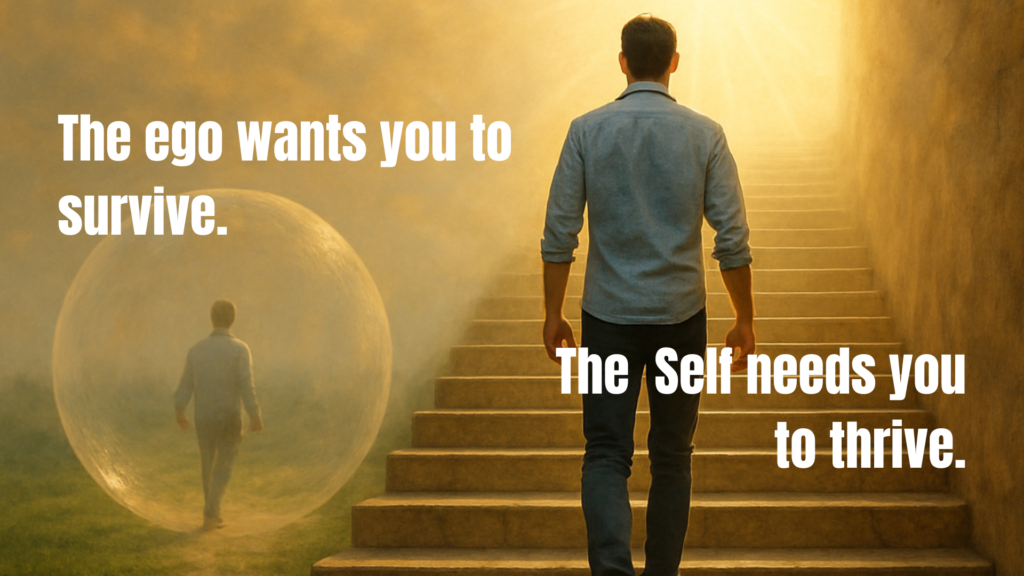
Whenever you feel inner peace, a sense of purpose, and unconditional love, you have transcended the ego.
Transcendence needs include: genuine altruism, peak experiences, unconditional love, bliss, ecstasis, genuine self-mastery, and the self-directed orientation of a person who has moved beyond the ego’s agenda without losing themselves in the process.
What happens when transcendence needs go unmet?
The person who has achieved significant external success but whose orientation remains fundamentally self-referential will eventually encounter the particular hollowness that genuine transcendence is the only available remedy for. You cannot think or achieve or acquire your way to this level. It requires doing the inner work.
When transcendence needs are met, the motivation for action shifts from what can I get, to what can I give.
You become selfless and serve others. You no longer need anything and become happy to give. This shift is not the death of the self. It is its completion — the fullest, most genuinely alive expression of a human being who has met their own needs sufficiently to make the needs of others genuinely, freely, and unconditionally their concern.
How to satisfy transcendence needs:
- Trust your inner knowing rather than waiting for external permission or direction
- Contribute anonymously — give where no recognition is possible or expected
- Help others reach their potential
- Seek awe in nature, in art, and in extraordinary experiences that take you beyond yourself
- Transcend emotional urges to do the right things in the right moments
Archetypes That Satisfy Self-Actualisation Needs
The two transcendent archetypes are the Trickster, which deflates the ego and shatters the illusions of perceived reality. The Ruler is responsible for aligning your behaviours with your intentions, which often involves fighting against emotional pulls and subconscious programs that make you believe false truths.
Want to Know More About The Archetypes Which Influence Your Life?
Libera Mente has developed an archetypes program that explains the functions, motivations and emotional wounds that influence your life. You will learn how to recognise which archetypes are developed, which are undeveloped, and how they can help you to improve all aspects of your life.
Each month, you will work with a different archetype and discover whether that part of your personality is helping you to manage your life effectively, or whether it is causing problems, conflicts and challenges. When an archetype is carrying an emotional wound, our archetypes model explains what the wound is, how it caused and how you can resolve it.
If you want to get from where you are to where you want to be faster, easier and more successfully, sign up for our self-development program today and transform your life by moving Beyond The Comfort Zone.
