

How the mind becomes matter is a debate worthy of discussion. Because the contents of your Mind eventually become your experience of reality.
Matter is your experience of physical reality. So too is your central nervous system (CNS) which includes the brain. It is the functionality of the CNS and your brain that determine how you think, feel and act.
This is important because the thoughts, emotions and actions that are processed by the brain contribute to your experience of reality.
Therefore, the information processed by your brain becomes matter.
Most people think that what happens to them is how they experience life.
That’s not the case.
How you react to what happens is how you experience life.
Once you know how your thoughts, emotions and actions create your experience of reality, you come to understand that life does not happen to you; it happens for you.
Life is a teacher. It shows you what you are doing wrong so that you can learn how to do it right.

There is a case to argue that the reason so many people create, chaos, disappointment and misery is that they are unaware of how they are creating their experience of reality.
That may sound like spiritual, mystical or philosophical hogwash, but this Truth is also what frontier sciences reveal: how you experience reality is something you actively create.
Yet no single scientific mode of enquiry shows how mind becomes matter.
The mind-matter dichotomy consists of an overlap of several disciplines: neuroscience, psychology, biology, quantum physics, and consciousness studies.
However, there is a single, overriding theme that appears throughout each of these disciplines.
Energy.
And all energy is guided by consciousness, or, as we will call it, In-Formation.
What is In-Formation?
Information, or In-Formation, influences how you think, feel and act. They are archetypal qualities which make you who you are and feel how you feel: anger, joy, pensive, active etc
Thoughts, emotions and actions are expressions of In-Formation. Every action we take is rooted in a thought, an emotion or both.
Sometimes the emotion takes control of you before you have time to think. In the words of neuroscientists, the amygdala (Emotional Brain) hijacks the neocortex (Thinking Brain). The “amygdala can be informed about something scary before the cortex has a clue.” [1]
The Emotional Brain is an unconscious activity which compels you into action unless you are able to control it. We’ve all had “moments of madness” and emotional overwhelm that incapacitate the ability to think.
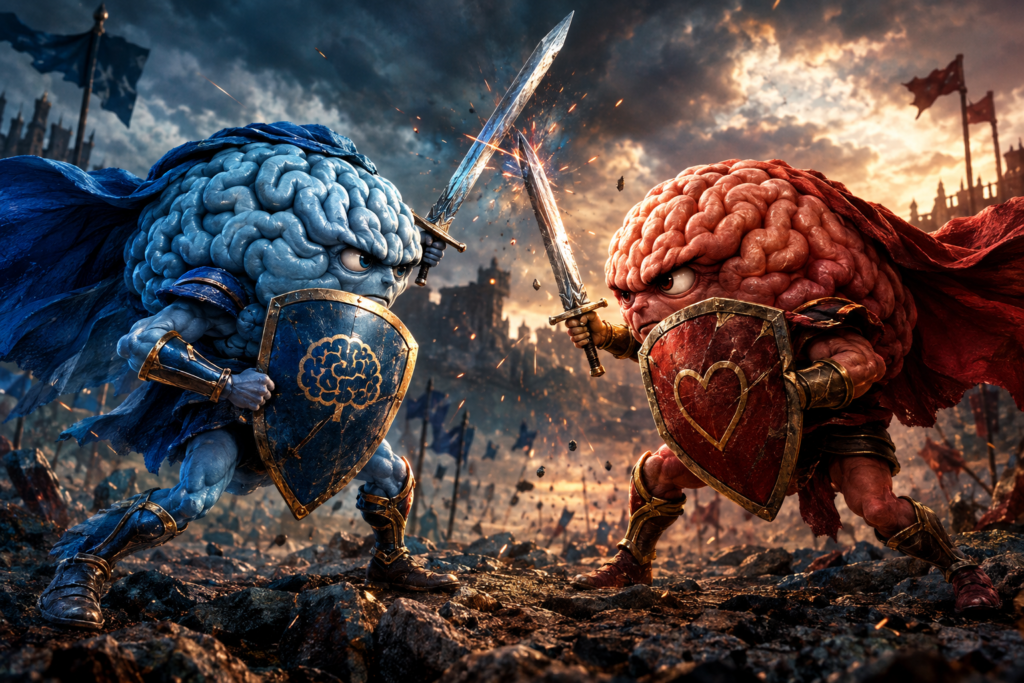
This is one example of how mind becomes matter. How you react or respond to the environment creates your experience of reality.
And the archetypes play a significant role here.
To learn more about archetypes, refer to the article: What Are Archetypes?
Archetypal qualities are behaviours, attitudes and motivations — character traits belonging to all mankind. Carl Jung, one of the leading voices of depth psychology, noted that archetypes play an influential role in how you experience reality.
Jung noted that archetypes are “impressions of ever-repeated typical experiences” [2] and seize hold of the whole personality.
“The archetypes usually appear in projection; and, because projections are unconscious, they appear on persons in the immediate environment, mostly in the form of abnormal over- or undervaluations which provoke misunderstandings, quarrels, fanaticisms, and follies of every description.”
~ Carl Jung, CW7 Two Essays on Analytical Psychology, 2nd Ed, para 152 (1966)
Both conscious thought and unconscious projections are, by and large, the result of In-Formation stored in the central nervous system. Information, energy, is transmitted by electrical impulses travelling across neural networks in the brain and body.
In his best-selling book, the American psychologist Joseph Murphy warned to watch your thoughts. In particular, observe thoughts you believe as concrete facts because what you hold to be true is “brought into your world as a reality.” [3]
“All your experiences and everything that enters into your life depend upon the nature of the mental building blocks that you use in the construction of your mental home. If your blueprint is full of mental patterns of fear, worry, anxiety or lack, and if you are despondent, doubtful, and cynical, then the quality of the mental materials you are installing in your mind will come forth as more toil, care, tension, anxiety, and limitation of all kinds.” [4]
~ Dr Joseph Murphy, The Power of Your Subconscious Mind, p.73 (1963)
The mental building blocks are memories — In-Formation communicated between neural networks.
Each time you have an experience, your central nervous system (CNS) encodes it, processes the input and stores it as memory.
Joseph LeDoux, an influential neuroscientist, explains that the brain is plastic and stores learned behaviours in networks that function outside of conscious awareness.
“Learning, and its synaptic result, memory, play major roles in gluing a coherent personality together as one goes through life. Without learning and memory processes, personality would be merely an empty, impoverished expression of our genetic constitution. Learning allows us to transcend our genes…Salman Rushdie said, “Life teaches us who we are.” Our genes may bias the way we act, but the systems responsible for much of what we do and how we do it are shaped by learning.” [5]
~ Joseph LeDoux, Synaptic Self, p.9 (2002)
The quality of the In-Formation that is communicated between neural networks shapes your perception and determines how you react.
But, as we shall see, In-Formation, or a lack thereof, also determines what you attract.
In short, the In-Formation you transmute from your conscious and subconscious minds becomes your experience of reality.
The big question to ask and to answer is:
If your subconscious habitually makes most of your decisions, but the conscious mind can help to program your subconscious, which mind do you want in charge?
Obviously, it’s the conscious mind.
What Is Consciousness?
Scientists claim that consciousness is the “hard problem.”
It’s not that hard.
Mainstream science just makes it hard because it can’t be measured and analysed as data.
If we are to consider what consciousness is without the irrational argument of measuring data, it is quite simply In-Formation that you are consciously aware of and unconscious content that you are not aware of.
Sometimes unconscious content drives your decision-making. Sometimes, you think things through with your conscious mind and make a decision after deliberating.
Other times, you think you are making a conscious choice, but your unconscious is actually doing the choosing. These are habitual behaviours that you are consciously aware of doing, but you don’t know why you’re doing it.
For example, why do you keep eating when you’re full?
Why do you feel the need to drink alcohol or take drugs even when your conscious mind says you know you shouldn’t?
Why do you wake up feeling frustrated, irritable or lost?
The unconscious is clearly at play here.
Yet, the general, consciousness among institutions is that consciousness is an: “Internal knowledge or conviction; the state or fact of being mentally conscious or aware of something”. [6]
Consciousness clearly plays a lead role in how we view the world, interpret reality and interact with our environment.

But the description given by institutions does not tell the whole story. It ignores the unconscious, which is established in psychology as having a major influence on decision-making and, therefore, influences how you experience life.
Neuroscience reached the same conclusion as psychologists.
Actually, neuroscience showed what depth psychologists like Sigmund Freud, Carl Jung and Albert Adler were saying over 100 years ago.
Freud describes the unconscious is a repository of repressed desires, fears, and unresolved conflicts that covertly drive thoughts, emotions, and behaviour.
But the unconscious does not only influence how you experience reality through thoughts, actions and behaviours. It is a store of energy — and all energy transforms.
When unconscious content becomes stagnant, it causes dis-ease, or disease.
Disease comes by way of repression — ego resistance.
Conscious Mind vs Unconscious Mind
To fully understand how the human psychobiological system — or central nervous system — creates your experience of reality, it’s pertinent to understand the difference between the conscious mind and the unconscious, or subconscious mind.
N.B. Psychologists used to use the terms unconscious and subconscious interchangeably. It is now called non-conscious. But ignores the superconscious!
We shall call them subconscious programs.
The conscious mind is the neocortex. Its key functions are conscious thinking; reason, rationality, logic, discrimination, and processing.
Consciousness as a whole has a much broader meaning. The unconscious has to be included — because our conscious awareness is influenced by our personal unconscious (projections) and the collective unconscious (possession).
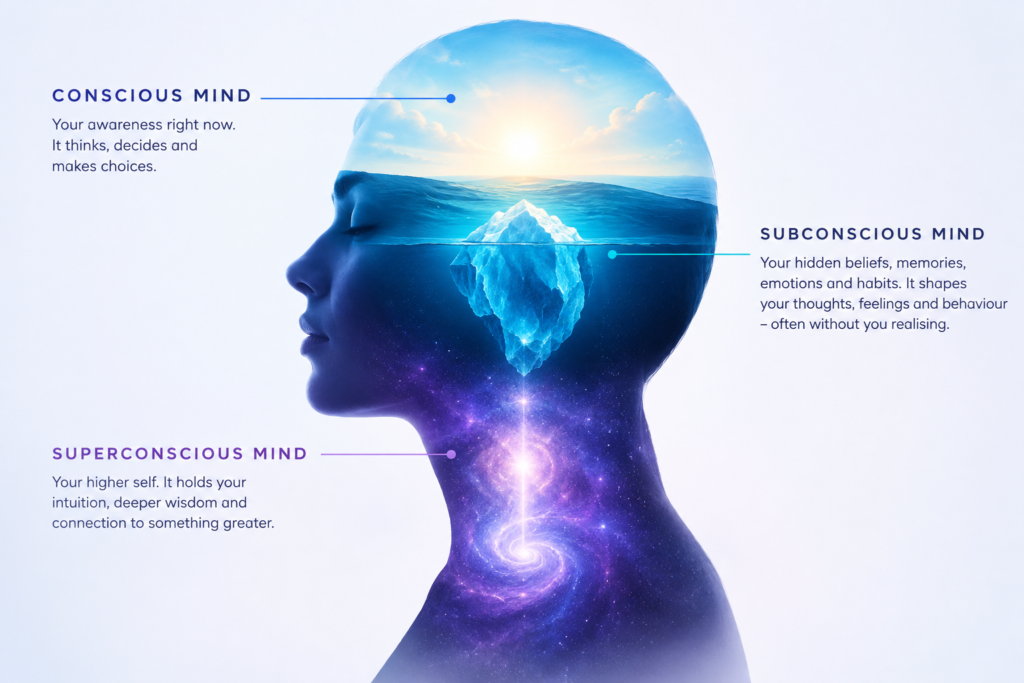
One of the key ways in which consciousness shapes our worldview is by influencing our beliefs and attitudes and how we respond. That’s determined by the information we receive from our environment.
For example, someone with a strong sense of self-awareness may be more open-minded and receptive to new ideas. On the other hand, someone with concrete beliefs is generally closed off to outside opinion and more inclined to resist alternative ideas or new experiences.
Where the closed-minded type has strong opinions and is unconscious of biases and prejudices, new information is typically dismissed out of hand.
This type is one-sided. Unbalanced.
Moreover, the one-sided personality is less self-aware and more likely to be prompted by habitual behaviours stored as subconscious programs in the central nervous system.
And it’s fairly well established that the subconscious mind makes a decision before the conscious mind.
That being the case, it would be beneficial to program your subconscious with decisions that you would consciously choose.
Ironically, the one-sided individual who is stubborn, pig-headed and obstinate, may not actually be making their own choices.
It’s the CNS.
In-Formation is passed between neural networks via synapses. At the end of each synapse is a “synaptic cleft” which transmits electrical impulses. The information being transmitted is either accepted or rejected.
You can read more about this in the article: How The Nervous Works: How Your Environment Programs Behaviour
It’s a fairly established fact now that episodes you experienced in childhood laid the foundations of a subconscious program you operate as an adult. Sometimes, the Thinking Brain (neocortex) will win the battle over the Emotional Brain (limbic system) and other time the Emotional Brain wins.
You know this from personal experience.
“Childhood adversity accelerates amygdaloid maturation in a particular way. Normally, around adolescence the frontal cortex gains the ability to inhibit the amygdala, saying “I wouldn’t do this if I were you.” But after childhood adversity, the amygdala develops the ability to inhibit the frontal cortex, saying, “I’m doing this and just try to stop me.” [7]
~ Robert Sapolsky, Behave: The Biology of Humans at Our Best and Worst (2017)
Sigmund Freud called this process repression. When information taken from the environment is “repressed”, some part of your nature is “cut off” from conscious awareness.
This In-Formation doesn’t make it into the memory banks.
This means that repressed content in a subconscious program continues to have an influence on your behaviour outside of conscious awareness.
It is these thoughts, behaviours and emotions which need to be observed (another word for measured). Doing so resolves the “hard problem” posed by academia.
Observing unconscious content can be tricky — unless you know what you are looking for.
It becomes easy once you know that unconscious content typically emerges as maladaptive behaviours, childish and irrational reactions Jung called ‘complexes.’
- Angry outbursts
- Irrational fear
- Anxiety
- Emotional overwhelm
- Avoidance
- Withdrawal
- Procrastination
- Perfectionism
The list goes on.
Complexes are “split off” or fragmented archetypes. One could say they are undeveloped and immature parts of the personality.
What’s more, Jung pointed out, repressed archetypes need to be given expression because energy transforms. The Swiss showed that complexes become neuroses and neuroses become disease.
A growing body of evidence today confirms this. But the knowledge has been around for around a century (if not more).
According to the physician and psychoanalyst Wilhelm Reich, amongst others, repressed consciousness takes on a life of its own and creates conflict with the psychobiological system.
“According to the conception, just about all physical illnesses resulted from unconscious desires or anxieties. A person became sick with cancer “in order to…” Another person destroyed himself through tuberculosis because he unconsciously wished to. In the psychoanalytic clinic there is a profusion of data which confirms this view. The data was incontestable, but the professional community rebelled against it.” [8]
~ Wilhelm Reich, The Function of the Orgasm (1927)
Reich also noted that there was a higher number of physical and mental illnesses in “patients where part of the personality had failed to go along with the total development toward adulthood.” [9]
Mental patients, Reich said, were inundated by unconscious content and outer reality was lost. This is typified by modern man who deploys “characterological armoring against his inner nature and against social misery.” [10]
By maintaining societal norms and wanting to keep up the appearance of how we want others to see us, we suppress and repress instincts.
This same observation compelled Jung to note:
“Hence every man is, in a certain sense, unconsciously a worse man when he is in society than when acting alone.” [11]
~ Carl Jung, CW7 Two Essays on Analytical Psychology
Individuals who develop negative attitudes toward life increase the risk of anxiety and depression. At the core of neuroticism is a fear of independence and a freedom-oriented way of life.
Anxiety is a function that operates counter to the expansion of pleasure. Making the desire conscious paves the way to the cure [12] and to manifestation.
How Mind Becomes Matter
Neuroscience and psychology go a long way toward explaining how the contents of the mind translate into lived experience.
But psychobiology does not paint the entire landscape.
Consciousness has an underlying mystery. Somewhere and somehow, your personal consciousness intertwines with the fabric of reality.
Consciousness still holds a deep, unresolved mystery — somewhere, somehow, your personal awareness intertwines with the very fabric of reality itself.
The familiar phrase “everything happens for a reason” only really holds up when you examine the conscious and unconscious patterns behind an experience. And even then, some things remain genuinely unexplainable.
Quantum physics sheds some light on how mind becomes matter, but at the same time, makes the conversation more problematic.
Yet it is a conversation that need to be discussed.
Some quantum physicists propose that information is the fundamental building block of reality. “In-formation,” writes Ervin Lazlo, “links all things in the universe. [13] [?] Ervin Laszlo, Science and the Akashic Field (2004)
David Bohm, a colleague of Einstein’s and one of the most significant theoretical scientists of the last century, developed a closely related idea through his pilot-wave theory. He believed the mechanical nature of matter is only possible by active information.
In this framework, a particle’s motion cannot be driven by mechanical force alone — it’s guided by information embedded in a quantum field. This information actively shapes the particle’s behaviour.
His ideas can be likened to a radar signal that guides a ship on autopilot without supplying any of the ship’s actual propulsion.
This concept became the seed for Bohm’s wider theory of the implicate order, in which information is understood as being inseparable from wholeness. His conclusions coincide with ancient ideas of unity and duality.
In the Tao Te Ching, for example, it is written: “The Tao generates the one, the one generates the two, the two generate the three, the three generate the myriad things.” [14]
Physicist Amit Goswami takes the implication a step further, arguing that consciousness — not matter — is the true ground of existence:
“Everything (including matter) exists in and is manipulated from consciousness… the reality of matter is secondary to that of consciousness, which is the ground of all being.” [15]
~ Amit Goswami, The Self-Aware Universe, p.10 Kindle Loc 387 (1995)
The question then is, where does consciousness begin if it ends in matter?
It has to start in the mind.
Ancient doctrines say as much.
Strings and Mirrors
Modern scientists describe how mind becomes matter through a phenomenon called quantum entanglement. Physicists liken the communication to two pieces of string with cups tied to the end, like you might have done as a kid.
Or telephones. They call it string theory, presumably because it sounds better than telephone theory.
Ancient sages described the same phenomenon using the image of a mirror.
The 3rd-century Neoplatonist philosopher Plotinus described how the human “soul” (subconscious) functions as a mirror reflecting the “Divine Soul” (wholeness). The intellect (Nous) and the One Divine Source occupy the same space, but the One is whole and the intellect is fragmented.
“And how do we possess the Divinity? In that the Divinity is contained in the Intellectual-Principle and Authentic-Existence; and We come third in order after these two, for the We is constituted by a union of the supreme, the undivided Soul – we read- and that Soul which is divided among [living] bodies. For, note, we inevitably think of the Soul, though one undivided in the All, as being present to bodies in division: in so far as any bodies are Animates, the Soul has given itself to each of the separate material masses; or rather it appears to be present in the bodies by the fact that it shines into them: it makes them living beings not by merging into body but by giving forth, without any change in itself, images or likenesses of itself like one face caught by many mirrors.”
~ Plotinus, Ennead I.1.8
In the Kabbalistic Tree of Life, for example, the creative process begins in the first World, Atziluth. This is the world of the archetypes — the energies that impact life. For the Kabbalists, the world of the archetypes is the inmost principle of man and the active principle of all things.
Seen this way, your thoughts — which are both informational and energetic in nature — don’t merely reflect your reality. They help shape it.
The occultist J.F.C. Fuller explains:
“Our consciousness is the mirror which catches the rays of Divine Thought; therefore all thoughts are images of God’s Thought, and the more spiritual, alive, our consciousness becomes, the more perfect are these images, which are not illusions but symbols of Reality.” [16]
~ J.F.C. Fuller, The Wisdom of the Qabalah
If all thoughts are images of God’s thought, God is consciousness, omniscient, omnipresent and omnipotent.
The ancient view finds support in one of quantum theory’s strangest findings: that observation itself affects outcome, as demonstrated in the famous double-slit experiment. Energy exists as wave-particles, inactive, and at one with the field.
Until they are observed or measured.
Goswami explains that “every event of measurement is potentially creative and may open new possibilities…The wave and the particle natures of the electron are not dualistic… they are complementary properties. [17]
Einstein discovered that energy (waves and particles) exists in discrete bundles of matter, force, and light; physicists call them ‘potentia’. These bundles can exist in multiple states simultaneously, but do not carry any fixed characteristics.
Thus, wave-particles exist as potential.
When the wave-particle is observed, it collapses and becomes a single-state particle.
In simple terms, you have a thought, send out its vibration and frequency which is responded to by potentia with the corresponding frequency.
Your thought are beamed into the universe, the collective unconscious which Jung called the World of the Archetypes. Accept in the collective unconscious, the archetypes are whole.
In your mind, they are fragmented. Dismembered.
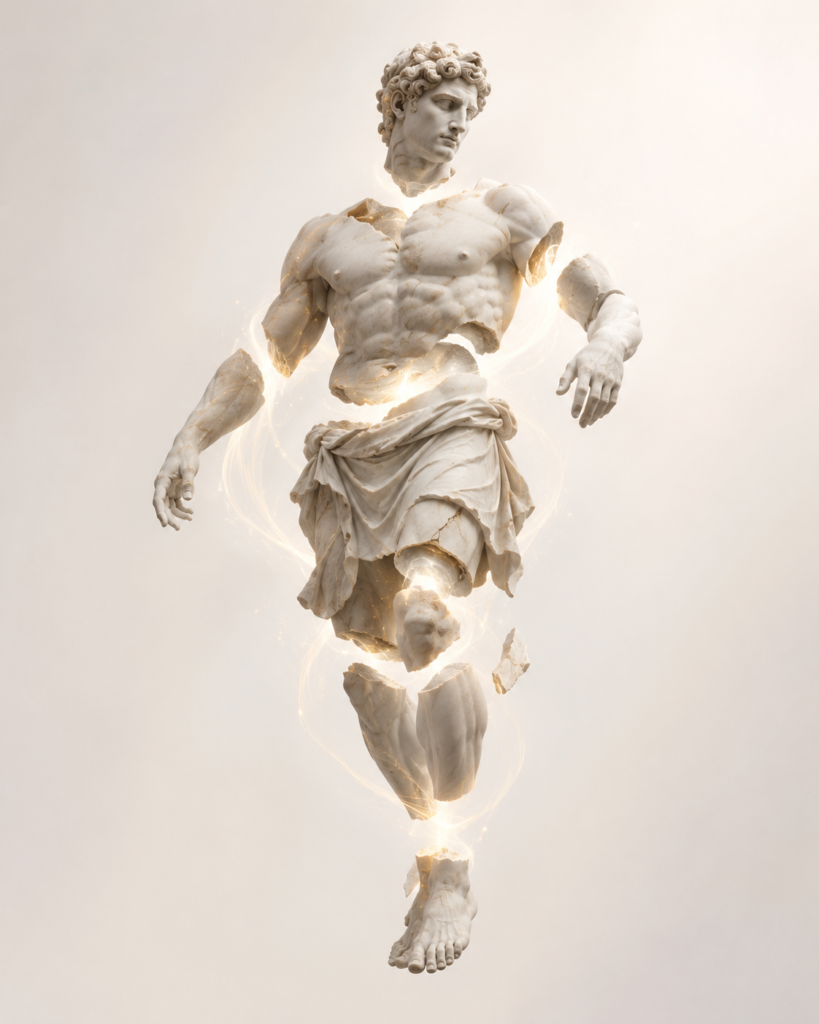
For you to become whole, the dismembered parts of your personality must be re-membered.
However, archetypes can only be brought into fullness when you integrate all the In-Formation they possess into the conscious personality. Archetypes have to be given expression, but can only do that when something in your environment gives them the opportunity to be expressed in a way that can be integrative.
And that takes conscious awareness; otherwise, you don’t transcend the ego and continue to run on a subconscious program.
Thus the observer is never fully separate from what’s being observed. Moreover, intention appears to influence the field.
How many times have you faced a challenge and later realised that you have to encounter the problems you faced to get to where you wanted to be.
You can manifest the life you want to create if you don’t have the archetypal qualities to attain your goal.
How mind becomes matter id determined by the information stored by your CNS and communicated by neural networks.
The double-slit experiment illustrates how bundles of energy aren’t isolated from one another, but are interlinked. Einstein described entangled particles as “spooky action at a distance.”
In the setup, physicists fired electrons and individual photons — actual particles of matter and light — through two slit cut out of an obstacle. When left unobserved, the particles produced an interference pattern, behaving exactly as the experimenters expected wave particles to behave.
However, when a measuring device was introduced to detect which slit a particle passed through, the “spooky” thing happened — the particles behaved like a single particle. The interference pattern vanished.
The implication is startling: the simple act of observation appears to influence how energy behaves and what outcome results. Thought and attention, it seems, influence the field itself.

Bell’s Inequality and Entanglement
Another experiment that weighs in on the double-slit conundrum was devised by physicist John Stewart Bell in 1964.
Bell wanted to test whether undiscovered “hidden variables” might explain quantum entanglement through ordinary, local physics. The result, which has become known as Bell’s Inequality, presents a mathematical boundary defining the limits of what any local hidden-variable theory could predict.
If real-world measurements of entangled particles violated that inequality, it would mean two things: no local hidden variables could account for entanglement, and nonlocal effects are genuinely real — meaning a change in one particle instantly affects its entangled partner, regardless of the distance separating them.
Beginning in the 1970s, and most decisively with Alain Aspect’s experiments in 1981–82, physicists tested Bell’s Inequality directly, using entangled photons in the lab.
The result, replicated again and again: Bell’s Inequality was violated.
In other words, entangled particles really are mysteriously linked — a change in one correlates instantly with a change in the other.
As Ervin Laszlo describes it like this:
“Until they are observed or measured, quanta have no definite characteristics but instead exist simultaneously in several states at the same time. These states are not “real” but “virtual” — they are the states the quanta can assume when they are observed or measured. It is as if the observer, or the measuring instrument, fishes the quanta out of a sea of possibilities.” [18]
~ Ervin Laszlo, Science and the Akashic Field, (2004)
Let’s imagine it this way:
Thoughts are not merely products of electrical impulses within the brain. They are vibrations that ripple out into the universe. Every question you ask seeking an answer sends out a frequency, a vibration that resonates beyond the limits of space and time.
When this vibration interacts with the wave-particles and excites a corresponding electron, the wave-particle collapses, and a response is sent back to your brain — a bit like a radio signal.
When you know this, it brings a whole new meaning to a fairly well-known verse of the Bible. Matthew 7.7-8 says:
“Ask, and it shall be given you; seek, and ye shall find; knock, and it shall be opened unto you: For every one that asketh receiveth; and he that seeketh findeth; and to him that knocketh it shall be opened.”
Matthew 7.7-8
Just saying.
When new information is received, it is processed and translated by your brain into a coherent thought. Sometimes it will appear as divine inspiration when the information flashes into your mind, and for a second you understand everything.
But then the thought evaporates and you’re left scrambling to retrieve it.
Other times, we might presume, the new In-Formation surfaces in the conscious mind, but is mingled with other information and does not emerge as a clear and coherent thought. It is cloudy.
Other times, the thought appears, but is immediately counteracted by an opposing thought — one you are familiar with.
You will know those voices:
New information. “I need to quit smoking.” [Insert your addiction here]
Old information: “Just have one more. We’ll stop tomorrow.”
In reality, In-Formation is a reflection of an interaction between your conscious mind and the quantum fabric of the cosmos which we call the Superconscious, or collective consciousness, the abode of the archetypes.
Mind Becomes Matter: Systems Theory
Back to David Bohm. (And Jung).
In his book, Wholeness and the Implicate Order, Bohm states the case for identifying the world as an undivided whole.
The enigmatic physicist believes the world we perceive through our senses and nervous systems represents a tiny fragment of reality in a much larger matrix. He proposes that everything we see, and don’t see, is composed of interference patterns that carry information.
What we don’t see is the unconscious. Above, we spoke about how subconscious programs influence your experience of reality. The subconscious stores and feeds information to your Emotional Brain and the Thinking Brain.
But there is another source of In-Formation which also has an impact on your decision-making process: the Instinctive Brain.
This is the part of the brain that Jung called the Collective Unconscious.
Jung promulgated the idea that the collective unconscious is a part of the psyche which should be identified as separate from the personal unconscious because content surfacing from the collective unconscious does not “owe its existence to personal experience and consequently is not a personal acquisition.” [19]
These experiences can be classified as those moments when you act instinctively and feel in awe of yourself. “Divine inspiration” is another example.
Jung said the collective unconscious is the world of the archetypes, the instincts which belong to an undivided whole, split in fragments within the individual. The CNS gathers snippets of In-Formation and pieces you together.
“The contents of the personal unconscious are chiefly the feeling-toned complexes, as they are called; they constitute the personal and private side of psychic life. The contents of the collective unconscious, on the other hand, are known as archetypes.” [20]
~ Carl Jung, CW9 Part 1, The Archetypes and the Collective Unconscious (1968)
Bohm also feels the mind is capable of responding to more than personal memory. He argues that “intelligent perception” does not always arise from “knowable structures” or a “conditioned act of perception.” [21]
That being the case, Bohm says, conscious thought cannot exist in “structures such as cells, molecules, atoms, elementary particles, etc.” [22]
The theoretical physicist likens the mind to a radio receiver. When the signal becomes sensitive to a radio wave, a wave-particle in the universe, its internal structure of vibration and frequency brings meaningful order. [23]
“In a certain sense, this implies that what have been commonly called mind and matter are abstractions from the universal flux, and that both are to be regarded as different and relatively autonomous orders within the one whole movement. It is thought responding to intelligent perception which is capable of bringing about an overall harmony or fitting between mind and matter.” [24]
~ David Bohm, Wholeness and the Implicate Order (1980)
The human psychobiological system works in a similar way. When the information stored in our nervous system corresponds with the information we are receiving from the environment, we react accordingly.
In the first instance, information is processed by the Instinctive Mind hundreds of milliseconds to seconds before the Emotional Brain and the Thinking brain.
It’s widely regarded by mainstream science that “Instincts are in place to ensure that we survive” [25], but instincts can also help us to thrive.
Again, you probably know this from personal experience. How many times in your life, especially in adolescence, have you changed an attitude or behaviour and resolved a problem? And also became a better person for it.
This is maturity, the evolution of the personality, archetypal instincts integrated into the conscious mind.
However, sometimes we have to unlearn the behaviours we are accustomed to and learn the attitude or behaviour we need to adopt.
Thought forms that appear in the mind are not, and cannot always be something you have experienced.
However, before you can adopt a new attitude or behaviour, it must first exist in the conscious mind. You need to be aware of the In-Formation you need to integrate; otherwise, you will always fall back to your default setting.
According to quantum field theory, there are a series of microscopic fields within matter which exist as quanta of vibratory energy. These vibrating energy fields integrate all material systems and actively shape everything that exists in the universe.
“Vibrating electromagnetic fields underlie the functioning of our brains and bodies, ourselves and our molecules. And all around us…All our lives go on within these fields.” [26]
~ Rupert Sheldrake, The Presence of the Past
Rupert Sheldrake is another thought leader in the academic community who has performed groundbreaking studies which have produced compelling evidence of supreme intelligence.
The Cambridge-educated biologist postulates that “memories are not stored in the brain: the brain tunes into them” via morphic resonance. Morphic fields explain that memory is inherent in nature and the brain is more like a TV receiver than a recording system. [27]
Needless to say, Sheldrake’s theory is not well received by mainstream science and has been dismissed as pseudoscience.
Sheldrake is, however, unfazed by the criticism. Academia hasn’t found evidence to the contrary.
“When the hypothesis was first published, it was inevitably controversial. I was not surprised by disagreement, but I was surprised – and relieved – by the fact that even my most vociferous critics came up with no evidence against the hypothesis, nor pointed out any serious logical flaws. Instead, they dismissed the hypothesis as unnecessary.” [28]
~ Rupert Sheldrake, The Presence of the Past
Mind Becomes Matter Through Fields
It’s becoming quite clear that when the Newtonian-Cartesian model fails to explain a certain phenomenon, the new evidence is brushed to one side and ridiculed as pseudoscience.
This is more or less what the ego does to the Self.
It is what the synaptic cleft does to inhibit sensory data it wants to filter out from conscious awareness.
Information gets repressed.
But the thing is, you know that memory has to be accessed from somewhere because you have memories, right?
You may also be aware that unconscious memories, the split-off archetypes, influence how you behave, feel and think.
Regardless of which scientific theory is correct, what exists in the mind becomes matter as your physical experience of reality.
But this is not a new idea either. Ancient cultures documented this extensively in their myths and philosophies. However, because the “mysteries” are disguised by symbolism, the principle (or secrets) of the universe are misunderstood.
Or maybe just ignored.
This concept has certainly been ignored by the scientific community for over 100 years now. Even Einstein said that vibratory fields cannot be explained in terms of matter.
Systems theory, on the other hand, does explain the formation of matter.
And systems theory began in the early 1920s, Hans Spemann, Alexander Gurwitsch, and Paul Weiss proposed that morphogenesis in living organisms is organised by fields.
Paul Weiss wrote:
“A field is the condition to which a living system owes its typical organisation as its specific activities. These activities are specific in that they determine the character of the formations to which they give rise… Inasmuch as the action of fields does produce spatial order, it becomes a postulate that the field factors themselves possess definite order.” [29]
~ Paul Weiss, Principles of Development
The energy field, although a whole, must also have individual departments which store relevant information, or memory, for every system. Sort of like a cosmic filing system.
If thoughts are vibrations that interact with energy fields, your personal unconscious, or subconscious programs, is accessed through morphic resonance. But the central nervous system, and your neural networks only process a fragment of the whole that it relates to.
The CNS, or ego, prevents you from achieving wholeness because it wants to feel comfortable. The CNS does not like the disturbance of tension that is caused by the conflict between the information you receive from your environment and the information you have access to in your personal unconscious.
However, fragmentation leads to neuroses and neuroses to illness.
Wholeness is healing.

Neglecting to integrate the Self will eventually make you ill.
Energy fields and morphic resonance also explain why you experience an energy shift you feel in your head, body or both when you have a moment of deep insight or intuition. It often feels like the information comes from outside the body, like a download to upgrade your software.
This is why I feel the subconscious and the unconscious cannot be used interchangeably. The nervous system creates subconscious programs to feel safe and relief you of tension.
In-Formation available in the superconscious tries to make itself known to bring Equilibrium to the psychobiological system.
Whereas the subconscious separates, the superconscious strives for wholeness.
The superconscious is the world of the archetypes that emerge as consciousness. But the bipolar nature of archetypes means they create tension between what is and what could be.
Therefore, whenever you feel tension, the archetypes are demanding your attention. It is the archetypes that influence how mind becomes matter.
For example, when a one-sided attitude invests too much energy in a particular way of being, or a fixed point of view, you start to notice traits in other people that you either don’t have but need, or that you have but don’t see in yourself.
The good traits, you admire. The bad traits you hate.
When consciousness invests more energy in a particular perspective, those energies are projected into the world.
Recognising your projections helps you to identify which parts are unbalanced because In-Formation, which would activate another part, is absent.
Or as the Jungian analyst, Dr. John R. Van Eenwyk puts it:
“In the dynamic between conscious and the unconscious, resolution breeds conflict and conflict breeds resolution.”
~ John R. Van Eenwyk, Archetypes & Strange Attractors: The Chaotic World of Symbols (1997)
In your most emotionally intense moments, the subconscious mind becomes matter because an undeveloped part of your personality is on the stage.
You will see a fragmented archetype in childish behaviour.
The Brain’s Role in Shaping How Mind Becomes Matter
The science shows that what exists in the mind becomes matter.
What exists first as a thought or pattern in consciousness doesn’t stay confined to the mind — it shapes what you go on to experience as physical reality.
Reality can feel fixed and objective, but modern neuroscience tells a different story. Your experience of reality is highly subjective, continuously shaped and filtered by your own consciousness.
Far from passively absorbing the outside world, the brain actively constructs it — interpreting, filtering, and reassembling raw information into what you ultimately perceive as “real,” and using that construction to guide how you respond to everything around you.
Understanding this process is genuinely useful, because it opens a real door to personal transformation. If the brain constructs your experience of reality, then learning to understand — and deliberately reshape — your own mental patterns gives you a direct way to change your experience of life itself.
This is how mind becomes matter.

The Reticular Activating System (RAS)
The RAS functions as the brain’s filter, deciding which sensory information actually makes it through to conscious awareness.
When you focus intently on something — a goal, a desire, an idea — the RAS starts surfacing related information, quietly feeding you relevant knowledge and opportunities you’d otherwise filter out.
Once something enters your awareness, you start noticing it everywhere. Decide to buy a car — say, a white Tesla — and suddenly you seem to spot white Teslas constantly. There aren’t actually more of them on the road. They were always there. Your conscious awareness simply started letting them through.
Neuroplasticity
One of neuroscience’s most significant discoveries is neuroplasticity: the brain’s capacity to physically change its own structure and function in response to experience.
Thoughts and experiences don’t just pass through the brain — they physically rewire it, building new synaptic connections as they go. Focus consistently on a particular possibility, and your brain builds dedicated networks that actively search for ways to realise it.
Neuroplasticity suggests real, practical shifts are possible:
- Fear-based thinking can be rewired into genuine confidence.
- Scarcity mindsets can shift toward abundance.
- Reactive emotional patterns can be replaced with calm and awareness.
Mindfulness research has documented measurable neurological changes in the brain regions responsible for stress regulation, self-awareness, and emotional balance.
A study from the University of Alabama at Birmingham demonstrated this directly: stroke patients who were required to use their affected limb regained meaningful motor function, with structural changes appearing in the brain’s motor cortex — even years after the original injury.
The brain rewired itself to compensate for damage, offering concrete evidence that sustained new habits and repeated focus can genuinely reshape life experience. [31]
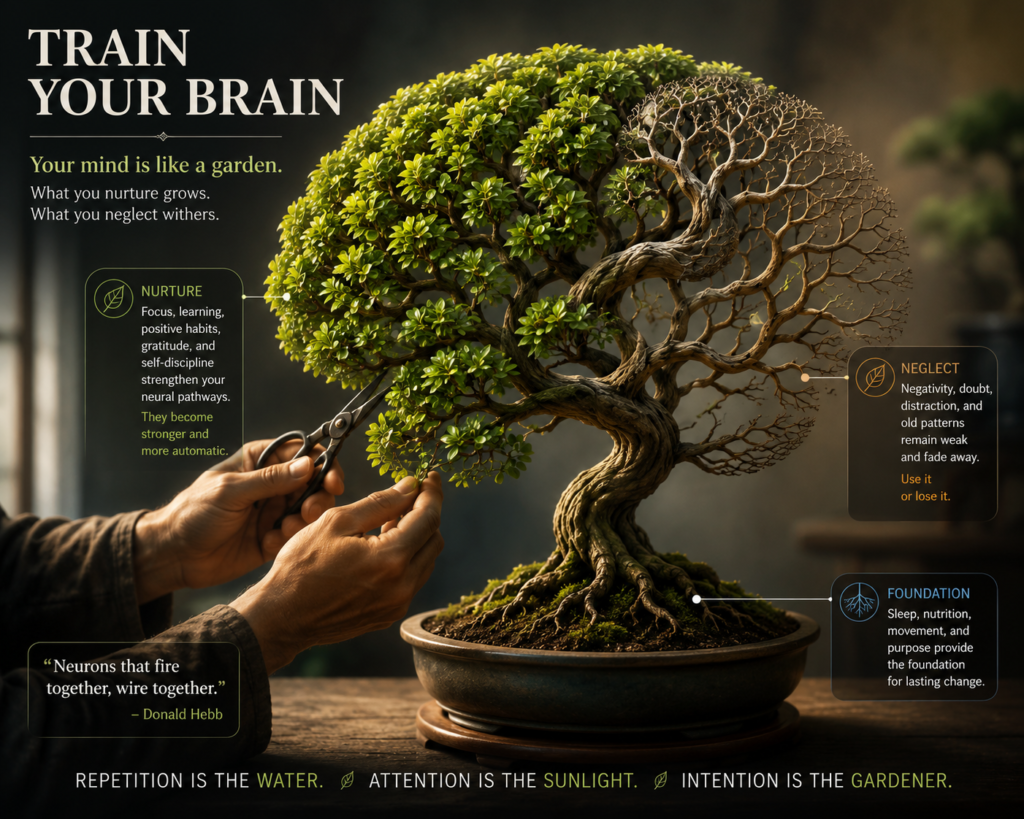
The reverse holds true as well. When you operate from fear and a sense of limitation, your conscious mind ends up making decisions through neural networks already wired for avoidance — thus, mind becomes matter in the opposite, more limiting direction.
Many of your decisions are likely unconscious ones. You’re often fully aware of the experience you’re having, yet unaware of the deeper motivating factor actually driving your behaviour.
Take a simple example: a guy is interested in a woman and wants to ask her out, but an unconscious fear of rejection keeps holding him back.
So he never asks.
He never gets the date.
He doesn’t fail to get what he wants because he isn’t good enough — he fails because a subconscious program informs him that he isn’t good enough.
This kind of self-sabotage plays out constantly until you heal the emotional wound by upgrading the subconscious program.
Transform Your Mind
If mind becomes matter, it makes sense to upgrade the In-Formation in your subconscious mind.
The archetypes model designed by Libera Mente brings missing In-Formation into conscious awareness. Knowledge enables you to consciously integrate archetypal qualities and overcome problems, conflicts and challenges you face.
If you believe you’re capable of reaching your life goals, your brain will search for opportunities to prove it.
Make sure you’re ready to create the life you want to create.
Sign up for the Libera Mente Self-Development Program today.

Resources
[1] Robert Sapolsky, Behave: The Biology of Humans at Our Best and Worst (2017)
[2] Carl Jung, CW7 Two Essays on Analytical Psychology, 2nd Ed pp.109-110 (1966)
[3] Dr Joseph Murphy, The Power of Your Subconscious Mind, p.94 (1963)
[4] Ibid, p.73
[5] Joseph LeDoux, Synaptic Self, p.9 (2002)
[7] Robert Sapolsky, Behave: The Biology of Humans at Our Best and Worst (2017)
[8] Wilhelm Reich, The Function of the Orgasm
[9] Ibid
[10] Ibid
[11] Carl Jung, CW7 Two Essays on Analytical Psychology, 2nd Ed, para 240 (1966)
[12] Wilhelm Reich, The Function of the Orgasm
[13] Ervin Laszlo, Science and the Akashic Field p.26 Kindle Loc 540, (2004)
[14] Tao Te Ching, Chapter 42
[15] Amit Goswami, The Self-Aware Universe, p.10 Kindle Loc 387 (1995)
[16] J.F.C. Fuller, The Wisdom of the Qabalah, p.14 (1937)
[17] Amit Goswami, The Self-Aware Universe p.43 Kindle Loc 897, (1995)
[18] Ervin Laszlo, Science and the Akashic Field, p.26 Kindle Loc 540 (2004)
[19] Carl Jung, CW9 Part 1, The Archetypes and the Collective Unconscious, 2nd ed, para 88 (1968)
[20] Ibid, para 4
[21] David Bohm, Wholeness and the Implicate Order, pp.67-68, (1980)
[22] Ibid
[23] Ibid
[24] Ibid
[25] Professor Steve Peters, The Chimp Paradox
[26] Rupert Sheldrake, The Presence of the Past, p,160 (1988)
[27] Ibid pp.16-17
[28] Ibid p.12
[29] Paul Weiss, Principles of Development
[30] John R. Van Eenwyk, Archetypes & Strange Attractors: The Chaotic World of Symbols (1997)
[31] Taub, E., et al. (2006). Constraint-induced movement therapy: a new family of techniques with broad application to physical rehabilitation—a clinical review. Journal of Rehabilitation Research and Development, 43(3), 273–286.