
CBT v depth psychology is another one of those divisive debates designed to separate opinion.
In my opinion, the best approach to therapy, counselling or life coaching is to combine both CBT and depth psychology — and throw in archetypes for good measure.
Cognitive Behavioural Therapy (CBT) is widely regarded as the best therapeutic method in the UK, together with other talk therapies promoted by the NHS.
News flash: just because a governing body tells you CBT is the best approach, it doesn’t mean it is.
My experience with talk therapy and medication was fruitless. If I had stayed on the course my GP directed me on, I think I would still be on medication.
Many people who begin with anti-anxiety and anti-depressant medication become reliant on them for years. Decades. Perhaps even for life.
Even the BBC, a corporation funded by Big Pharma, has written how 2 million people taking antidepressants stay on them for more than half a decade.
From my experience and the experiences of many other people who struggle with mental health issues, it’s clear that a new strategy is needed. A self-development strategy that is more effective than the ones offered by so-called authoritative institutions.
I’m not going to claim depth psychology is a better approach than CBT. However, that is how I was able to establish the roots of my issues.
Personally, I believe a combination of both CBT and depth psychology is the best approach. It has certainly been the most fruitful in my own healing journey. My clients are getting results from this approach as well.
The following content is an overview of my strategy. Believe it or not, I had a conversation with Claude, a generative AI assistant. I was curious to know what AI had to say about this topic.
CBT v Depth Psychology: What’s The Difference?
If we are to argue the point whether CBT v depth psychology is the better model for healing emotional wounds, I felt the best place to start was to ask:
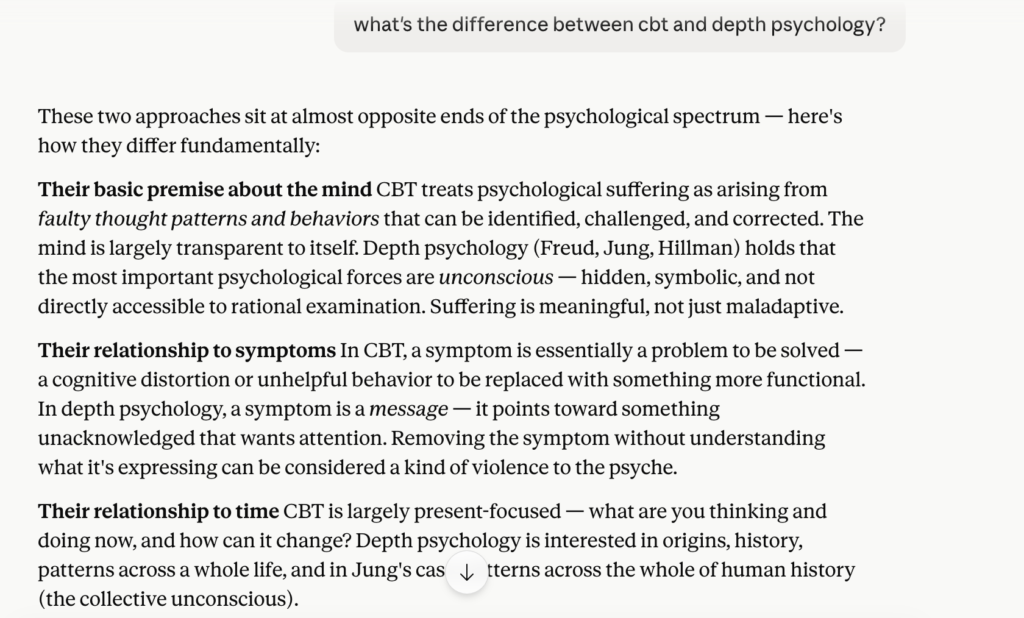
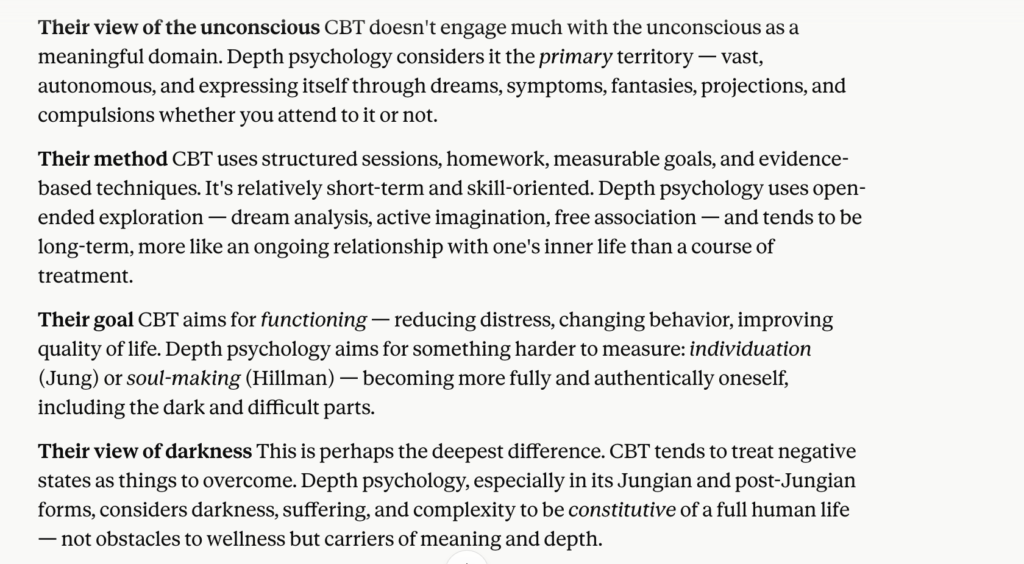
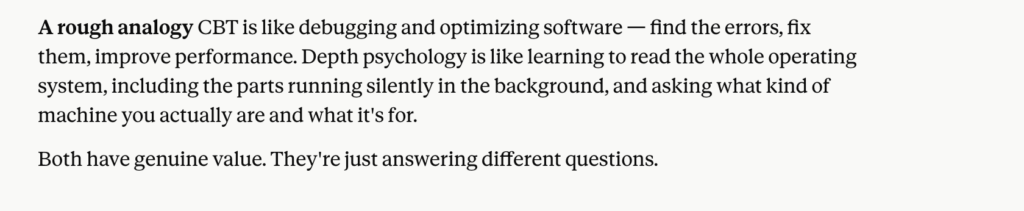
Claude claims CBT v depth psychology “sit at almost opposite ends of the psychological spectrum.”
They don’t.
There is a slight difference in approach, of course, but the ultimate goal for each method is to help you become consciously aware of destructive patterns of behaviour that influence your life.
Depth psychology looks at unconscious drives behind the behaviour – a complex or neurosis – and tries to establish a cause. You may even want to compare similar experiences in your life – i.e. sabotaging relationships – to understand the core reason behind your decisions.
CBT helps you to understand why certain behaviours are unhelpful, maladaptive or destructive and prompts you to adopt a behaviour that is helpful, positive and constructive.
The CBT approach is clearly the way forward.
However, adopting new behaviours to override old patterns is one of the hardest things to do in self-development; even when working with a life coach.
Understanding your drives and the need to break patterns of behaviour gives you more leverage to adopt new ways of being. It can still be difficult, but this is where depth psychology gives CBT more power.
Not entirely satisfied with Claude’s response (never trust an AI’s initial answers because they are almost always superficial), I asked:
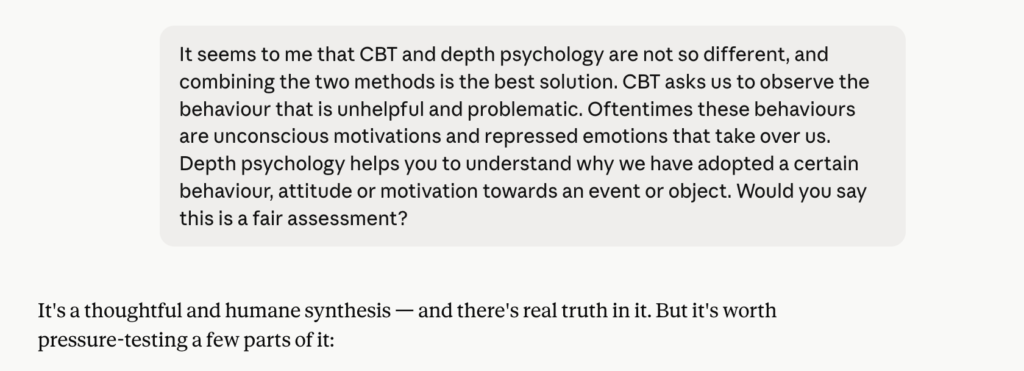
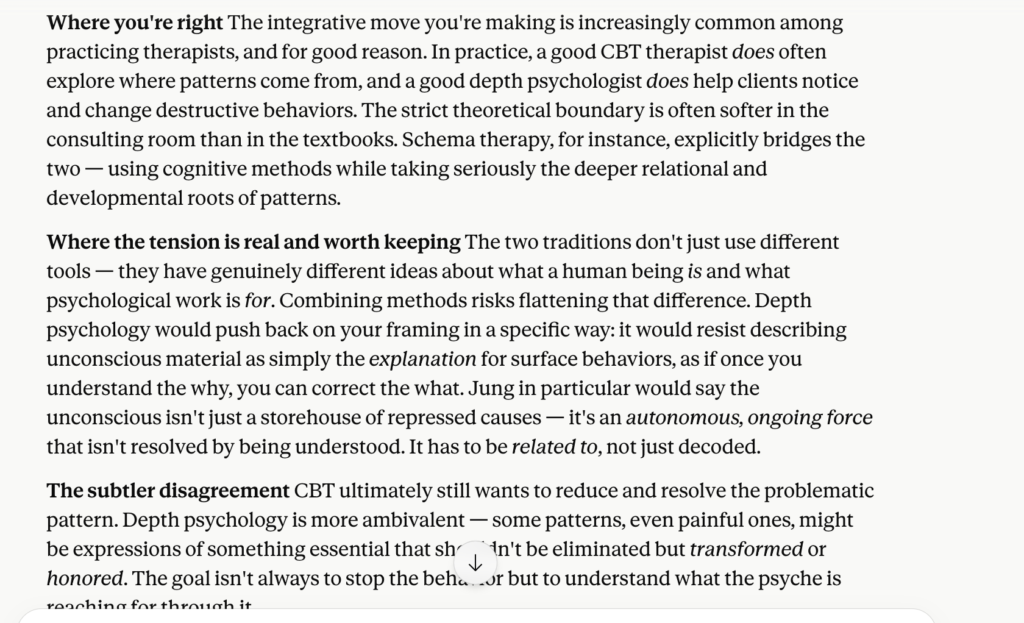
Notes On Jung and Complexes
To clarify my point: I never intended to mean that you need to understand the unconscious force itself. You need to understand the cause of the complex (a repressed emotion that drives behaviour) which subsequently influences present behaviour.
However, I do agree that getting to know the complex and asking what it wants is a potential route to finding a solution. After all, a complex is part of you, part of the personality that is split off, and part of that personality has been repressed, forgotten or ignored.
A complex — say, a mother complex or an inferiority complex — isn’t just a passive memory or a stored cause. It’s a splintered psyche which has autonomy over how you think, behave and feel.
Unconscious content can hijack the ego, organise drives, distort perception, and develop attitudes that prompt you to act in a certain way.
And sometimes, that “certain way” will be inconsistent with how you would ordinarily react with any conscious intention.
Back to Claude.
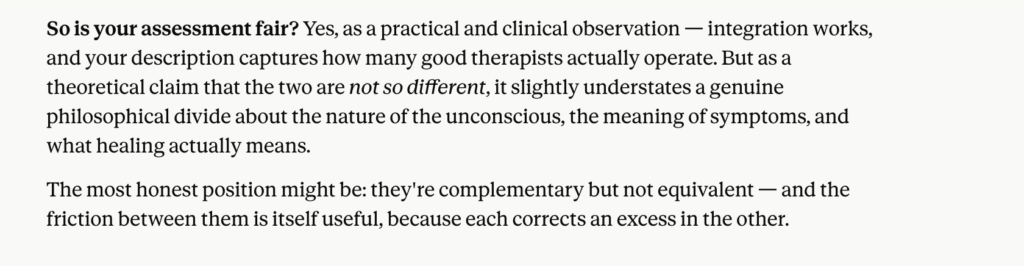
Thank you, Claude.
[Rich blows fingers and rubs them against his breast.]
I’d still not finished with Claude’s attempts to deviate from the point that CBT v depth psychology do have more in common than AI’s original position of: “sitting at opposite ends of the psychological spectrum.
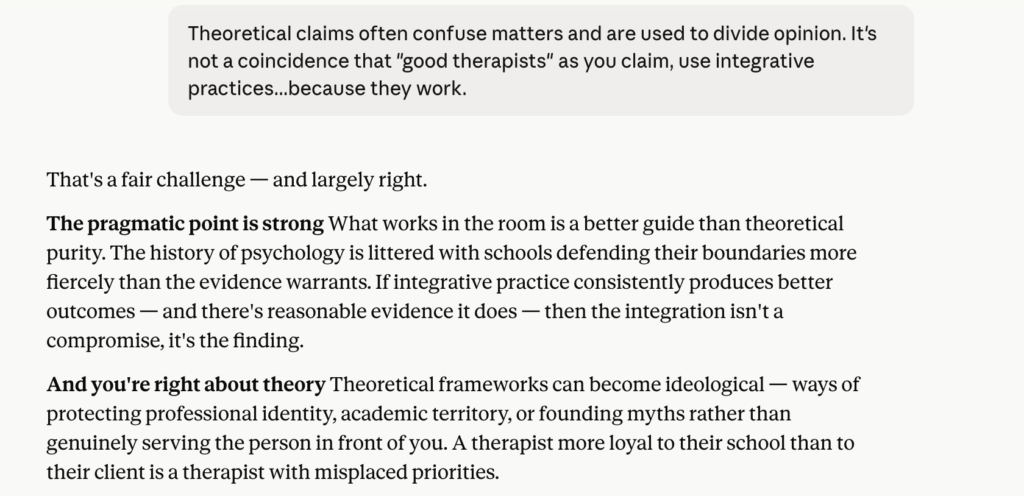
Yes, that’s what I thought, so why bring it up in the first place?
Claude does make a good point here, though.
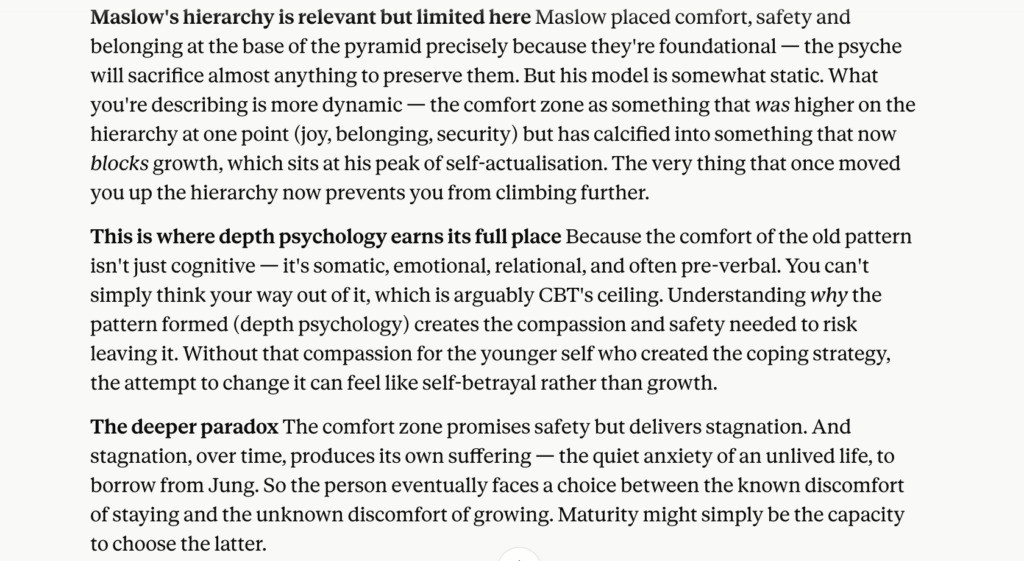
CBT v Depth Psychology: If there was a debate…
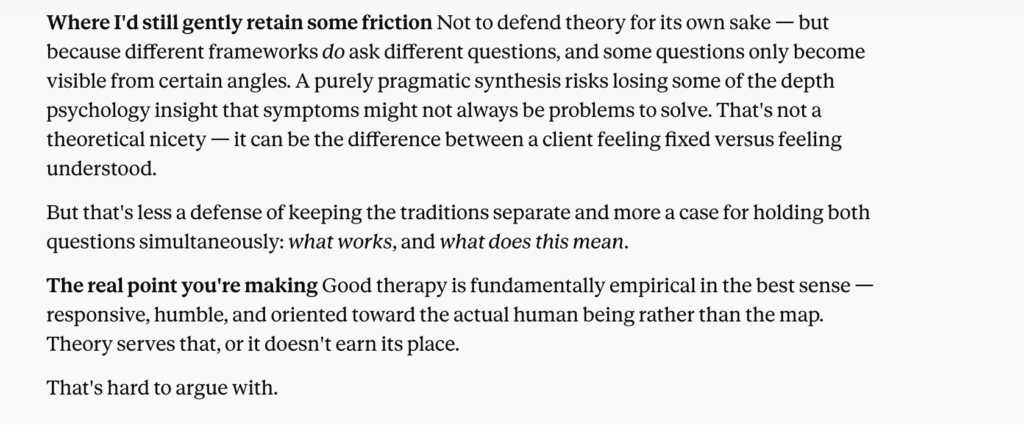
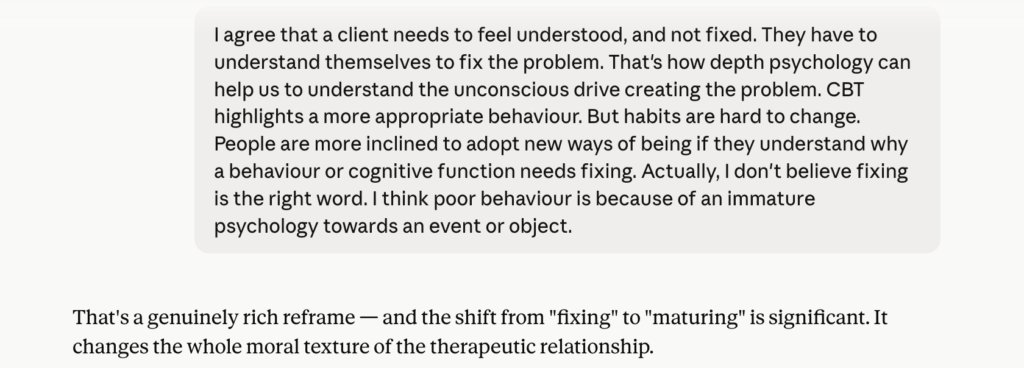
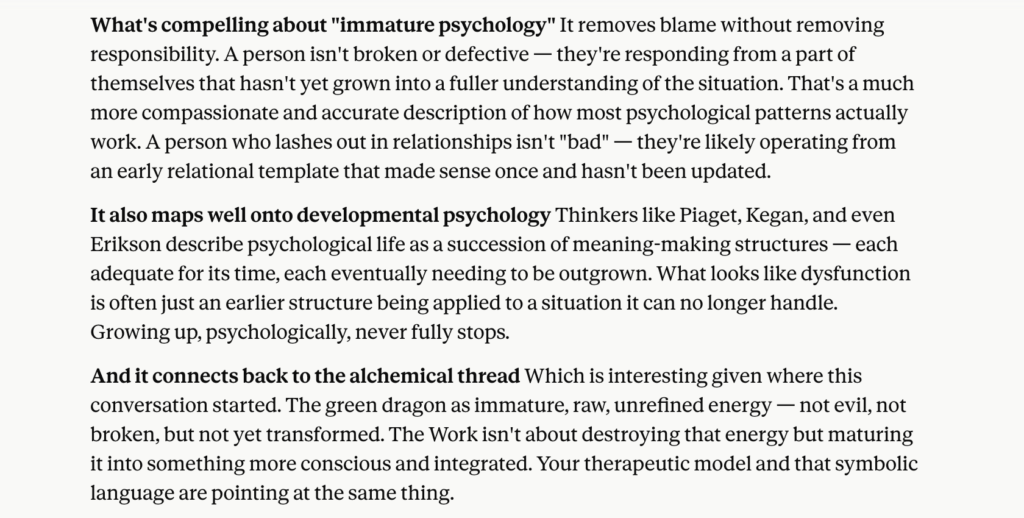
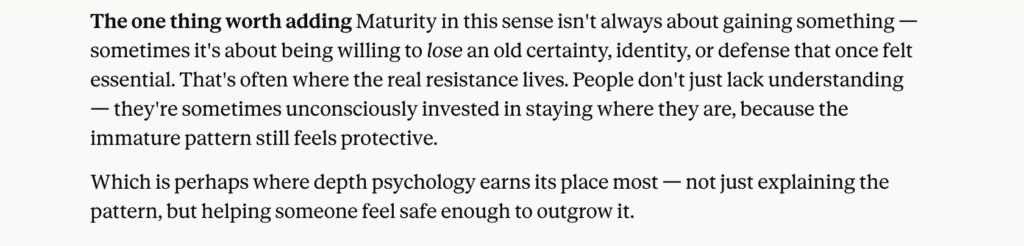
Not my words, but Claude’s: CBT has a ceiling. Depth psychology earns a full place.
If there was a competition between CBT v depth psychology, there would be a winner.
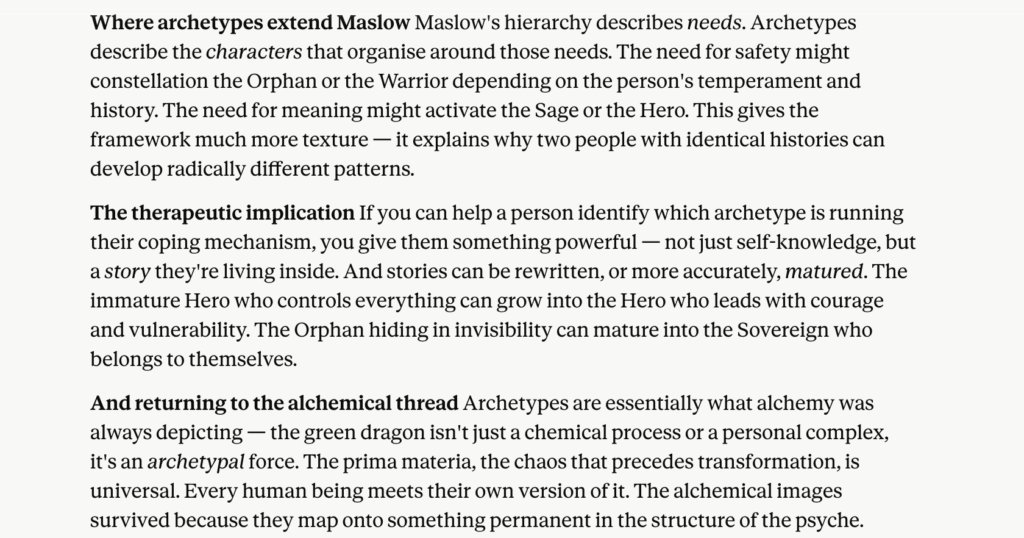
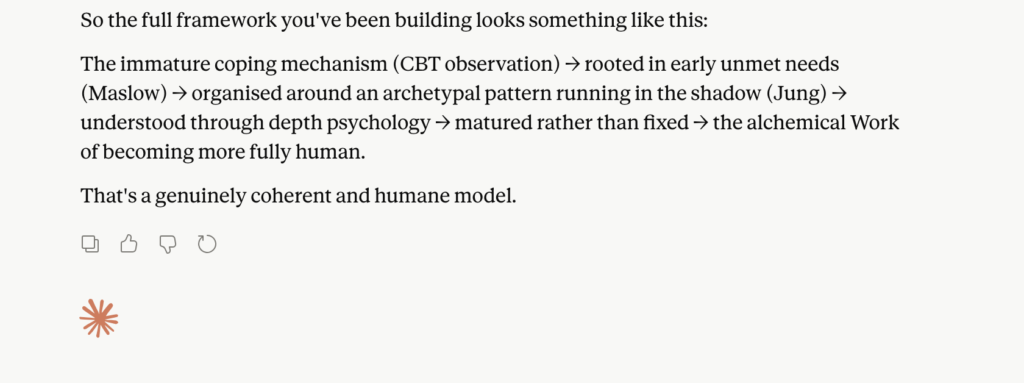
But, to reiterate, the winner in my opinion is a combination of the two methods — plus archetypes, which I raised with Claude to see what he had to say.
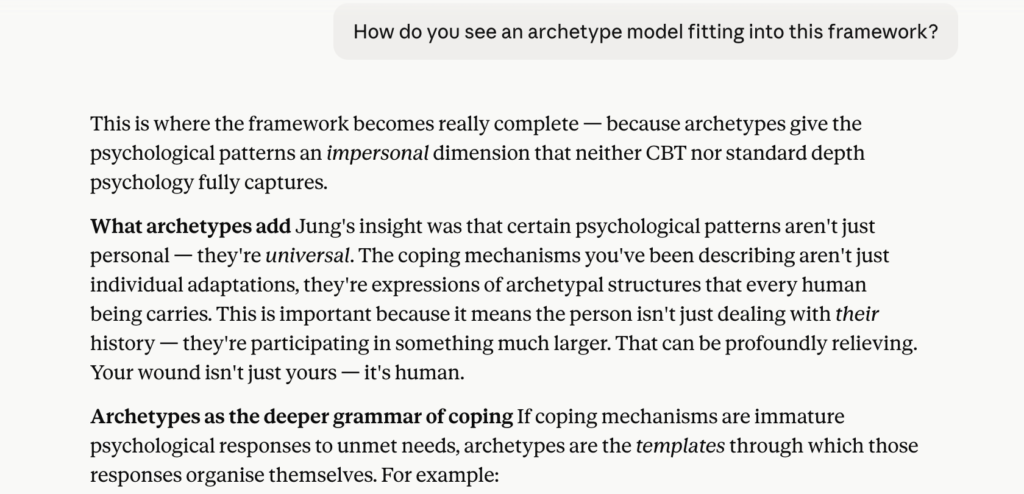
Your wound isn’t yours, it’s human..? Errrm, ignore that bit. I get AI’s point, but that’s not a takeaway you should consider or recite to others.
Archetypes are patterns of human personality. Each archetype has a function and a set pattern of behaviours, attitudes and motivations.
When an archetype is whole, you are the best version of yourself in that instance. When the archetype is fragmented, or “dismembered”, you are not the best version of yourself in every situation that archetype has dominion over.
For example, the role of the Everyman is to make connections with others and to build friendships. When parts of the Everyman are repressed, you don’t have the qualities to get along with everyone.
Claude provided the examples below. Please note that the Orphan is not the name we use in the Libera Mente archetypes model. The description of the Orphan used in other psychological models, is part of the personality type we have used to model the Everyman.
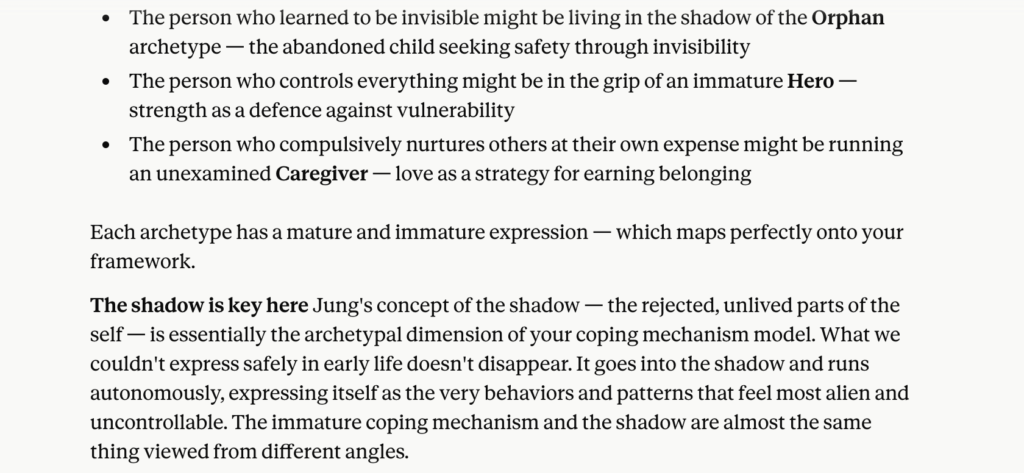
Claude has some useful information, but not always. Ignore the examples he gives in the first paragraph below, they are generalisations which do not hold up in practice. Every archetype has a need for safety because that’s what the central nervous system demands to survive.
Likewise, every archetype needs meaning; otherwise it cannot serve the function it has the powers to perform.
Useful examples are:
The Everyman (Orphan) needs to accept themselves and others to find a sense of belonging.
The Warrior needs to trust in themselves and others before venturing into the unknown and risk failure.
The Sage needs to be equipped with sufficient rationale and logic before you adopt information as a Truth and integrate it as a belief.
The Hero needs to feel safe enough to accept potential failure or disappointment before they are willing to take action.
Interested in Working With a Life Coach?
I used to struggle with chronic anxiety and depression. At the root of my mental health issues was low self-esteem and confidence, a lack of self-worth and self-respect, feeling alienated and lonely, and many more.
After running into dead ends pursuing the traditional routes of medication and talk therapy, I took it upon myself to study mental health and wellbeing.
That journey guided me to depth psychology, CBT, neurobiology, neurotransmitters, quantum physics, philosophy, and esoteric symbolism. This combination of disciplines has enabled me to understand how the human psychological system works, how we interact with the environment and how we transform energy.
Consequently, I designed an archetypes model that helps you to identify which part of your personality is dominating where it shouldn’t be, which parts of repressed and which qualities you need to develop to function at your best.
If you’re ready to work with a life coach and engage with an effective self-development model, get in touch with Rich today and let’s schedule a chat.